November 10, 2026 | Through Week 9
The Jacksonville Jaguars are now the most efficient team in football by a fairly comfortable margin.
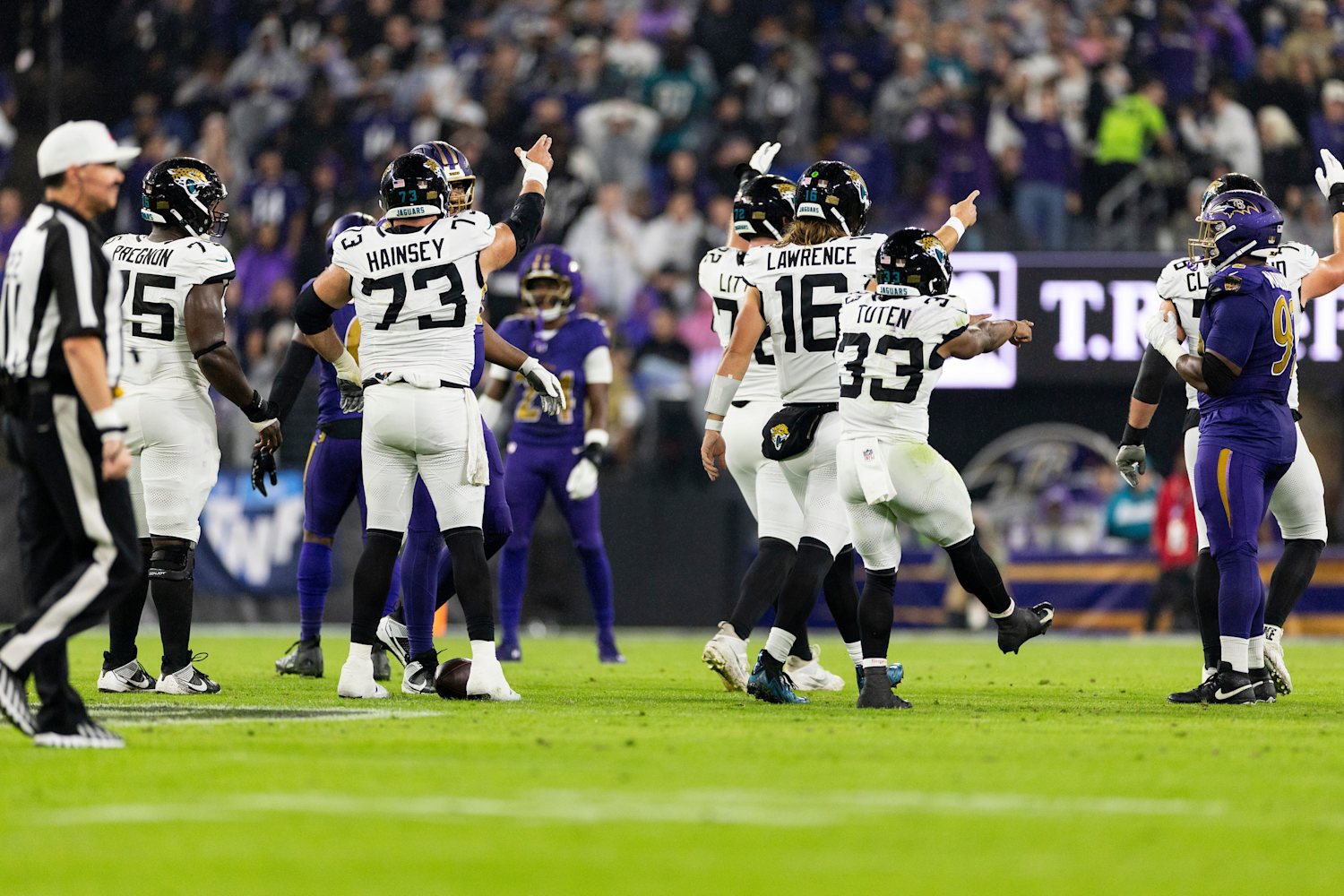
Unfortunately for Ravens fans, we got a firsthand demonstration of exactly why on Thursday night.
Jacksonville's 33-10 demolition of the Ravens pushed its Dual Eights Efficiency Index score to 70.95, extending its lead over second-place Chicago to 2.89 points. A considerable gap in a league where several of the top ten teams are clustered within a point of each other.
The Bears and 49ers remain virtually tied for second, separated by just 0.06 points. San Francisco, meanwhile, continues to lead our forward-looking Power Index (DEPI), which sees the 49ers as the strongest team in football when projecting future matchups.
Kansas City made the biggest move among the contenders, climbing three spots to seventh in Efficiency and returning to the DEPI top ten after a convincing win over the Jets. The Rams have quietly won three straight and now sit third in DEPI despite a 5-4 record.
Elsewhere, the Giants made the largest jump in the Efficiency rankings, Green Bay's offense exploded against New England, and Buffalo provided an interesting example of why our two models occasionally disagree.
You can explore both models, including all 32 teams, at theDual Eights NFL Rankings Dashboard.
Week 9 Dual Eights Efficiency Index Top 10
| Rank | Team | Record | Index | Change | DEPI Rank |
|---|---|---|---|---|---|
| 1 |  Jacksonville Jaguars |
6-2 | 70.95 | — | 4 |
| 2 |  Chicago Bears |
7-2 | 68.06 | — | 2 |
| 3 |  San Francisco 49ers |
7-1 | 68.00 | — | 1 |
| 4 |  Tampa Bay Buccaneers |
3-6 | 62.95 | — | 10 |
| 5 |  Los Angeles Rams |
5-4 | 61.40 | ↑ 1 | 3 |
| 6 |  Buffalo Bills |
7-1 | 61.40 | ↓ 1 | 5 |
| 7 |  Kansas City Chiefs |
6-2 | 61.09 | ↑ 3 | 9 |
| 8 |  Cincinnati Bengals |
6-2 | 60.97 | ↓ 1 | 6 |
| 9 |  Detroit Lions |
6-2 | 60.97 | ↓ 1 | 7 |
| 10 |  Seattle Seahawks |
5-4 | 60.50 | ↓ 1 | 11 |
Movement is relative to the last published Week 8 rankings. The Rams/Bills and Bengals/Lions are separated by fractions of an index point not visible in the rounded scores.
1. Jacksonville Jaguars — 70.95
6-2 | Previous: 1 | Change: +1.00 | DEPI: 4
Jacksonville's convincing victory in Baltimore reinforced what the Efficiency Index has been telling us for much of the season. The Jaguars are an exceptionally balanced team, capable of winning games without asking Trevor Lawrence to carry the entire offense.
Their defense was outstanding Thursday, holding the Ravens to just ten points and limiting the offense to -0.281 EPA per play. That defensive performance was the biggest driver of Jacksonville's improvement in the opponent-adjusted index.
Lawrence provided the decisive offensive moment with a 50-yard touchdown pass to Parker Washington that extended the lead to 17-3 before halftime. Cam Little added four field goals, and Jacksonville never allowed the Ravens to make the game particularly interesting.
There is obviously a quarterback caveat to evaluating a defense that faced an injured rookie making his first NFL start. Joe Fagnano was in an almost impossible situation, and Baltimore's offensive limitations made Jacksonville's job considerably easier.
But that doesn't erase the performance. The Jaguars still executed their assignments, prevented explosive plays and repeatedly put the Ravens in situations they couldn't escape.
Jacksonville's lead in Efficiency is now almost three points. DEPI is slightly more cautious, placing the Jaguars fourth at +5.27, but both models agree that this is one of the NFL's strongest teams, and that was before their flurry of moves at the trade deadline.
2. Chicago Bears — 68.06
7-2 | Previous: 2 | Change: +0.43 | DEPI: 2
The Bears won their fourth straight game, beating Tampa Bay 27-24, though it was less convincing than their week 8 win over Seattle.
After storming out to an early lead, Caleb Williams threw four interceptions, and Chicago ended up averaging a miserable -0.218 offensive EPA per play. That is an extraordinarily poor offensive performance for a winning team.
Fortunately, the Bears received enough from their defense and special teams to survive. Williams then delivered when it mattered, completing a 38-yard pass to Colston Loveland to set up Cairo Santos' winning field goal.
The turnovers were a major problem, but the Efficiency Index evaluates the entire season rather than treating the latest result as a referendum on a team's quality. Chicago's adjusted defensive and special-teams improvements more than offset the offensive decline.
DEPI remains impressed as well. The Bears are second at +6.07, just 0.84 points behind San Francisco.
A team that wins despite four interceptions is doing something right. It probably shouldn't plan on repeating the experience.
3. San Francisco 49ers — 68.00
7-1 | Previous: 3 | Change: +0.74 | DEPI: 1
The 49ers returned from their bye and promptly forced five turnovers in a 38-17 victory over Las Vegas. San Francisco's defense allowed -0.353 EPA per play, producing the adjusted defensive improvement responsible for most of its index gain.
That matters because the offense has carried much of San Francisco's outstanding statistical profile this season. DEPI assigns the 49ers an enormous +6.11-point offensive contribution, the foundation of their league-leading +6.91 overall rating.
The defense doesn't need to perform like it did against Las Vegas every week for San Francisco to contend. But if it can consistently support that offense with disruptive performances rather than merely avoiding disaster, the 49ers become much more difficult to beat.
The Efficiency Index sees Chicago and San Francisco as virtually identical.
DEPI gives San Francisco a clearer edge because of its projected offensive strength.
4. Tampa Bay Buccaneers — 62.95
3-6 | Previous: 4 | Change: -1.23 | DEPI: 10
Tampa Bay continues to be the strangest team near the top of our rankings.
The Buccaneers are 3-6 after their loss in Chicago. They have lost far more games than they've won, yet the Efficiency Index still places them fourth.
The explanation is the enormous imbalance between its units. Tampa's defense improved in Chicago and continues to perform at a high level. DEPI assigns the defense a +2.82-point contribution, among the strongest in football.
The offense, meanwhile, carries a -1.94-point contribution. A strong defense can keep a mediocre offense competitive, but eventually the offense needs to produce some points. DEPI's tenth-place ranking is a more restrained assessment of their overall prospects.
The efficiency ranking might overlook their flaws, but in a division where every team sits at three wins, Tampa seems like the best bet to win it and make the playoffs. From there, the defense will make them a tough out.
5. Los Angeles Rams — 61.40
5-4 | Previous: 6 | Change: +0.46 | DEPI: 3
The Rams have won three straight and were beginning to look considerably more like the team DEPI has expected them to be. Their 20-13 victory at Washington was not especially convincing offensively, but Puka Nacua produced 14 catches for 150 yards, and Myles Garrett returned from injury with three sacks.
DEPI ranks Los Angeles third at +5.55, driven by strong contributions from both offense (+4.21) and defense (+2.20). Sean McVay said Nacua is likely headed to injured reserve and could miss at least a month. The Rams’ rating reflects the base projection before accounting for his absence. Rams injury update.
The Rams were one of the most interesting disagreements between the models earlier this season, when their Efficiency ranking lagged well behind their DEPI projection.
That gap has narrowed considerably.
The question now is whether the recent winning streak represents the Rams catching up to their underlying strength or merely a favorable stretch of results.
6. Buffalo Bills — 61.40
7-1 | Previous: 5 | Change: +0.18 | DEPI: 5
Buffalo dominated Minnesota 23-6 on Monday night, holding the Carson Wentz-led Vikings to an almost unbelievable -0.632 EPA per play.
It was an impressive performance by the defense, but they have benefitted from back to back weeks against backup (or third string) QBs.

The Bills' offense was less impressive, averaging -0.045 EPA per play, but the defense more than compensated. Interestingly, Buffalo actually improved its Efficiency score by 0.18 points despite dropping one position. The Rams narrowly passed the Bills in the full-week rankings, with the two separated by only 0.003 points.
The more interesting movement came in DEPI, where Buffalo fell from fourth to fifth and lost 0.62 projected points.
We'll examine that discrepancy below, because it provides a useful explanation of how a team can win convincingly without necessarily improving its future projection.
7. Kansas City Chiefs — 61.09
6-2 | Previous: 10 | Change: +2.73 | DEPI: 9
Kansas City is this week's most significant mover among the established contenders.
The Chiefs beat the Jets 35-12, improving their Efficiency score by 2.73 points and climbing three places. Unlike some victories driven entirely by turnovers or one exceptional unit, Kansas City improved on both sides of the ball.
The offense averaged +0.166 EPA per play, while the defense allowed -0.302. Kenneth Walker III scored three touchdowns, and the Jets managed just 46 yards in the second half.
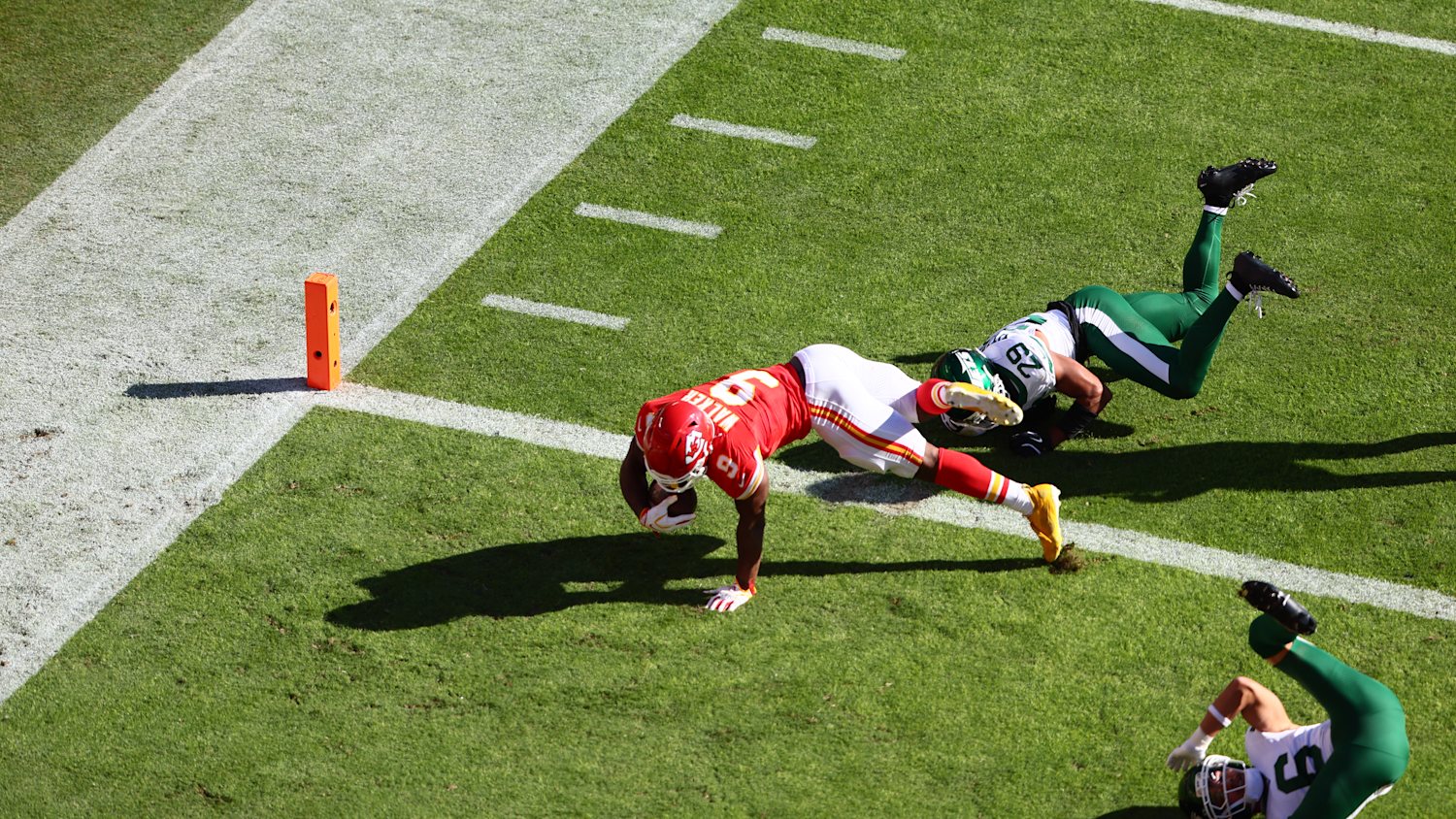
That is the sort of comprehensive performance the Chiefs needed after an uneven stretch.
The Power Index has been less enthusiastic about Kansas City than the standings might suggest, but even there the improvement is meaningful. The Chiefs gained 0.87 DEPI points and climbed from 11th to ninth, replacing Pittsburgh in the top ten.
A single victory over the Jets doesn't prove Kansas City has rediscovered championship form.
But a 6-2 Chiefs team improving simultaneously on offense and defense is not something the rest of the AFC should enjoy seeing.
8. Cincinnati Bengals — 60.97
6-2 | Previous: 7 | Change: +0.33 | DEPI: 6
Cincinnati beat Atlanta 34-17 in Madrid, powered by another highly efficient offensive performance. The Bengals averaged +0.351 EPA per play on offense, an exceptional number that reinforces the value of Joe Burrow and his supporting cast.
The defense was considerably less impressive, allowing Atlanta +0.113 EPA per play.
Those two performances nearly canceled each other in the opponent-adjusted Efficiency calculation, leaving Cincinnati with a modest 0.33-point improvement despite winning by 17.
DEPI is more optimistic as the Bengals climbed to sixth at +4.18, with the offense contributing +4.45 points to the projection. Cincinnati's ability to score gives it a credible chance against almost anyone. The concern remains whether the defense can provide enough resistance against other elite offenses.
9. Detroit Lions — 60.97
6-2 | Previous: 8 | Change: +0.95 | DEPI: 7
Detroit has won four straight after beating Miami 19-9.
The Lions didn't produce much offensive excitement Sunday, scoring only one touchdown while Jake Bates connected on four field goals. But the defense was excellent, holding Miami to -0.211 EPA per play and allowing just nine points. That defensive improvement drove most of Detroit's 0.95-point Efficiency gain.
DEPI still identifies the offense as the Lions' strongest unit, assigning it +3.51 projected points. The defense remains slightly below average at -0.57 despite the recent improvements. That creates an interesting question heading into Detroit's Week 10 matchup against New England.
Can the Lions continue improving defensively against stronger competition, or has their recent success been aided by the quality of the opposing offenses?
We'll get a better answer in Munich.
10. Seattle Seahawks — 60.50
5-4 | Previous: 9 | Change: +0.91 | DEPI: 11
Seattle improved its Efficiency score following a 17-3 victory over Arizona.
The Seahawks' adjusted offense showed improvement with Drew Lock starting, while the defense again did enough to control the game. The Seahawks remain outside the DEPI top ten at +1.76, largely because the forward-looking model is less enthusiastic about their offense.
Biggest Risers: The Giants, Packers and Saints Make Their Moves
Three teams produced particularly interesting improvements outside the top ten.
New York Giants: 21st to 16th
The Giants made the largest jump in Efficiency ranking, climbing five positions after beating Philadelphia 19-11.
New York recorded seven sacks, including three from rookie Arvell Reese, in a defensive performance that largely controlled the game.
The result added 3.02 Efficiency points to New York's rating.
But the Power Index remains skeptical.
Despite a 5-2-1 record and a rapidly improving defensive profile, the Giants rank just 24th in DEPI. Their offense contributes -2.23 projected points, a substantial limitation.
That is one of the largest disagreements between the two models.
The Giants have earned credit for winning games and playing effective defense. DEPI questions whether that formula can consistently overcome the offensive problems against stronger opponents.
Green Bay Packers: 23rd to 19th
Green Bay produced one of the most impressive offensive performances of Week 9, scoring 45 points in a 45-27 victory at New England.
Jordan Love threw for 372 yards and three touchdowns, helping the Packers gain 2.01 Efficiency points and climb four positions.
The adjusted offense accounted for most of the improvement.
Green Bay also gained 0.52 DEPI points, although it remained 13th in the forward-looking rankings.
One explosive offensive performance cannot erase the Packers' earlier inconsistency, but this was an important step toward becoming the dangerous team their personnel suggests they can be.
New Orleans Saints: 29th to 25th in DEPI
The Saints produced the largest improvement in both raw Efficiency score and DEPI points this week.
Their 23-22 overtime victory over Cleveland added 3.03 Efficiency points and 1.06 DEPI points, with defensive improvement driving much of the change.
Those were the largest score gains in either model.
New Orleans also climbed four spots in DEPI, from 29th to 25th.
That still leaves the Saints well below average. But there is a difference between a team remaining bad and a team showing evidence of meaningful improvement.
The Saints are beginning to demonstrate the latter.
Biggest Fallers: Jets Collapse, Browns Slide and Patriots Lose Ground
New York Jets: 18th to 23rd in both indexes
The Jets suffered the biggest ranking decline in both models, falling five places after their 35-12 loss in Kansas City.
Their Efficiency score dropped 3.60 points, while DEPI declined 0.81.
Both sides of the ball contributed to the deterioration, although the defense suffered the larger adjustment.
The Jets were held to just 46 yards after halftime and increasingly looked incapable of sustaining anything offensively.
At 2-7, the standings are ugly enough. The underlying numbers are now catching up.
Cleveland Browns: 25th to 27th in Efficiency, 28th in DEPI
Cleveland's 23-22 overtime loss in New Orleans produced a 3.42-point Efficiency decline and a 1.13-point DEPI drop.
The offense was the largest source of deterioration.
Shedeur Sanders started in place of the injured Deshaun Watson, and the Browns failed on a late two-point conversion attempt in overtime.
Cleveland is now 5-4, yet both models place the Browns among the league's weakest teams.
That is a substantial warning about how sustainable their earlier success may be.
New England Patriots: Still eighth in DEPI, but the defense took a hit
The Patriots weren't among the biggest ranking fallers, but their 45-27 loss to Green Bay was statistically damaging.
New England lost 2.29 Efficiency points, largely because of the defensive performance.
DEPI fell 0.32 points, although the Patriots remained eighth.
That is an important distinction. One poor defensive afternoon doesn't erase the broader projection, but surrendering 45 points raises legitimate questions before facing Detroit's dangerous offense.
Philadelphia deserves mention as well. Its DEPI rating fell 1.19 points after losing to the Giants, the largest projected-point decline of the week.
The Eagles' offensive performance and quarterback-related lineup factors drove the decrease.
The DEPI Top 10: San Francisco Still Leads
The Efficiency Index rewards Jacksonville's sustained current-season performance.
DEPI remains more enthusiastic about San Francisco.
Here are the ten strongest teams according to our forward-looking model.
| Rank | Team | DEPI | Change | Efficiency Rank |
|---|---|---|---|---|
| 1 | San Francisco 49ers |
+6.91 | — | 3 |
| 2 | Chicago Bears |
+6.07 | — | 2 |
| 3 | Los Angeles Rams |
+5.55 | — | 5 |
| 4 | Jacksonville Jaguars |
+5.27 | ↑ 1 | 1 |
| 5 | Buffalo Bills |
+4.88 | ↓ 1 | 6 |
| 6 | Cincinnati Bengals |
+4.18 | ↑ 1 | 8 |
| 7 | Detroit Lions |
+3.95 | ↓ 1 | 9 |
| 8 |  New England Patriots |
+2.57 | — | 12 |
| 9 | Kansas City Chiefs |
+2.16 | ↑ 2 | 7 |
| 10 | Tampa Bay Buccaneers |
+1.89 | ↓ 1 | 4 |
The top three remain unchanged, but Jacksonville has moved ahead of Buffalo into fourth.
Kansas City is the only new member of the top ten, replacing Pittsburgh, which slipped to 12th despite having a bye.
There are several interesting disagreements between the two rankings.
Tampa Bay is fourth in Efficiency but tenth in DEPI because its outstanding defensive production hasn't been accompanied by anything resembling a dependable offense.
The Rams are fifth in Efficiency but third in DEPI, suggesting their current record may undersell their underlying strength.
New England is eighth in DEPI despite ranking 12th in Efficiency, while Seattle falls just outside the Power Index's top ten despite a stronger current-season performance profile.
But perhaps the most interesting change this week is Buffalo.
Buffalo’s defensive contribution rose 0.65 points after the Minnesota win, and its quarterback contribution rose 0.38. Its offense fell 1.13 and special teams fell 0.52, leaving the overall projection 0.62 points lower than last week. The defensive adjustment for facing Baltimore’s backups now stands at −0.44, down from −0.50 as the Minnesota game added to the sample.
The Ravens Have Fallen Out of the Contender Tier
For Ravens fans, the most concerning part of the latest rankings is how far Baltimore has fallen since the opening month.
After Week 5, the Ravens were fifth in Efficiency at 62.5 and fourth in DEPI at +5.72.
Four weeks later, the picture is dramatically different.
Baltimore is now 17th in Efficiency at approximately 48.1 and 22nd in DEPI at -1.5.
The Ravens are 4-5, have lost four straight and are no longer performing like one of the league's better teams.
Obviously the decline is largely a reflection of playing without their starting quarterback.
Lamar Jackson's absence has fundamentally altered the offense, and Thursday's loss to Jacksonville featured Joe Fagnano playing his first NFL game as a starter while dealing with an ankle injury. He completed 10 of 18 passes for just 60 yards and threw two interceptions.
It would be unreasonable to treat those performances as representative of what a healthy Lamar-led offense can accomplish.
The Power Index also accounts for expected quarterback availability. Its current Ravens projection assumes Jacoby Brissett, whom the team acquired from Arizona and expects to start against the Chargers.
That helps explain why Baltimore's forward-looking rating has fallen so dramatically.
But the decline isn't entirely about the quarterback.
The Efficiency Index measures what actually happened on the field, and the Ravens have struggled to maintain their early-season standard even outside the passing game.
Thursday was another example. Jacksonville's defense dominated, but Baltimore's defense also allowed 33 points and struggled to prevent the Jaguars from controlling the game.
The Ravens entered this season expecting Jesse Minter's defense to provide the stability needed to survive precisely these kinds of offensive difficulties.
Instead, the defense has been inconsistent, and the team's overall performance has deteriorated as the injuries have accumulated.
The two models are now telling slightly different versions of the same uncomfortable story.
Efficiency says the Ravens have stopped playing like a contender.
DEPI says that with their current quarterback situation, they should not be expected to perform like one going forward. The only hope is that Brissett can win enough games to keep them afloat for a potential December return by Lamar.
Three Week 10 Gaps Between DEPI and the Market
| Matchup | DEPI Spread | Market Spread | Gap |
|---|---|---|---|
| Miami at Indianapolis | IND -5.89 | IND -2.5 | 3.39 |
| Buffalo at NY Jets | BUF -5.35 | BUF -8.5 | 3.15 |
| Washington at NY Giants | NYG -0.32 | NYG -2.5 | 2.18 |
The gap measures the difference between projected and market margins in points. Lines can vary by sportsbook and change after publication.
Miami at Indianapolis: A Bad Team Meets Another Bad Team
The largest discrepancy of the week comes in Indianapolis, where the market favors the Colts by 2.5 points. DEPI makes Indianapolis a 5.89-point favorite. Indianapolis ranks 21st in DEPI at -1.46 and has lost two straight. Its projected defense contributes -1.48 points, hardly an encouraging foundation.
The Dolphins are last in both indexes, with a -5.81 DEPI rating and negative contributions from offense, defense and special teams. Detroit held Miami to just nine points and 182 net yards last week.
The model's argument is essentially that Indianapolis doesn't need to be especially good to justify a larger favorite's role against this version of the Dolphins.
That is reasonable, although trusting a 2-7 Colts team to win comfortably carries its own obvious risks.
Buffalo at the Jets: The Market Is More Impressed With the Bills
This is one of the more interesting disagreements because DEPI has already downgraded the Jets following their blowout loss to Kansas City.
Buffalo still rates 6.89 points stronger than New York on neutral ground.
After accounting for the Jets' home-field advantage, the model projects a Buffalo victory by 5.35 points. The market line of Buffalo -8.5 is considerably more aggressive.
The Bills are clearly the better team, and there is little evidence that the Jets have the offensive consistency to threaten Buffalo regularly. The question is whether the market has made Buffalo too large a favorite after two big wins over backup quarterbacks.
Washington at the Giants: Is New York's Defense Hiding Its Offense?
The Giants' defensive performance against Philadelphia was impressive enough to move them five places in Efficiency. Yet DEPI remains skeptical of the overall team.
Washington actually rates 1.22 points stronger on neutral ground, although New York's home-field advantage makes the Giants slight 0.32-point favorites.
The market favors New York by 2.5, creating a 2.18-point discrepancy toward Washington.
The explanation is the Giants' offensive weakness. The Giants have managed to build a 5-2-1 record through defense and timely results, but DEPI still assigns its offense a -2.23-point contribution.
There is some quarterback uncertainty as well, with J.J. McCarthy dealing with a hip injury.
Interestingly, switching the model to Jameis Winston changes New York's projection by only 0.11 points.
The more important question is whether the Giants' defense can continue compensating for the lack of reliable offense.
Week 10 Matchup to Watch: Patriots vs. Lions in Munich
Sunday, November 15 | 9:30 a.m. ET | Munich, Germany
The most interesting matchup on the Week 10 schedule might be the one kicking off before most of us have finished our morning coffee.
New England and Detroit have the best combined Efficiency rankings of any matchup this week, with the Lions ninth and Patriots 12th.
They are also seventh and eighth in DEPI, respectively. The models see two fairly evenly matched teams, with Detroit holding a slight advantage.
DEPI projection: Detroit -1.38
Market spread: Detroit -2.5
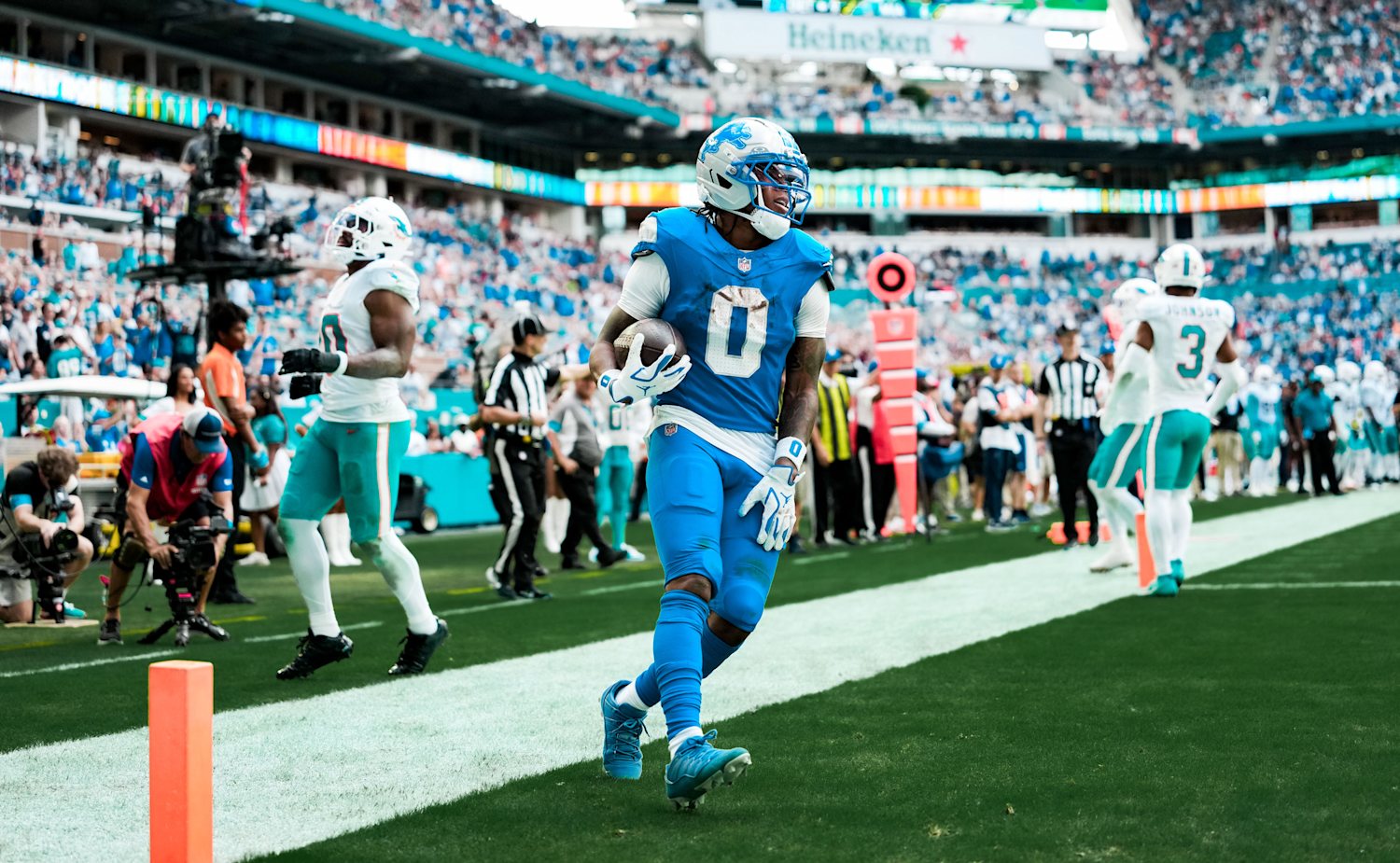
The most important matchup is Detroit's offense against a New England defense that just surrendered 45 points to Green Bay. The Lions' projected offense contributes +3.51 points to their overall rating, making it one of the strongest units in football.
New England's defense suffered a significant statistical setback against the Packers. If those problems carry into Sunday, Detroit has the personnel to exploit them.
On the other side of the ball the Patriots have a respectable +2.19 offensive contribution, while Detroit's defense still rates slightly below average at -0.57 despite holding Miami to nine points last week.
Detroit deserves to be favored, but the models suggest a close game. And unlike several Week 10 matchups, this contest offers an unusually balanced test of the teams' offensive and defensive strengths.
Explore the completeDual Eights NFL Rankings, review themodel methodology, compare theWeek 10 projected spreads and trackmodel results against the betting market.
Rankings reflect the November 10, 2026, 10:03 a.m. ET snapshot. Market spreads were captured at 10:02 a.m. ET. Ratings and lines may change as additional information becomes available.