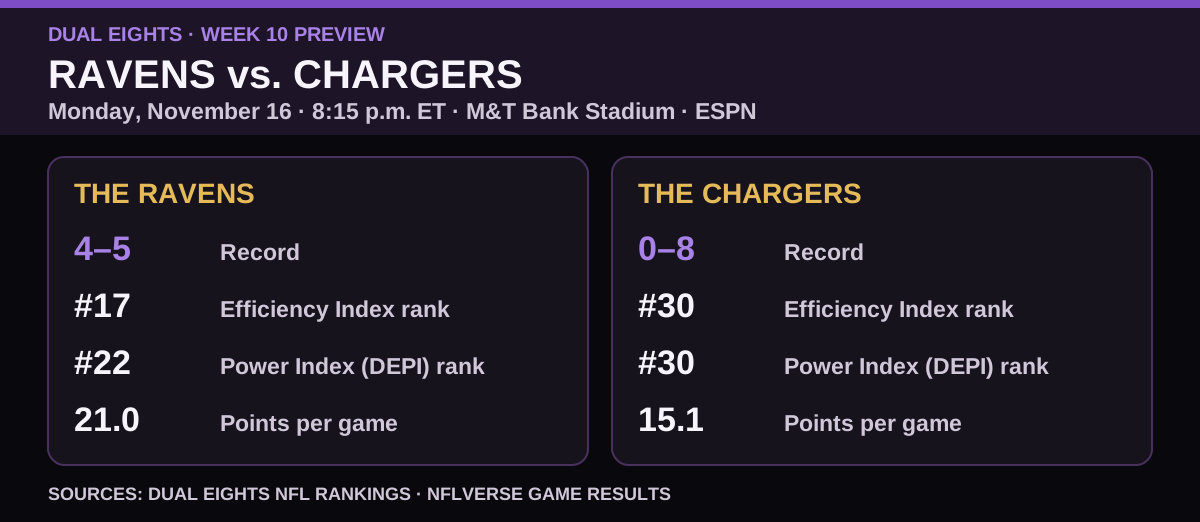
Monday, November 16, 2026 | 8:15 p.m. ET | M&T Bank Stadium
Get ready for the game with the Ravens Season Dashboard.
The Ravens have lost four straight games, haven’t scored more than 13 points in a month and are about to start their fourth different quarterback in four games.
Somehow, they’re still favored by more than a field goal on Monday night.
That probably tells us as much about the Los Angeles Chargers as it does about the Ravens.
The Chargers arrive at M&T Bank Stadium with an 0-8 record, the NFL’s least efficient offense and a quarterback in Justin Herbert who looks like a shell of himself. Jim Harbaugh’s team entered the season with championship aspirations. Instead, they’re still looking for their first victory.
The Ravens aren’t in much better shape.
After beginning the season 4-1, they’ve lost four consecutive games by a combined 74 points. The offense has managed just 43 points during that stretch, while the defense has increasingly struggled to compensate for an offense that can barely sustain possessions.
Lamar Jackson’s consecutive injuries have changed the season. Tyler Huntley’s subsequent injury made things worse. Joe Fagnano did what he could under impossible circumstances, but the Ravens have been operating an offense that barely resembles the one we watched in September.
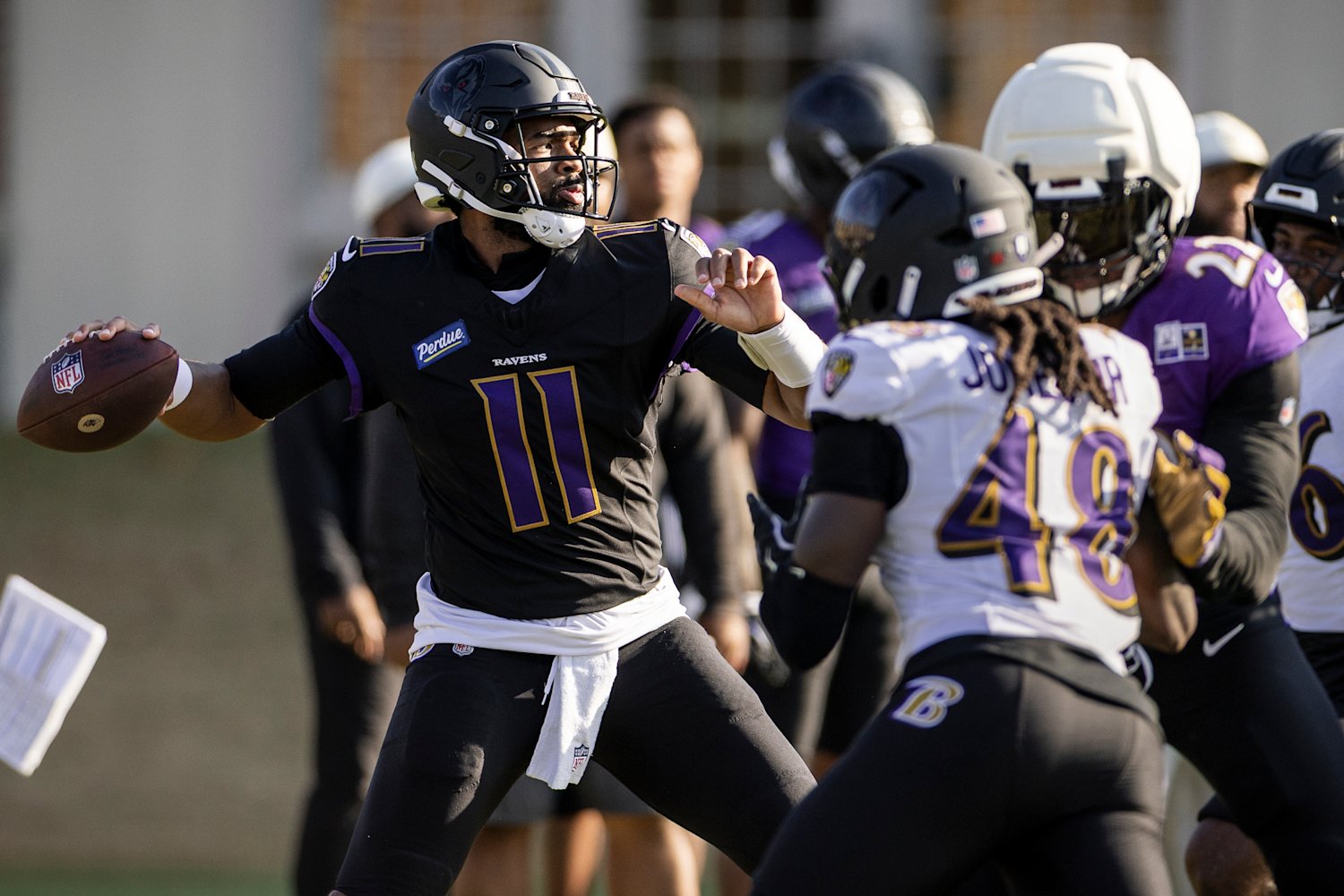
Now Jacoby Brissett gets his opportunity.
With New England losing and potentially losing Drake Maye for some period of time, and the Steelers getting shellacked by the Bengals, there is a glimmer of hope as the Ravens chase the final Wildcard spot down the stretch. If they want to have any hope, they need to take care of business against a winless team at home on a Monday night.
The two biggest questions Monday are whether Brissett can make Derrick Henry dangerous again and whether Jesse Minter can exploit Los Angeles’ protection problems without exposing his own struggling secondary.
1. What kind of quarterback is Jacoby Brissett?
The easiest way to describe Brissett is as an experienced, conventional pocket quarterback who generally wants to get the football out on time and avoid holding it unnecessarily.
He isn’t Lamar Jackson.
Brissett has made 73 NFL starts across an 11-year career, frequently stepping into difficult situations when another team’s preferred quarterback became unavailable. He’s comfortable operating a conventional passing offense. He can diagnose coverage, manage protections and throw accurately into intermediate windows when the structure around him works.
But we shouldn’t confuse experience with exceptional performance. In eight starts for Arizona this season, Brissett completed 63.3% of his passes for 1,719 yards, 10 touchdowns and seven interceptions. He averaged just 5.6 yards per attempt, one of the lowest figures among qualified quarterbacks. His EPA per dropback was also negative.
Those are not the numbers of a quarterback who was consistently moving the football effectively.
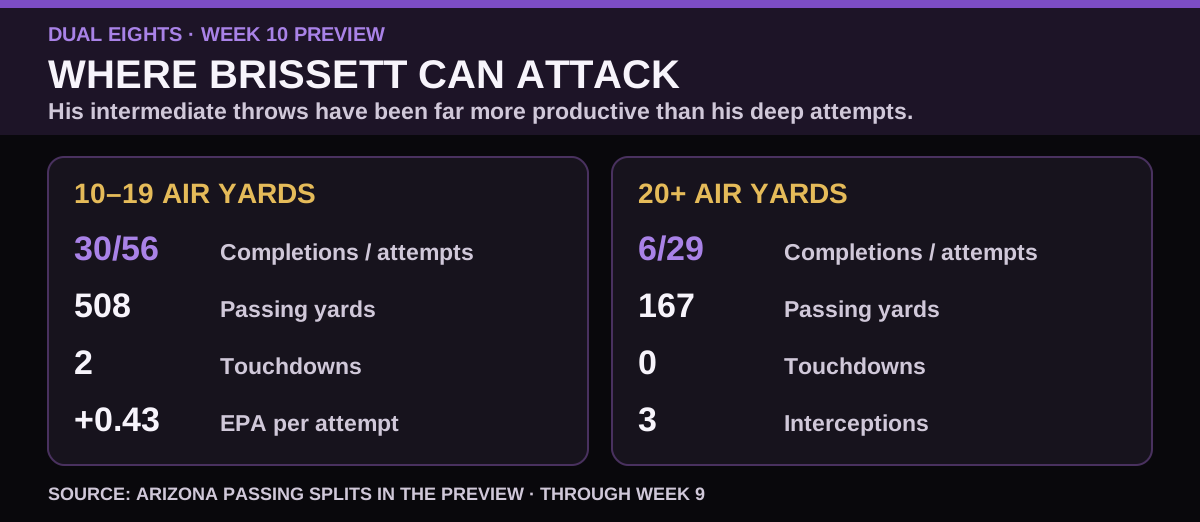
However, digging deeper reveals an interesting distinction. Brissett completed 30 of 56 intermediate throws, traveling 10 to 19 yards downfield, for 508 yards and two touchdowns. Those attempts generated an impressive +0.43 EPA per attempt.
Brissett has shown a willingness to attack the space between linebackers and safeties, particularly on in-breaking routes, seams and intermediate throws toward the sideline. He doesn’t necessarily need a receiver standing wide open before he’ll deliver the ball.
That alone could represent an improvement over what we’ve watched recently.
Huntley occasionally demonstrated his ability to make those throws, but he too often hesitated to challenge coverage, allowing defenders to squeeze the underneath routes. Fagnano’s limitations were even more apparent against Jacksonville, where the Ravens barely attempted to throw beyond the sticks.
Brissett offers a potential improvement, although he hasn’t been especially effective throwing deep either.
On passes traveling at least 20 yards in the air this season, Brissett is just 6-for-29 for 167 yards, no touchdowns and three interceptions. So Brissett probably isn’t someone the Ravens can expect to generate a collection of 40-yard completions every week.
The better news is that he has already demonstrated he can move the ball against this particular opponent.
In Arizona’s 26-14 opening-week victory over the Chargers, Brissett completed 27 of 37 passes for 277 yards, a touchdown and no interceptions. Trey McBride caught nine passes for 95 yards and a touchdown, while Kendrick Bourne and Michael Wilson combined for another 13 receptions.
That performance provides a possible blueprint for Declan Doyle.
The tight ends can work the middle of the field, Flowers can create separation underneath and across the formation, and Rashod Bateman can attack intermediate routes toward the sidelines.
There is also some familiarity to help the transition. Quarterbacks coach Israel Woolfork has worked with Brissett previously, while passing game coordinator Marcus Brady knows him from Indianapolis.
Brissett averages just 2.61 seconds to throw, according to PFF, which should help a Ravens offensive line that has struggled with protection. However, under pressure this season, Brissett has completed only 41.1% of his passes with one touchdown, four interceptions and an ugly -0.62 EPA per play.
The Ravens cannot simply ask him to stand behind a shaky offensive line and repeatedly rescue plays that have already broken down. Doyle needs to give him clear, comfortable answers. And Brissett needs to deliver the football decisively when those answers are available.
The Ravens desperately need him to make the offense functional again.
2. Can Brissett make Derrick Henry dangerous again?
Perhaps the biggest potential benefit of Brissett’s arrival won’t show up directly in his passing statistics.
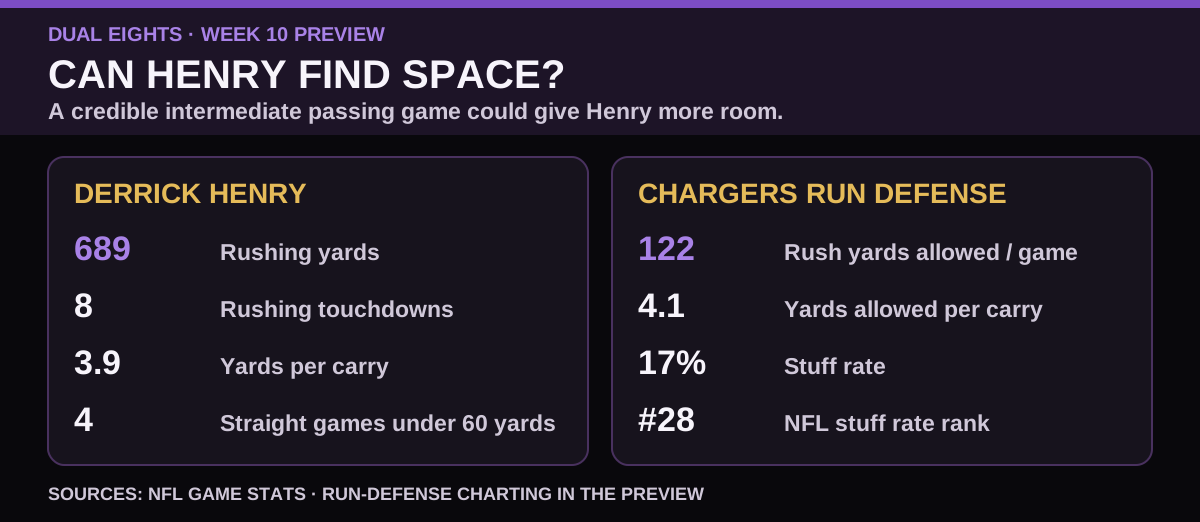
It could show up in Derrick Henry’s rushing numbers. Henry enters Monday with 689 yards and eight touchdowns on 175 carries, averaging just 3.9 yards per attempt. He has failed to reach 60 rushing yards in four consecutive games.
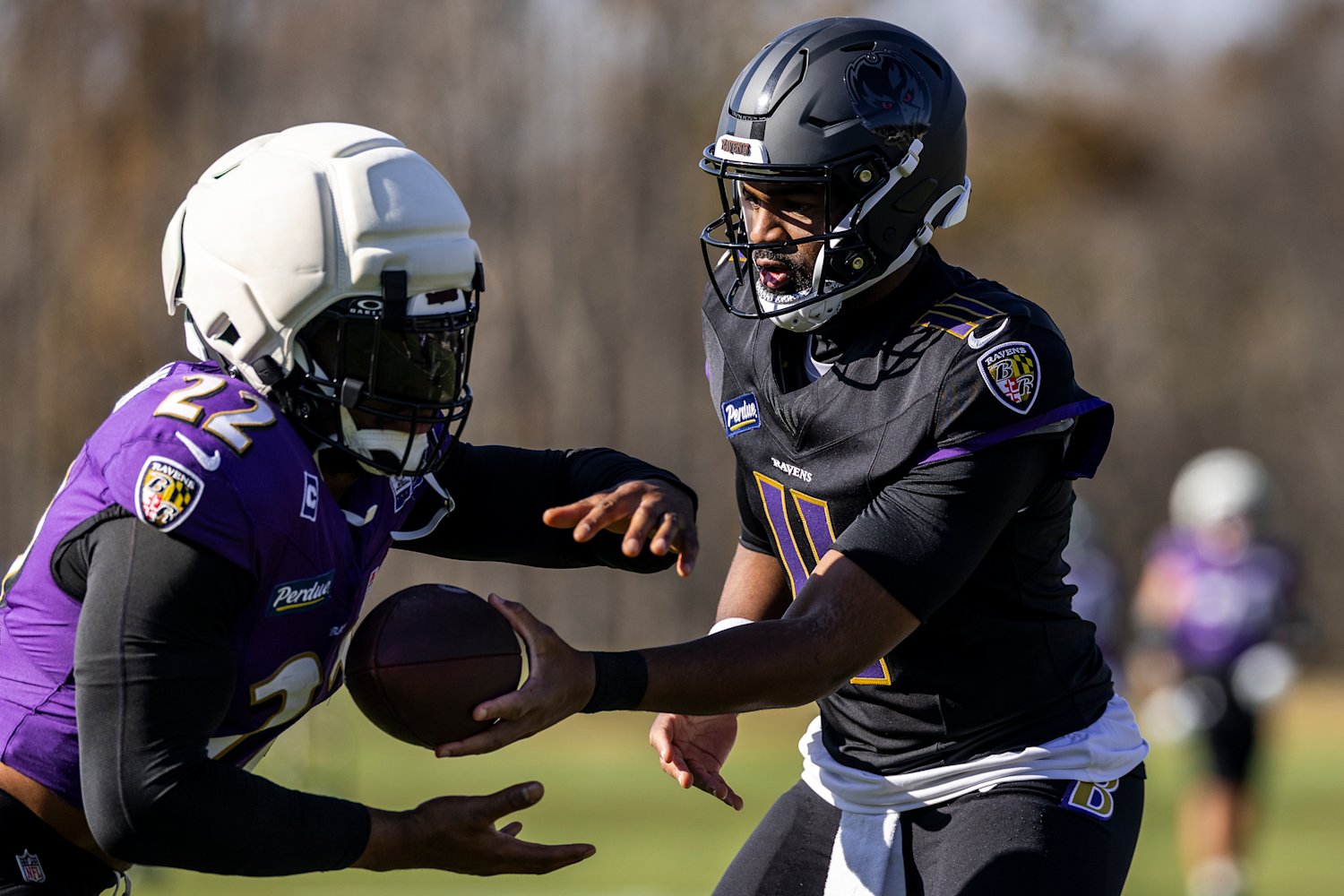
That’s a concerning stretch for a player the Ravens expected to remain the centerpiece of their offense, but I don’t think the explanation is simply that Henry has suddenly gotten old.
He has still generated 560 yards after contact, ranking among the league leaders, and is averaging approximately 3.1 yards after contact per attempt.
Those numbers suggest he remains capable of creating yardage when defenders reach him.
The more significant issue is what happens before he gets there.
Since the loss of Lamar, defenses have been able to attack Henry more aggressively because the quarterback is no longer a credible running threat. Linebackers can pursue downhill without accounting for an additional ball carrier. Safeties can creep closer to the line of scrimmage if they don’t believe the Ravens can punish them vertically.
Brissett cannot restore the mathematical advantage created by Lamar’s legs, but he might restore some of the spacing.
If Brissett consistently completes intermediate passes behind linebackers who are stepping toward Henry, those defenders have to become more cautious.
If the tight ends threaten the seam from a heavy formation, the safety responsible for helping against the run has another problem.
If Flowers starts winning on intermediate crossers, the defense cannot comfortably pack the middle of the field and dare the quarterback to beat it.
That is how Brissett could improve Henry’s production without becoming an exceptional passer himself. The Ravens need to use formations and personnel groupings that make their intentions less obvious and they need to be willing to throw on first down.
Los Angeles allows 122 rushing yards per game and approximately 4.1 yards per carry. The defense is hardly impenetrable, but those numbers don’t guarantee Henry will find open space when everybody in the stadium knows where the football is going.
The Ravens need to create that uncertainty.
Brissett’s arrival should make it possible.
Whether Doyle can take advantage is another question.
3. The Chargers defense is better than its record, but there are weaknesses to exploit
The Chargers are 0-8, but their defense is nowhere near the worst in football.
Los Angeles ranks 15th in defensive EPA per play allowed (+0.006) and 18th in opponent success rate (44.0%). That's a fairly average defense, which is considerably better than you'd expect from a team that hasn't won a game.
They've also faced one of the league's toughest schedules, so there is an argument that even those numbers undersell their performance.
However, a closer look reveals some interesting weaknesses that Declan Doyle should be able to attack. The most striking distinction is between how the Chargers perform on early downs and how they perform when opponents reach obvious passing situations.
Los Angeles ranks just 21st in EPA allowed on early downs, but seventh in EPA allowed on third and fourth down. Opponents have converted just 34.3% of their third downs, the ninth-best defensive mark in football. The Chargers are also 11th in red-zone touchdown rate allowed at 53.1%.
That's a defense capable of giving up yardage before tightening considerably when the offense needs a conversion. For the Ravens, that makes avoiding third-and-long particularly important.
They cannot afford to repeatedly hand Henry the football against crowded boxes on first down, gain two yards, then ask Brissett to rescue the possession against a defense that can disguise coverages and attack predictable passing situations.
The Chargers have Khalil Mack and Tuli Tuipulotu coming off the edges, with three sacks apiece. Los Angeles has recorded only 13 sacks as a team, but its 16.5% quarterback hit-or-sack rate ranks 12th. The pass rush is more disruptive than the sack total alone suggests.
Chris O'Leary has largely retained the defensive approach that Jesse Minter implemented in his time as Defensive Coordinator, relying on changing coverage pictures and pressure presentations rather than constantly sending extra defenders. The Chargers rush four defenders on roughly 74% of opposing dropbacks and blitz only about 25% of the time.
The more encouraging part of the matchup is what happens when opponents successfully avoid those situations.
The Chargers allow 5.5 yards per play, ranking 27th, and have surrendered explosive gains on 9.2% of defensive snaps, the sixth-worst rate in football. Opponents average 7.18 yards per dropback, a figure that ranks 29th defensively.
Those numbers suggest there are opportunities for Doyle to create meaningful gains without relying on long, low-percentage throws. The Chargers have also been vulnerable after the catch, allowing 5.6 yards of YAC per completion, ranking 23rd.
That sounds like an invitation for Doyle to get Flowers into space with blockers ahead of him. Doyle can look to get him back in the offense with crossing routes, screens and quick throws that allow him to attack defenders in space and take advantage of Brissett’s strengths.
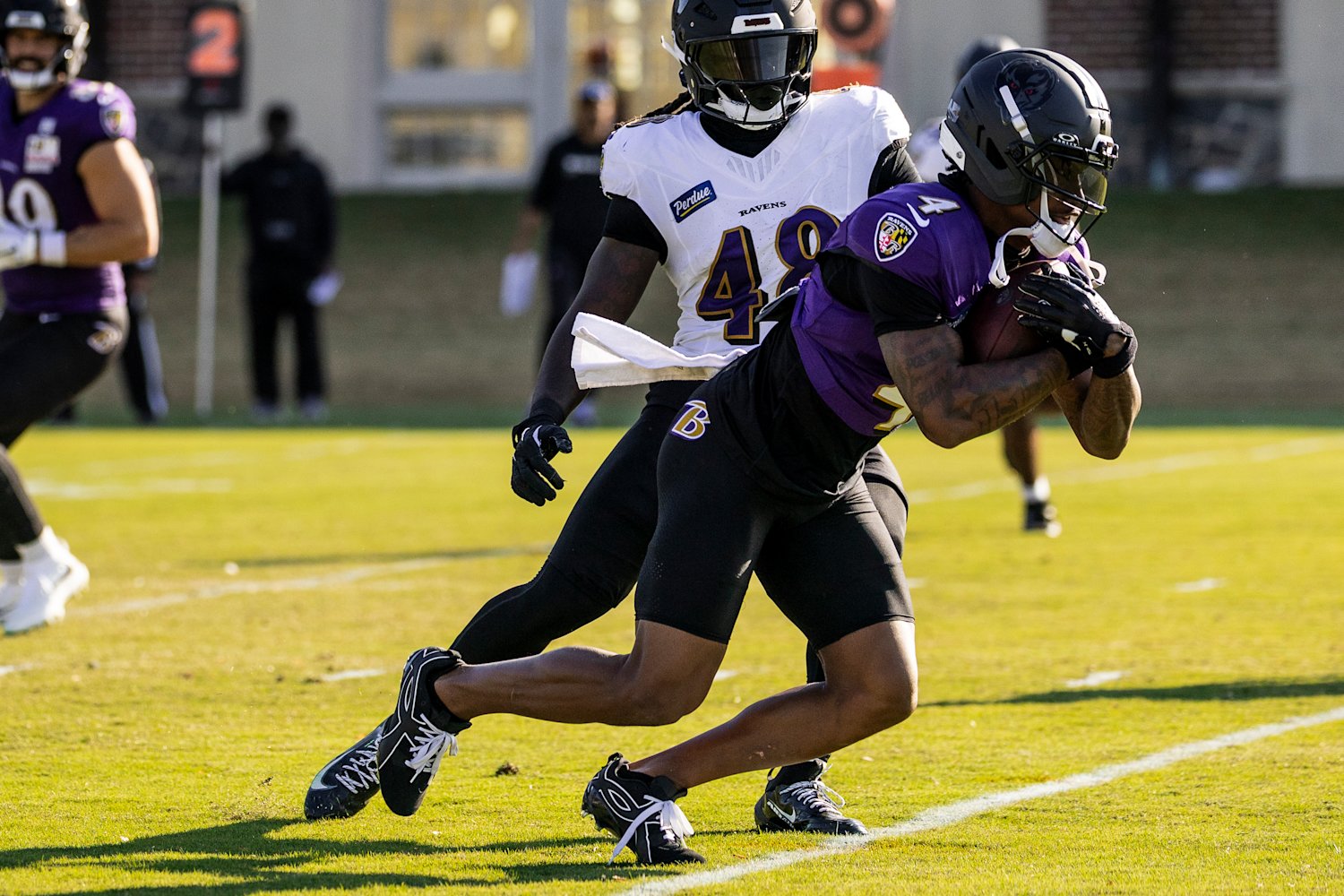
If the pass can soften the defense and make them indecisive, there may be an even better opportunity in the running game.
As mentioned above, the Chargers run defense has been fairly porous. Their 17% defensive stuff rate, which measures how often they stop a designed run at or behind the line of scrimmage, ranks just 28th.
The interior defensive line has struggled to consistently prevent runners from reaching the second level. Los Angeles ranks 27th in line yards allowed per carry, a measure designed to isolate the blocking contribution to rushing production.
There is also an interesting directional weakness. On 22 charted runs outside the offense's left end, the Chargers have allowed 6.5 yards per carry and +0.40 EPA per rush. That's a relatively small sample, but it suggests the Ravens should explore opportunities to get Henry moving toward the perimeter rather than repeatedly challenging the middle.
Houston demolished Los Angeles 44-22 last week, accumulating 485 yards at 7.3 yards per play. C.J. Stroud threw for 391 yards before sack adjustments, and the Texans generated nine passing gains of at least 15 yards.
It was easily the Chargers' worst defensive performance of the season, and O'Leary acknowledged afterward that his unit had failed to play to its usual standard.
The Ravens shouldn't assume the same defensive breakdowns will be waiting Monday. But they should recognize that this is a defense with exploitable weaknesses, particularly against opponents capable of creating space and attacking aggressively before third down.
The underlying numbers point toward a fairly straightforward approach.
Win first down, create explosive plays through formation and spacing, and don't allow the Chargers to dictate the game on third down.
4. Can the Ravens finally generate pressure against a damaged Chargers offensive line?
If there is one matchup that should strongly favor Baltimore, it is the Ravens defensive front against Los Angeles’ offensive line.
At least on paper.
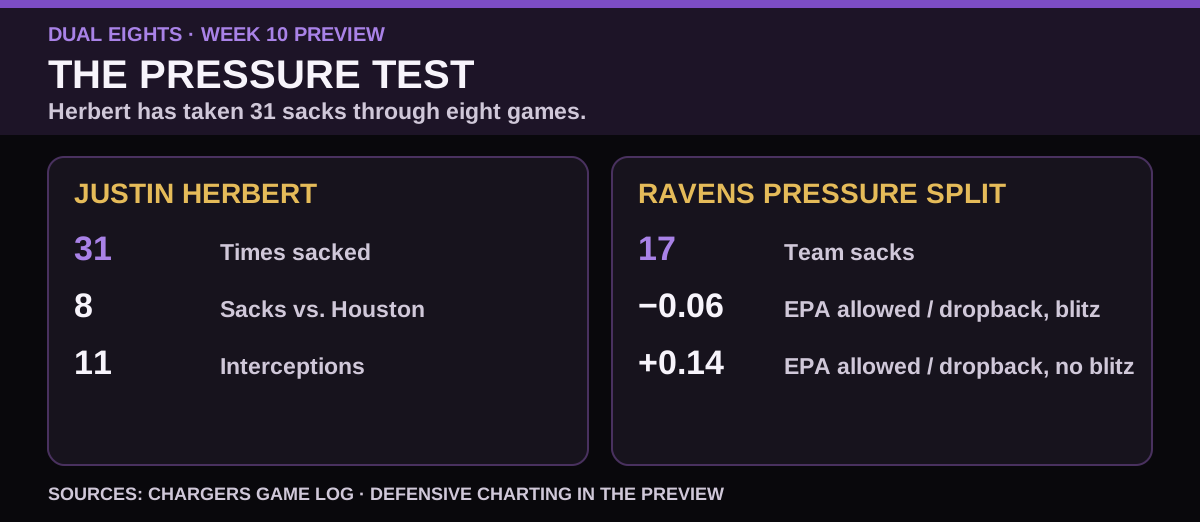
Justin Herbert has already been sacked 31 times in eight games, the second-highest total in football. He was sacked eight times against Houston last week alone. That is an extraordinary amount of punishment for a quarterback with Herbert’s arm talent and experience.
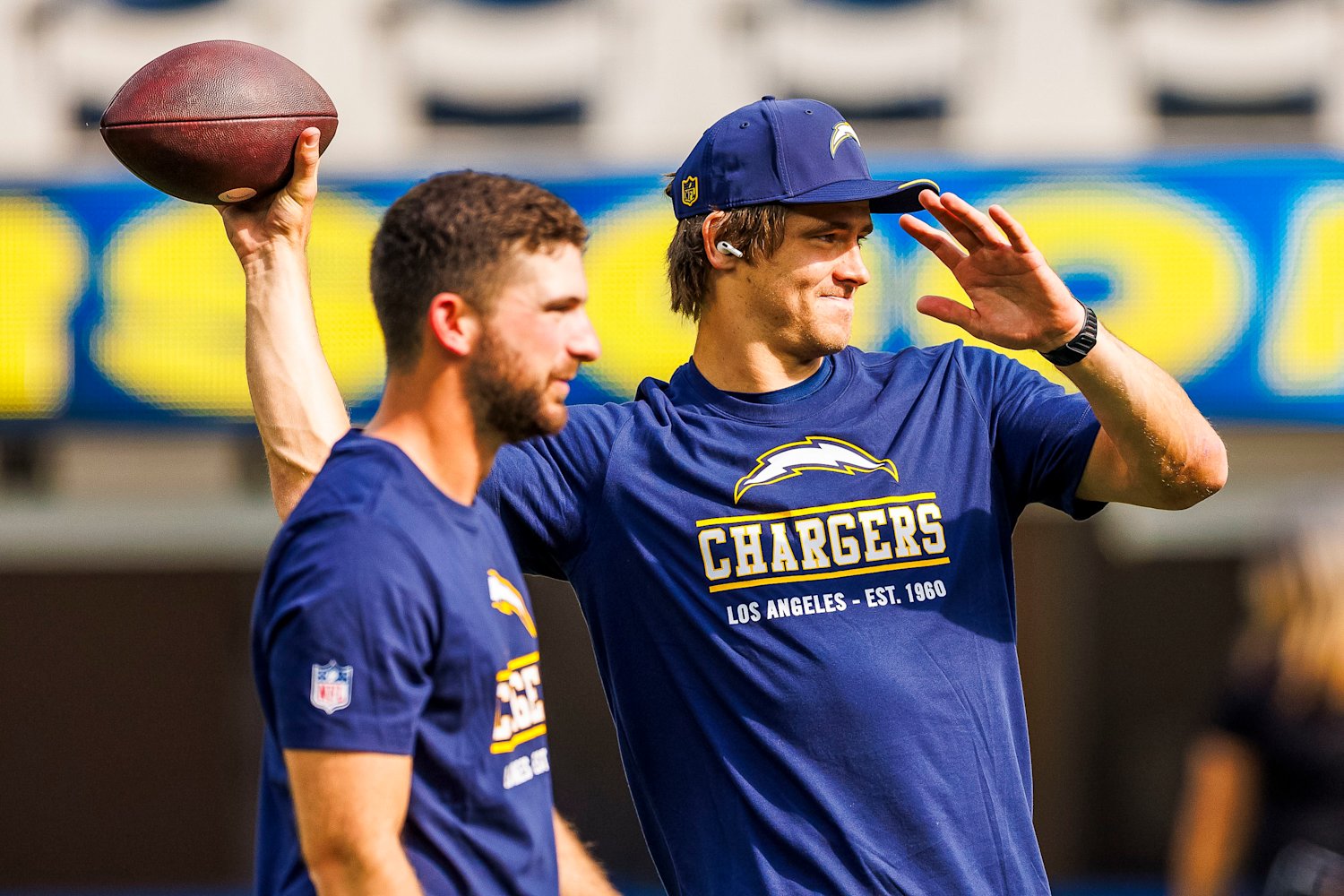
The Chargers have struggled with injuries and inconsistent play across their offensive line, leaving Justin Herbert under almost constant pressure.
Joe Alt remains a reliable presence at left tackle, but the rest of the line is far less settled. Jake Slaughter starts at center, with Cole Strange at right guard and Travis Burke at right tackle. Left guard Kayode Awosika is questionable with a fibula injury, while Trey Pipkins could return from injured reserve and provide some much-needed flexibility at tackle. Reserve Branson Taylor has already been ruled out.
The Ravens should be particularly interested in attacking the interior, where injuries and changing personnel have made protection difficult to coordinate. Minter can use simulated pressures, stunts and linebackers threatening the A-gaps to challenge that communication, potentially creating opportunities for Madubuike and Jones without consistently committing extra rushers.
The pass rush has been one of the more disappointing elements of Minter’s first season thus far. The Ravens have only 17 sacks, ranking 20th. Hendrickson has generated pressure and disrupted plays even when sacks haven’t followed, but the Ravens have not consistently converted those individual wins into collective disruption.
Too often, quarterbacks have found comfortable throwing lanes or escaped before the rush could finish.
Perhaps they can right that ship this week against this offensive line. Minter should be able to create considerable confusion for the Chargers’ offensive line without necessarily committing extra defenders on every passing down.
The objective is to force communication and blocking decisions before the snap, then make Herbert determine which defenders are actually attacking him. Against a line already struggling to protect its quarterback, that uncertainty can create favorable matchups for Hendrickson and Green.
The numbers suggest there is a reason to be aggressive. The Ravens have allowed approximately -0.06 EPA per dropback when blitzing, compared with +0.14 when rushing without a blitz. The Chargers have also been particularly vulnerable to sacks when facing blitzes, with a reported 17.1% sack rate in those situations.
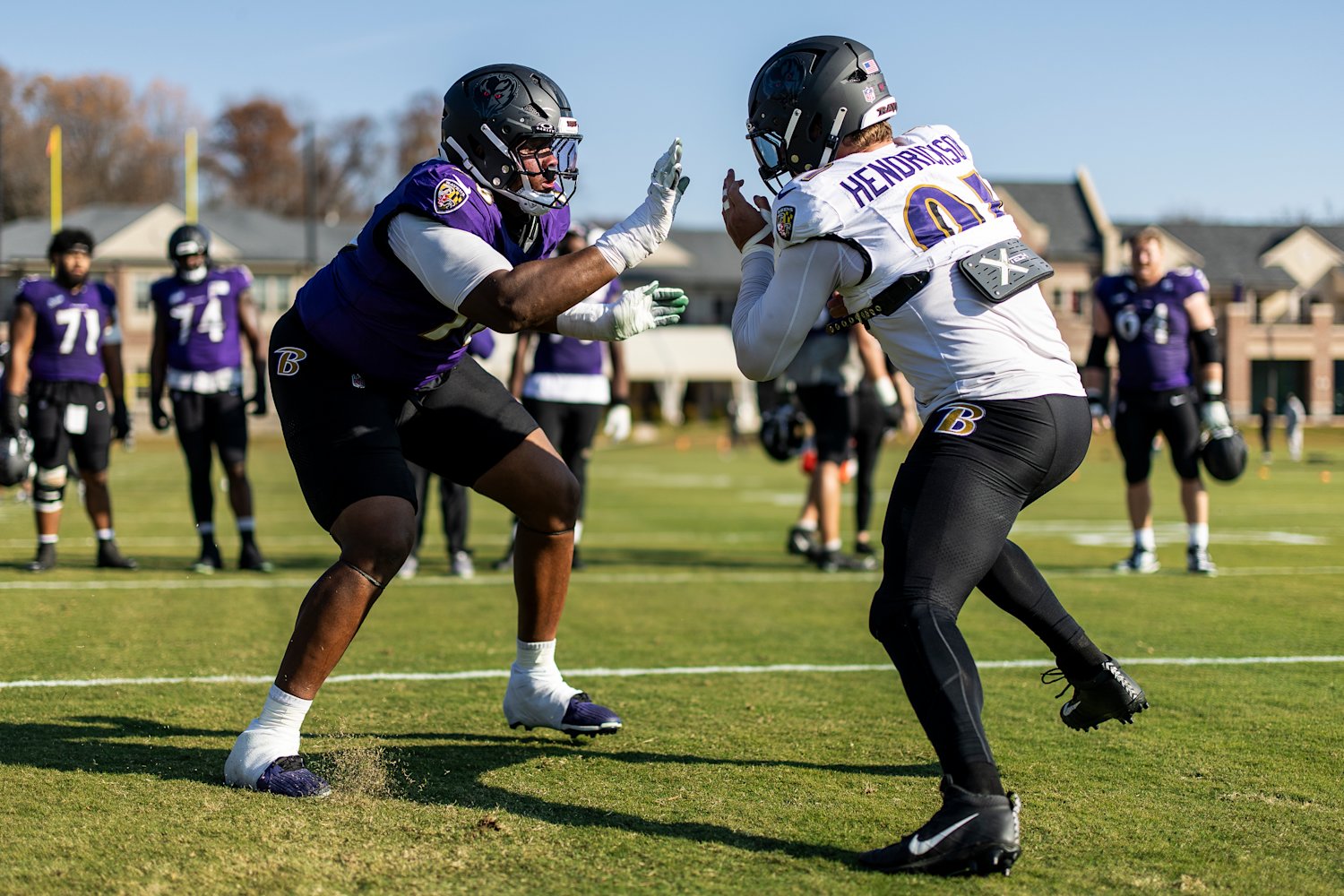
The key is creating pressure without repeatedly exposing the secondary. Herbert is having a terrible season, but he still has a dangerous arm. If the Ravens commit too many defenders to the rush and leave their corners isolated without help, Herbert is capable of making them pay.
That being said, he has been particularly error prone this season, with eleven interceptions. Herbert’s problems have not been exclusively caused by poor pass protection. His decision-making has also deteriorated, and Minter should be looking for opportunities to force him into difficult throws.
5. Don’t mistake an 0-8 record for an automatic victory
The Chargers are the NFL’s only winless team, but they also have a better defense than their record suggests, a quarterback with exceptional physical ability and a coaching staff that knows Baltimore’s defensive scheme unusually well.
There are reasons to be cautious. The Chargers may not be as bad as their record suggests.
Their offense, however, has been every bit as bad as the numbers indicate. They rank last in offensive EPA per play at -0.219, last in scoring at 15.1 points per game and have converted only 36.2% of their offensive plays into successful outcomes.
For comparison, the Ravens rank 20th in offensive EPA per play at -0.018, even after the miserable stretch without Lamar. The Chargers recently went 37 consecutive possessions without an offensive touchdown. That’s difficult to comprehend with Justin Herbert at quarterback and Mike McDaniel coordinating the offense.
The running game has been a major issue. Second-year running back Omarion Hampton has 369 yards on 102 carries, averaging just 3.6 yards per attempt. Former Raven Keaton Mitchell has added 178 yards, but the Chargers haven’t generated a reliable rushing attack to create manageable passing situations.
The problem becomes especially pronounced near the goal line, where the Chargers rank 29th in red-zone touchdown efficiency, converting just 47.4% of their opportunities. Over its last three games, the Chargers have advanced inside the opponent’s 30-yard line on 11 possessions and scored just one touchdown.
The injury situation could make things even more difficult for Herbert. Top receiver Ladd McConkey has been ruled out with a back injury and tight end David Njoku is also questionable as he works toward returning from a fibula injury.
McConkey’s absence removes an important receiving option from an offense already struggling to generate consistent production.
Week 10 availability: The Ravens ruled out Jaylinn Hawkins (knee) and listed Adam Randall (neck/hamstring) as questionable. Kyle Hamilton and Nate Wiggins have no game designation. Ravens injury update · Official injury reports.
Given the circumstances and opponent, the Ravens can’t afford another night where they win first and second down before allowing the opponent to convert third-and-long. If the defense can’t stop this offense at home this week, there isn’t much hope for the rest of the season.
The Ravens should win this matchup.
But considering how poorly they’ve played over the last month, they haven’t earned the right to take anyone lightly.
Prediction: Ravens 24, Chargers 17
The Ravens have reached the point where winning matters considerably more than style points.
At 4-5, they cannot afford to lose a fifth consecutive game, particularly against the league’s only winless team. A victory would move them back to .500 and at least preserve a realistic opportunity to make something of the remaining schedule while Lamar recovers.
I expect Brissett to provide a noticeable improvement over the offense we’ve watched in recent weeks. Simply by bringing some calm and control in the pocket and enough competence to utilize the weapons the Ravens do have on offense.
The concern is that Baltimore’s problems extend well beyond quarterback. The offensive line remains inconsistent. The defense has repeatedly failed to adjust when opponents find success. Penalties continue to undermine promising possessions. And this team has developed an unpleasant habit of looking entirely different after halftime.
Those problems won’t disappear simply because Brissett is more experienced.
Still, this matchup favors the Ravens. It probably won’t be especially pretty, but at this point, I’ll gladly take that.