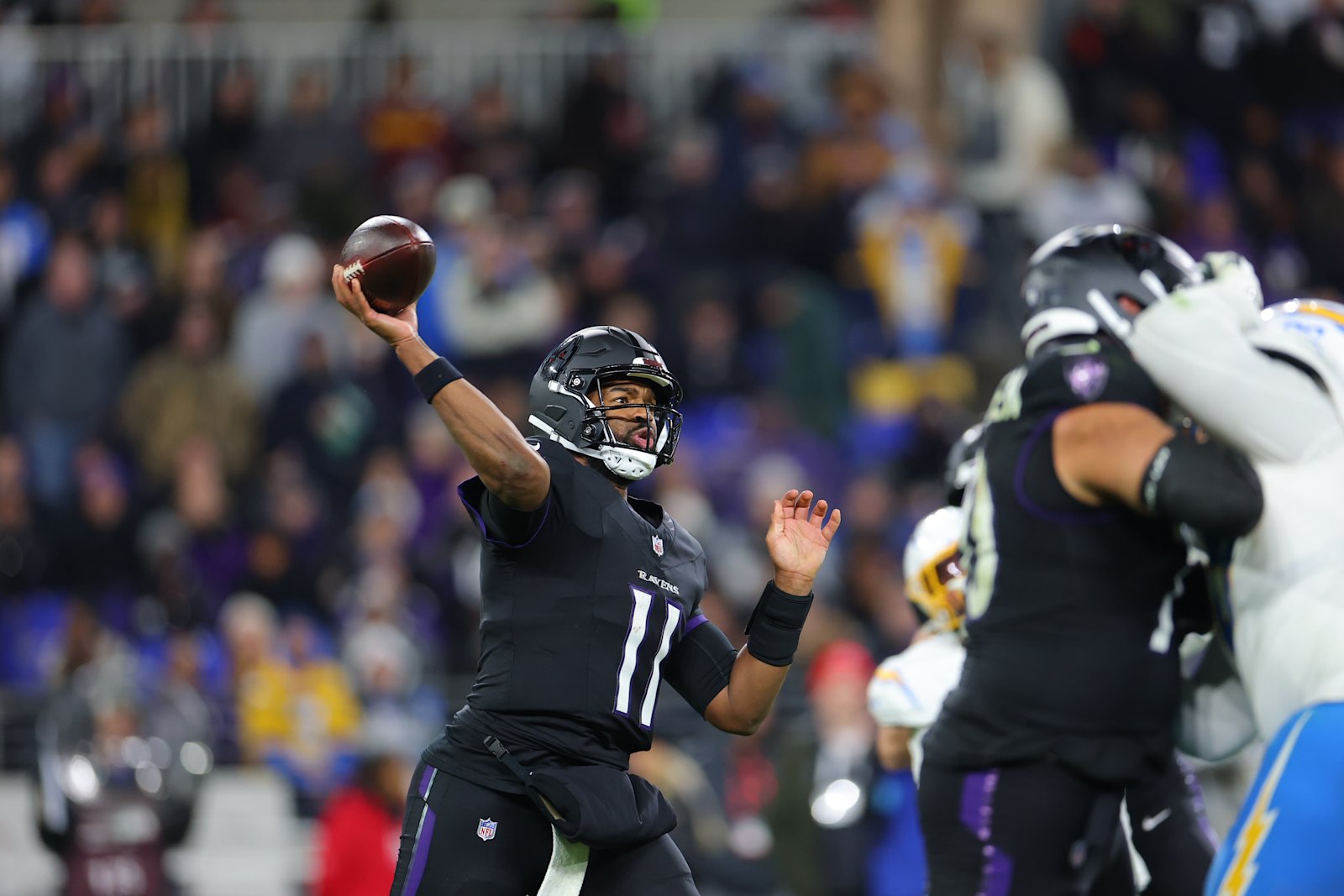
Five immediate takeaways from the Ravens' 23-20 loss to the previously winless Chargers, before any rewatch.
Follow the season. The Ravens Season Dashboard tracks results, advanced team metrics, unit grades, injuries and the next matchup.
I'm running out of ways to describe how disappointing this Ravens team has become.
After losing four straight games, they had 10 days to prepare for a home game against the only winless team remaining in the NFL. The Chargers arrived having lost 11 consecutive games dating back to last season, with an offense that had struggled to score against practically everyone.
Surely this was the opportunity to finally stop the bleeding.
Nope.
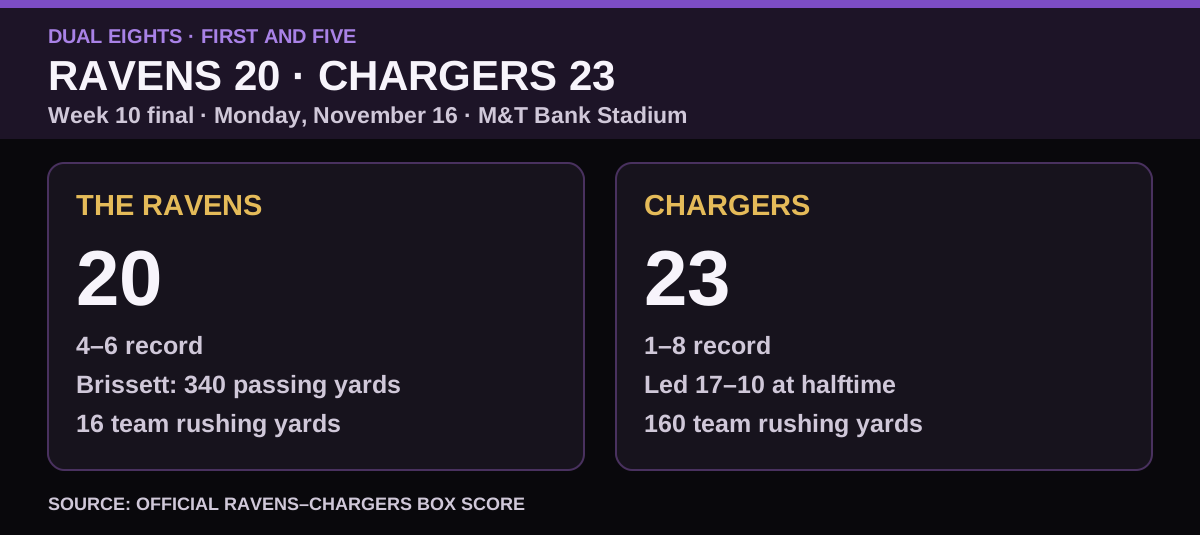
The Ravens lost 23-20, falling to 4-6 and extending their losing streak to five games. They are now 1-4 at home and haven't won a game since October 11.
Afterward, Kyle Hamilton said the Ravens were "disgracing those standards" that this franchise has established since 1996.
He's right. Unfortunately, we're approaching the point where the postgame declarations about accountability, preparation and playing to the Ravens standard are becoming almost as predictable as the mistakes themselves.
There were some encouraging individual performances Monday night. Jacoby Brissett gave the offense a spark. Mark Andrews looked like his old self. Mike Green continued his development into a potentially outstanding edge defender.
And somehow the Ravens still found a way to lose to an opponent that had been unable to beat anyone else.
Before going back through the tape, these are my five biggest takeaways.
1. Without Lamar, the Ravens are a very bad football team
We already knew the Ravens were going to struggle without Lamar Jackson. We've spent the past several weeks watching the offense become progressively less effective as defenses adjust to quarterbacks who cannot reproduce the problems Lamar creates.
But this is getting ridiculous.
The Ravens ran for 16 yards Monday night.
Sixteen.
On 15 carries.
That's the third-lowest rushing total in franchise history. Derrick Henry finished with 10 yards on 10 carries, his second-lowest rushing output in a game with at least 10 attempts across his entire career.
This happened against a Chargers defense that entered Monday allowing 122 rushing yards per game, ranking 20th in the NFL. The Chargers knew the Ravens would try to feed Henry and had absolutely no difficulty stopping them.
They crowded the line of scrimmage, attacked downhill and repeatedly disrupted running plays before Henry had an opportunity to build any momentum. The offensive line struggled to create space, and Declan Doyle never found a convincing answer.
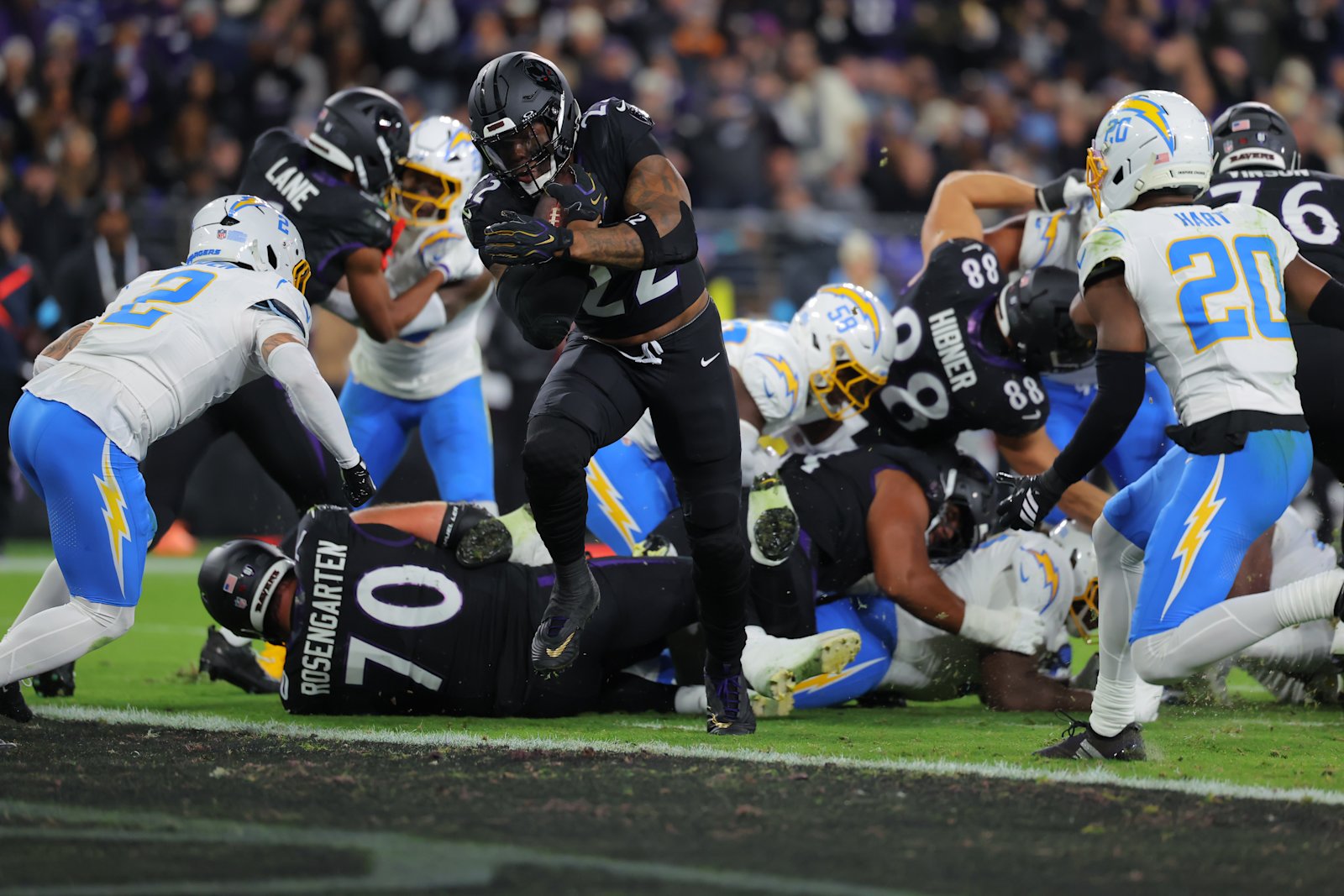
The absence of Lamar's running threat obviously makes Henry's job more difficult. But Baltimore's entire offensive structure shouldn't collapse to the point where a future Hall of Fame running back cannot average two yards per carry against an ordinary run defense.
The offensive line has become a disaster, and the problems are no longer confined to one position. We've spent much of this season waiting for the interior to stabilize. Cam Jurgens arrived. Vega Ioane returned to guard. Different combinations have come and gone. Yet the line continues to struggle with penetration, communication and basic execution.
And now Ioane has suffered another injury, leaving the Ravens with even more uncertainty at the position that looked like it might finally have some continuity.
The frustrating part is that the mistakes extend well beyond blocking. The Ravens continue to commit damaging penalties, drop important passes and make the kind of fundamental errors that turn manageable situations into difficult ones.
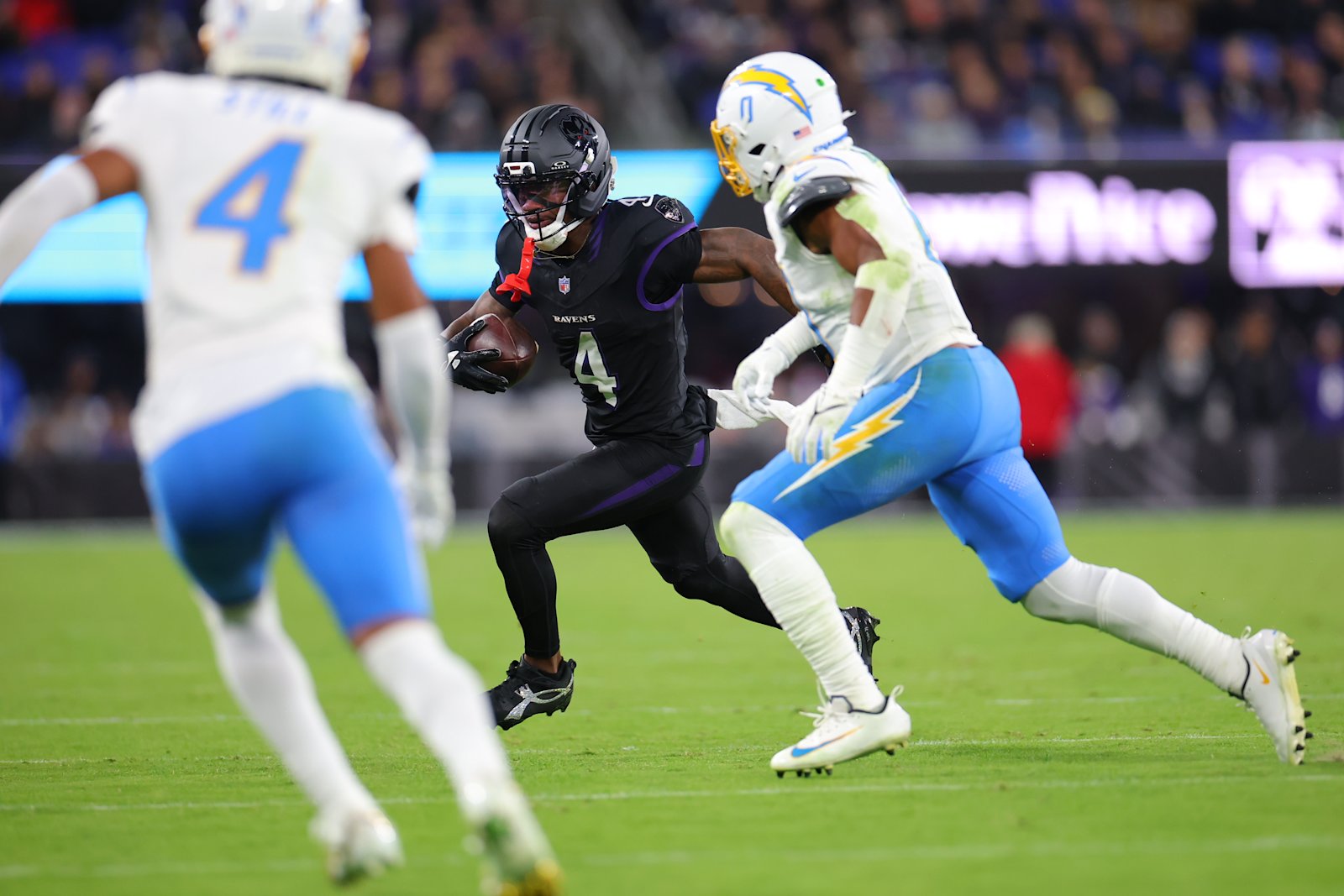
Ja'Kobi Lane dropped a pass in the third quarter that should have created first-and-goal. Instead, the Ravens settled for a field goal. Zay Flowers coughed up another devastating fumble as the Ravens were driving toward a potential game-winning score while trying to gain a few extra yards. That turnover essentially ended the game.
Flowers has been the most dangerous player on the offense this season, but he has now lost five fumbles since entering the league, tied for the most among wide receivers during that period.
With Lamar at the helm in the early season, this team looked like a title contender. Without him, they may be the worst team in the league. Maybe Lamar should be up for MVP this season after all. Or perhaps an easy opening schedule hid some of this team’s largest deficiencies and then injuries, inexperienced coaches and a lack of leadership exacerbated those problems.
2. Jacoby Brissett deserved better
I didn't expect to be particularly impressed with Jacoby Brissett on Monday night.
He had been with the Ravens for only 10 days, was learning an entirely new offense and was stepping behind an offensive line that had already made life miserable for Tyler Huntley and Joey Fagnano.
The opening three possessions weren't especially encouraging, but once Brissett settled in he was actually pretty effective.
He finished 33-of-49 for 340 yards and an interception. More importantly, he showed a willingness to attack portions of the field that the Ravens had largely abandoned with Huntley and Fagnano.
The Chargers were determined to make Baltimore win through the air. Brissett responded by finding receivers between coverage levels, challenging defensive backs and delivering several excellent throws under pressure.
He wasn't perfect. There were some inaccurate passes and moments when he held the football too long. His interception was a somewhat fluky play involving Ja'Kobi Lane and Cam Hart, with contact that could reasonably have drawn a pass interference flag. Brissett also appeared to anticipate the throw before Lane was in position, so I'm not ready to absolve him completely.
But given the circumstances, this was considerably better than anything the Ravens could reasonably have expected. He provided the offense with something it has been missing since Lamar went down.
A quarterback willing and capable of making NFL throws.
I also liked how Declan Doyle adapted once Brissett found his rhythm. The Ravens began moving the ball through their tight ends and running backs, creating manageable completions and occasionally attacking downfield.
For the first time in quite a while, Mark Andrews looked like the player the Ravens believed they were keeping when they signed him to that contract extension. He caught all eight of his targets for 82 yards, his highest reception total since 2023. He looked comfortable working the middle of the field, finding openings in coverage and securing passes that had too frequently been falling incomplete in recent weeks.
Perhaps we finally have an explanation for some of those struggles. During the broadcast, it was reported that Andrews had been playing with a broken hand since Week 3. Afterward, he confirmed that he had injured his left hand and had continued playing through it.
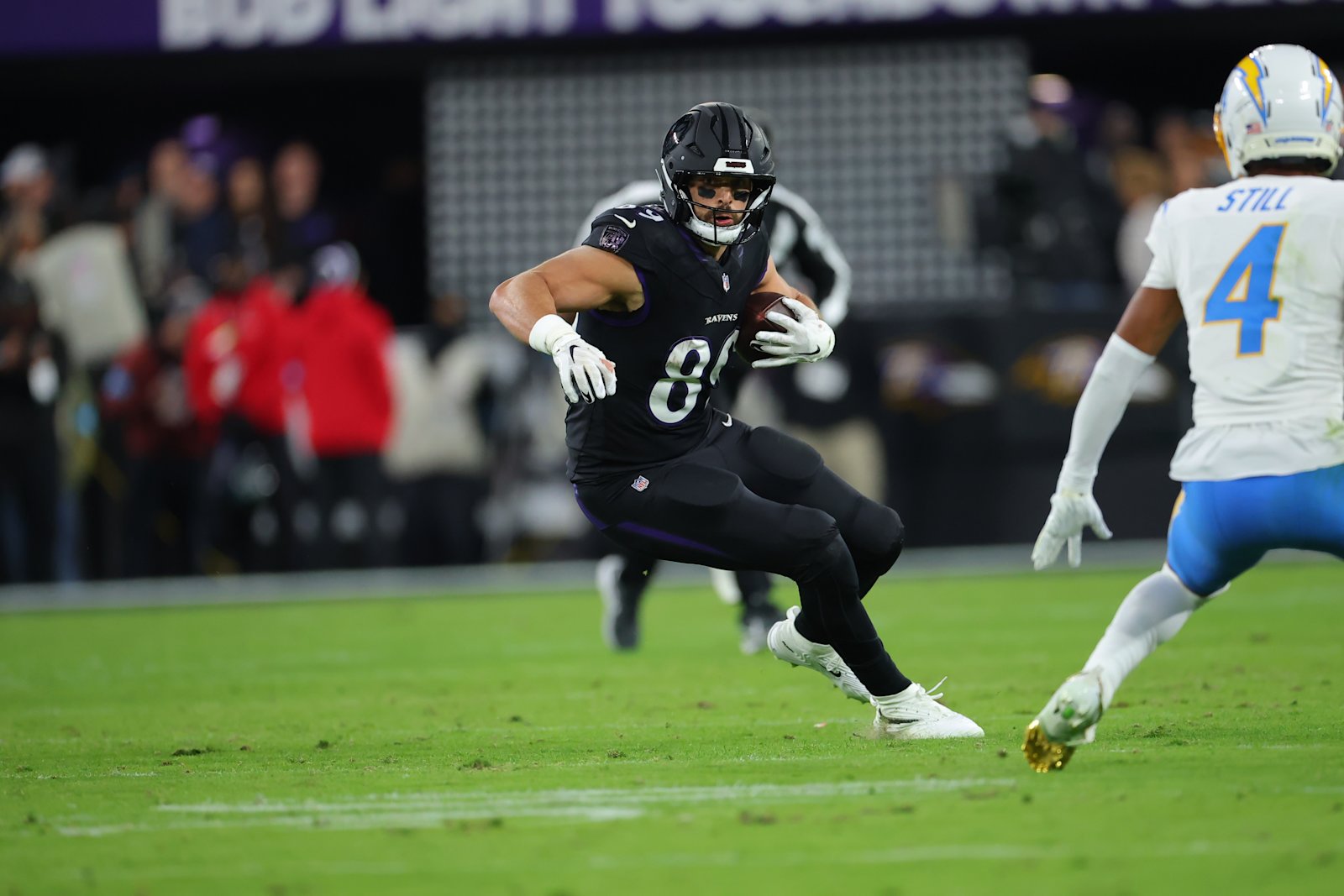
Knowing he was playing with a broken hand certainly changes how we should evaluate the catching problems, at least this season. Though it might lead one to wonder why he was on the field in the first place and doesn’t explain everything that has happened over the past couple of years.
Monday night was encouraging and hopefully this is the version of Andrews we see going forward.
Unfortunately, the improved offense and contributions from Brissett and Andrews still weren’t enough to beat the Chargers.
3. Jesse Minter might be lucky Lamar got injured
That probably sounds like an absurd statement.
How could a first-year head coach possibly benefit from losing the most important player on his roster?
But consider how differently we'd be evaluating Jesse Minter's rookie season if Lamar Jackson were healthy.
With Lamar injured, the explanation for the Ravens' disappointing season is relatively straightforward. Their franchise quarterback is unavailable, the offense is struggling, and the team simply cannot overcome losing one of the best players in football.
There's plenty of truth to that, but it's also conveniently obscuring just how disappointing almost everything else about this team has become.
Especially Minter's defense.
The Chargers entered Monday averaging an NFL-worst 15.1 points per game. They hadn't scored a first-half touchdown since Week 3. Against the Ravens, they scored 17 points before halftime and finished with 23, matching their highest output of the season.
Omarion Hampton rushed for 105 yards, and the Chargers finished with 160 as a team. They consistently found room to attack the Ravens' defensive edges, particularly as the game progressed.
And then there was Justin Herbert.
Herbert finished with 51 rushing yards, including a 22-yard touchdown on the opening possession when he escaped through the middle of the defense virtually untouched. That was hardly the only time he made the Ravens look foolish.
The defense repeatedly appeared to have Herbert trapped, only for him to escape pressure and turn a potential negative play into a positive gain.
How does that happen so consistently?
Minter spent the previous two seasons as the Chargers' defensive coordinator. He knows Herbert's athletic ability, his tendency to extend plays and the problems he creates when pass rushers abandon their lanes.
Yet the Ravens frequently looked completely unprepared to contain him.
Minter acknowledged afterward that poor rush lanes allowed Herbert to escape. That's fair, but recognizing the problem after the game is not especially reassuring when the same weaknesses keep appearing. The Ravens also failed to force a single turnover against a quarterback who had thrown an interception in every previous game this season.
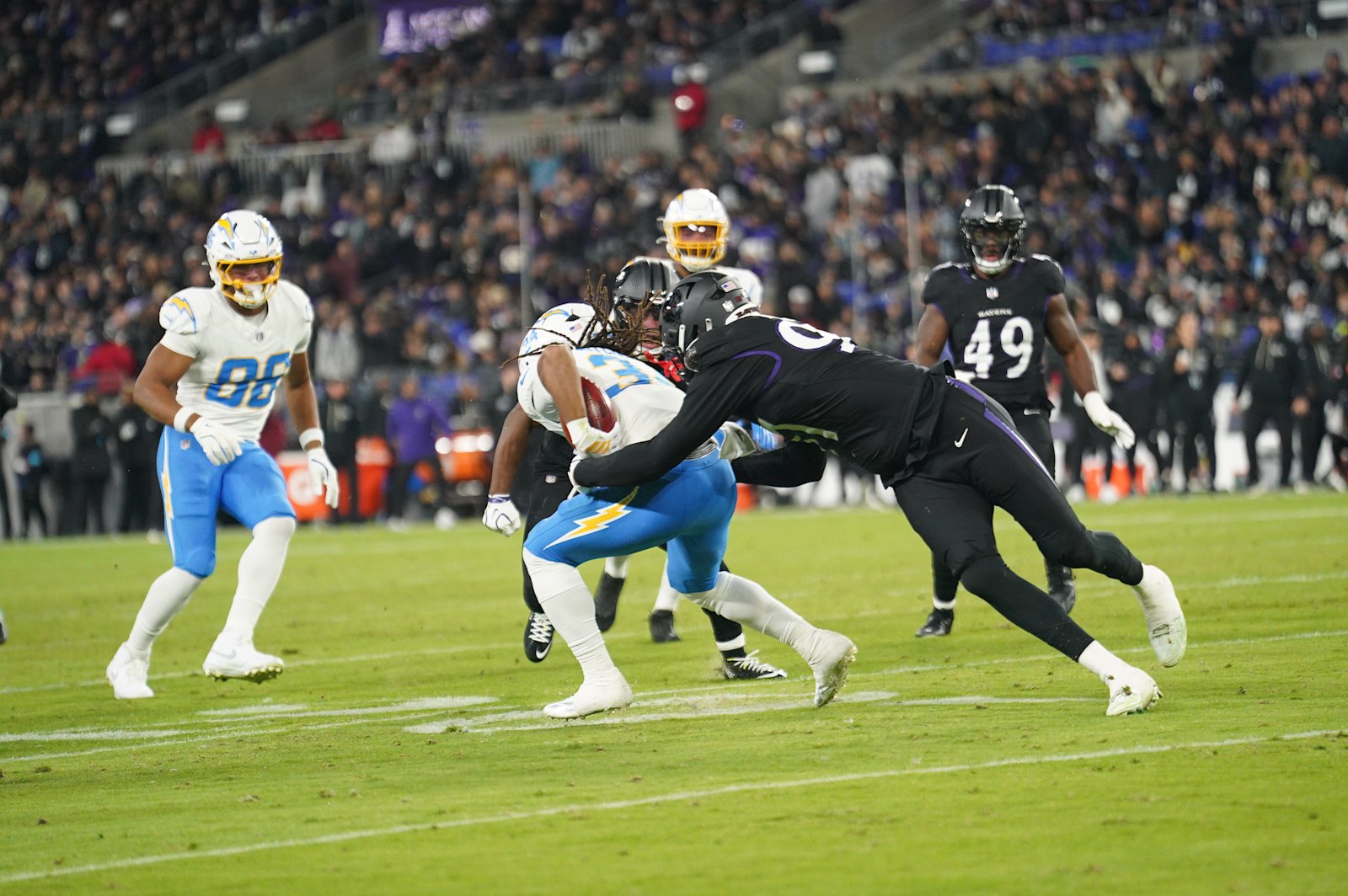
To be fair, the defense did improve considerably as the game progressed. The Chargers managed only six points after halftime, and several late stops gave the offense opportunities to come back.
A more functional offense would certainly help the defense, too. Fewer three-and-outs would reduce its workload, and fewer turnovers would limit the number of short fields, but those excuses only go so far.
The defense has too much cap invested into it to be performing this inconsistently, and the coaching staff has repeatedly struggled to find answers when opponents identify weaknesses in its initial plan.
Remember the offseason expectations.
Minter arrived with an outstanding defensive reputation. Anthony Weaver was supposed to provide an experienced coordinator alongside him. The Ravens invested heavily in Trey Hendrickson, retained an exceptionally talented secondary and expected Nnamdi Madubuike's return to strengthen the interior.
We weren't expecting an average defense.
We were expecting one capable of winning games even when the offense wasn't at its best.
Instead, this is a bottom-10 unit in the league.
Missed assignments. Poor tackling. Undisciplined penalties. Defensive backs losing leverage. Pass rushers failing to finish. Opponents exploiting weaknesses that Minter seems unable to correct.
At some point, those problems become a coaching issue. Of course, players have responsibility for executing assignments. Minter cannot personally tackle Herbert or stop a defensive back from taking a bad angle.
But when the same problems continue across different opponents, personnel groupings and game situations, it's reasonable to question whether the preparation, teaching and defensive structure are good enough.
If Lamar were healthy and the offense were regularly scoring 25 or 30 points, imagine the scrutiny Minter would be facing as his defense continued surrendering leads, missing tackles and failing to adjust.
Instead, the quarterback injury provides an explanation that will probably buy him more patience than his performance otherwise deserves.
He may need every bit of it.
And don’t look now, but the teams coached by John Harbaugh and Todd Monken are both well positioned to make the playoffs.
Just saying…
4. Mike Green is becoming a bright spot on a disappointing defense
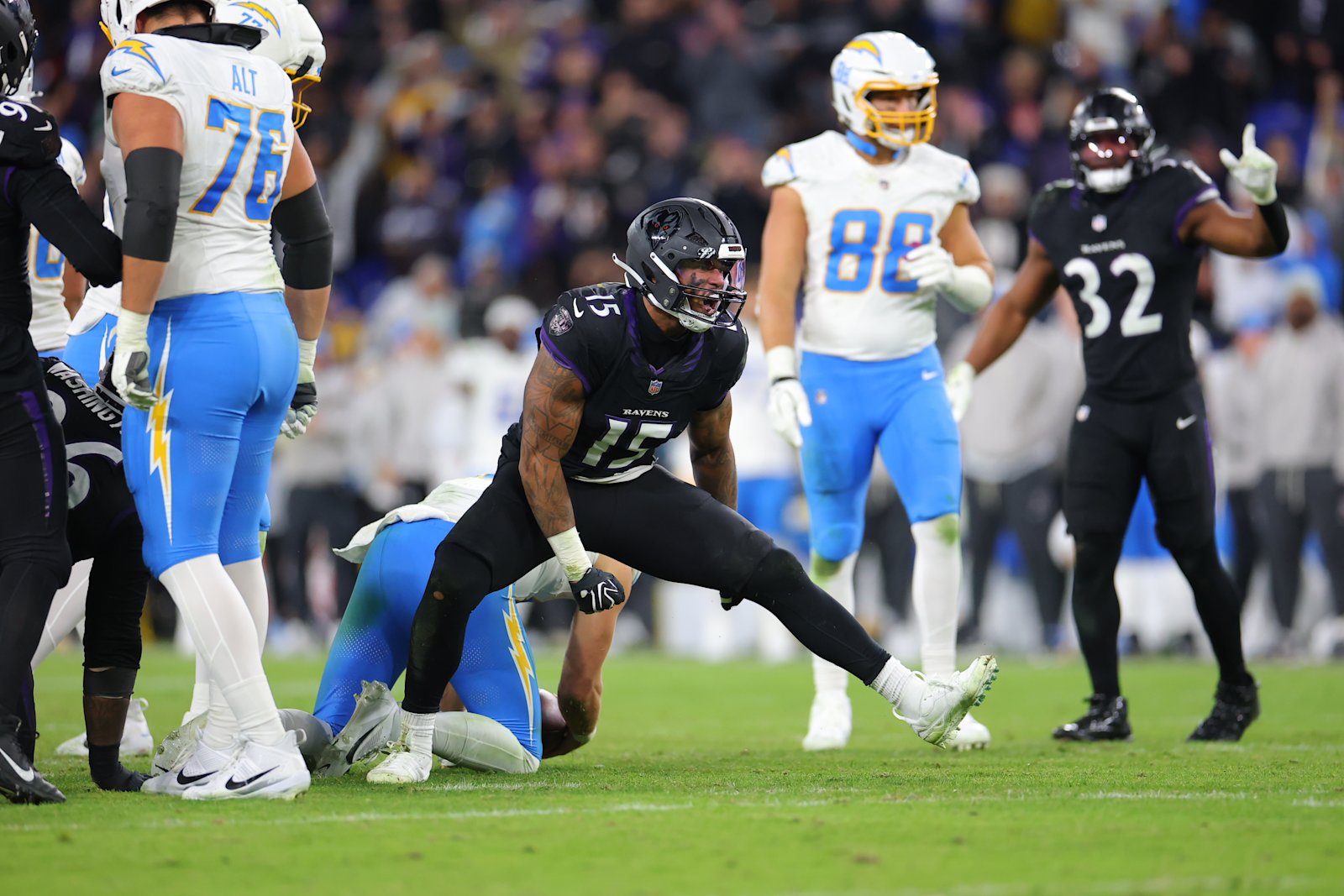
One of the few genuinely encouraging developments this season has been Mike Green. The second-year edge rusher was outstanding Monday night, finishing with two sacks, two tackles for loss and three quarterback hits.
He now leads the Ravens with 5.5 sacks after recording 3.5 during his rookie season. More importantly, Green increasingly looks like a player capable of affecting games in different ways.
He has the quickness to threaten offensive tackles around the edge, but he's also becoming more effective attacking inside and using his hands to create opportunities when his initial rush doesn't win. And he continues to demonstrate the willingness to attack running plays rather than simply concentrating on reaching the quarterback.
He was the best player on the field for the defense last night, despite the questionable roughing the passer penalty he picked up.
The larger concern is how little production the defense is getting from everyone else.
Trey Hendrickson played 41 defensive snaps against the Chargers and finished with just one tackle, no sacks and no quarterback hits. He hasn't recorded a sack since Week 6. That is nowhere close to what the Ravens expected when they made him their biggest defensive acquisition of the offseason.
Hendrickson was supposed to give Minter a pass rusher who could consistently win individual matchups, allowing the defense to create pressure without exposing its coverage through aggressive blitzing.
Instead, Green is increasingly becoming the player opponents need to worry about.
And the rest of the pass rush remains frustratingly inconsistent.
There were plenty of occasions Monday when a Ravens defender got close enough to Herbert to make a play. But getting near the quarterback isn't the same as finishing the rush. Sometimes a defender failed to complete the tackle. Other times the rush lost containment, giving Herbert an escape route that was more dangerous than the original passing play.
The Ravens have spent years trying to develop an effective, sustainable pass rush without constantly relying upon blitzes or manufacturing favorable matchups.
Green's progression offers genuine reason for optimism.
If he continues developing, they may have found a long-term answer at one of football's most valuable positions. However, they cannot build an effective pass rush around one young player while expensive veterans disappear for entire games.
Green is doing his part.
He needs considerably more help.
5. The season is over. Now what?
Technically, the Ravens are not eliminated from playoff contention.
Realistically, I think we can stop pretending this season is going to be rescued.
At 4-6, the Ravens sit 10th in the AFC, two games behind Cleveland for the final Wild Card spot, having already lost their first meeting with the Browns.
According to ESPN Analytics, the Ravens now have a 4.1% chance of making the playoffs.
That isn't mathematical elimination.
It's awfully close to practical elimination.
Consider what they would actually need to accomplish.
With seven games remaining, the possibilities look like this:
| Final seven games | Final record | Playoff outlook |
|---|---|---|
| 7-0 | 11-6 | Strong chance of qualifying |
| 6-1 | 10-7 | Realistic playoff possibility |
| 5-2 | 9-8 | Needs considerable outside help and favorable tiebreakers |
| 4-3 | 8-9 | Extremely unlikely |
| 3-4 or worse | 7-10 or worse | Effectively finished |
These aren't calculated probabilities for each scenario, but they illustrate how little wiggle room they have left.
Winning five of the final seven games might not be enough.
To give themselves a reasonable chance, the Ravens probably need to win at least six.
Now look at the schedule.
They travel to Carolina and Houston before their Week 13 bye. Then comes Tampa Bay at home, followed by four consecutive AFC North games: at Pittsburgh, home against Cleveland, at Cincinnati and home against Pittsburgh.
The Browns are currently 6-4. The Steelers are 6-3. The Bengals are 7-2 and have won five straight. Even if they get to 9-8, Cleveland would need to finish no better than 9-8 for the Ravens to catch them, with tiebreakers potentially deciding the outcome. Pittsburgh and New England also remain obstacles in the Wild Card race.
And somehow we're supposed to believe a team that hasn't won in more than a month is about to go 6-1 against that schedule?
Come on.
Which brings me to the uncomfortable conclusion.
The Ravens are probably better off losing the rest of their games.
I don't mean that the players should stop competing or that the coaching staff should deliberately sabotage games. I understand that no player in that locker room is interested in sacrificing his career, contract or professional reputation for next year's draft position.
But from the perspective of what's best for the franchise, what exactly would winning another two or three games accomplish?
Suppose the Ravens finish 7-10.
They miss the playoffs. The season remains a complete failure. The organization still has significant questions about its offensive line, defensive coaching, veteran contracts and overall roster construction.
And instead of potentially selecting near the top of the draft, they've pushed themselves several spots further down the board.
The Ravens already have an 8.6% chance of landing a top-five selection in the 2027 draft, according to ESPN Analytics. That's more than double their current probability of reaching the playoffs.
If they lose their remaining seven games and finish 4-13, they'll put themselves in a much stronger position to acquire a premium prospect, whether that's a potential cornerstone offensive lineman, an elite defensive player or another talent they wouldn't normally have the opportunity to draft. Or they could also use that position to trade down and accumulate additional draft capital.
This roster needs an infusion of young talent, particularly at positions where the Ravens have been relying too heavily on expensive veterans or replacement-level depth.
An unusually high draft pick could be enormously valuable.
I would much rather have the fifth overall pick and a chance to fix a major roster weakness than the 13th pick and the warm feeling of having beaten a couple of mediocre teams after the season was already lost.
The front office should use the remaining games to evaluate younger players, determine which veterans still fit its long-term plans and identify exactly what must change before 2027. And above all, they should not rush Lamar Jackson back onto the field simply to chase a mathematically possible playoff berth that has almost no realistic chance of materializing.
The Ravens entered this season believing they were legitimate Super Bowl contenders. They hired Jesse Minter to take a talented roster to another level, invested heavily in the defense and expected an improved offensive structure around Lamar.
Ten games later, the quarterback is injured, the offensive line is falling apart, the defense is underperforming and the season is almost certainly lost.
The championship window isn't closed, but next season will surely be a pivotal one in the trajectory of this franchise and its franchise quarterback.