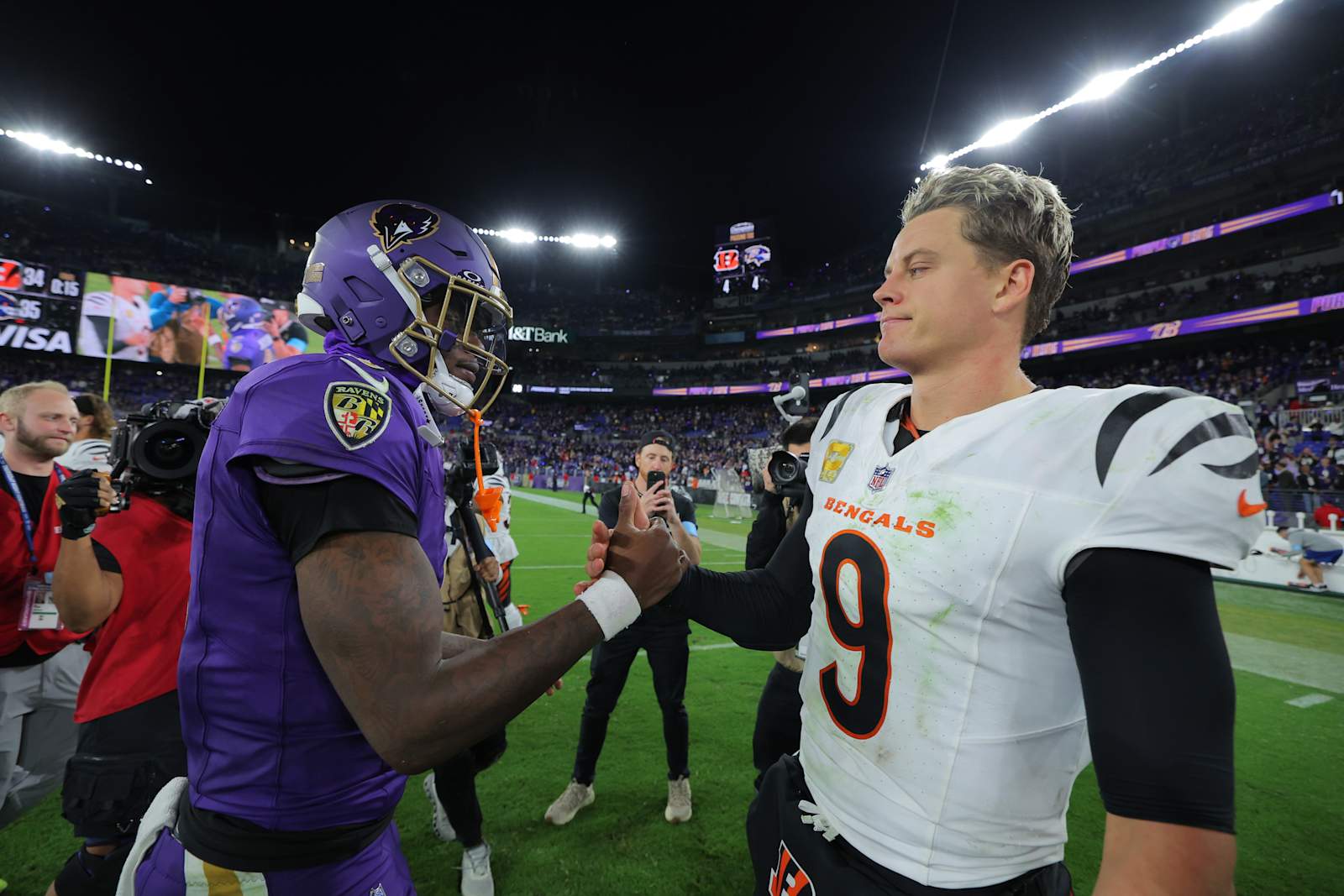
The AFC North looks familiar on the surface and almost unrecognizable underneath it.
The Ravens are again expected to contend for the division and the Super Bowl. Joe Burrow still makes Cincinnati dangerous. Pittsburgh still has enough defensive talent to ruin an afternoon. Cleveland still appears destined to make football much harder than it needs to be.
Like the Ravens, two of their division rivals are operating under new coaching regimes this season and the one that is not might have changed its roster more meaningfully than anyone else.
Mike Tomlin is gone from Pittsburgh after nearly two decades without a losing season. Todd Monken is now trying to rehabilitate Cleveland’s offense. Cincinnati is the only AFC North team returning its head coach, and the Bengals spent the offseason attacking the defense that ruined much of their 2025 season.
That makes this a strange division to project using historical assumptions.
Pittsburgh’s old floor belonged at least partly to Tomlin. Cleveland’s excellent defense lost both Myles Garrett and coordinator Jim Schwartz. Cincinnati’s 6-11 record tells us remarkably little about what a healthy Burrow team with a reconstructed defensive front might become.
Every team in the division enters the season with a quarterback with some health concerns. Lamar Jackson and Joe Burrow have missed significant time due to injuries in recent seasons, while Aaron Rodgers is just old and Deshaun Watson hasn’t played a meaningful game since 2024.
The Ravens remain the best bet to win the North. DraftKings has them just under even to win at +102, with the Bengals the clearest competition at +164, followed by the Steelers at a distant +510 and the Browns at a very longshot +2100.
Narrowly is the operative word.
If the Ravens fail to win this division, the Bengals are overwhelmingly the team most likely to take it from them.
Cincinnati is much better than 6-11
Key 2025 stats
- Record:
- 6-11
- Points per game:
- 24.4, 12th
- Points allowed per game:
- 28.9, 30th
- Offensive EPA/play:
- 19th
- Defensive EPA/play:
- 29th
- Yards per play allowed:
- 6.18, 32nd
- Turnover margin:
- -3
- Joe Burrow starts:
- 8, with Cincinnati going 5-3
Key offseason changes
- Added Dexter Lawrence in exchange for the No. 10 overall pick
- Added Jonathan Allen to the interior defensive line
- Added Boye Mafe on the edge
- Added Bryan Cook and Kyle Dugger at safety
- Continued investing in the defense through the draft
- Lost Trey Hendrickson to the Ravens
- Zac Taylor remains the head coach, making Cincinnati the only AFC North team with head-coaching continuity
Start with the easiest record to misread.
Cincinnati won six games last season, finished third in the division and fielded one of the worst defenses in football. Taken without context, that sounds like a team attempting a major turnaround.
It really needs two things: Burrow to remain healthy and the defense to become merely competent.
The Bengals still averaged 24.4 points per game last season, 12th in the NFL, despite Burrow starting only eight games. They went 5-3 when he did play. Cincinnati finished sixth in net passing yards per game and scored touchdowns on 66.7 percent of its red-zone trips.
The offense did not collapse. Its quarterback disappeared for nine games. Cincinnati still finished only 19th in offensive EPA per play, but finishing 12th in scoring despite getting only eight Burrow starts is a much healthier starting point than the 6-11 record implies.
The defense was the disaster.
Cincinnati allowed 28.9 points per game, 6.18 yards per play and ranked 29th in defensive EPA per play. Opponents could run or throw efficiently, which meant the Bengals’ offense too often needed to win games on demanding terms.
They responded with the division’s most aggressive attempt to fix a weakness.
Dexter Lawrence arrived in exchange for the No. 10 overall pick. Jonathan Allen was added beside him. Boye Mafe joined the edge group. Bryan Cook and Kyle Dugger strengthened the secondary, while Cincinnati continued adding defensive talent through the draft.
Losing Trey Hendrickson to the Ravens obviously hurts. The Bengals did not replace an elite edge rusher with another elite edge rusher. Instead they built a front that is harder to solve collectively.
Lawrence can command double teams in the middle. Allen provides another interior pass-rush threat. Mafe, Cashius Howell and Shemar Stewart do not need to reproduce Hendrickson’s sack total individually if quarterbacks are consistently facing longer down-and-distance situations and fewer clean pockets.
That should be particularly relevant against the Ravens, who enter the season with an entirely rebuilt interior offensive line. Vega Ioane is a rookie. Ethan Pocic is returning from an Achilles injury. John Simpson is back in Baltimore but still represents another new piece.
That unit would probably have preferred the old Bengals defensive front.
Cincinnati does not need Lawrence and Allen to turn the defense into the 2000 Ravens. It needs them to prevent opponents from living in second-and-5. A much more achievable standard.
A pile of defensive additions does not automatically fix communication in the secondary or guarantee that Cincinnati can generate enough edge pressure without Hendrickson. The betting market is no longer giving Cincinnati much of a discount for that upside: DraftKings has moved its win total from 9.5 earlier this offseason to 10.5 entering September.
Still, the logic behind the optimism is much stronger than simply expecting Burrow to save everything.
Cincinnati already showed it could score with its franchise quarterback missing half the year. If Burrow plays 16 or 17 games and the defense moves from bottom-five to somewhere near league average, 11 wins will not require anything unusual.
That is the Ravens’ biggest divisional problem.
Pittsburgh may have a new floor without Tomlin
Key 2025 stats
- Record:
- 10-7
- Pythagorean expectation:
- 8.8 wins
- Points per game:
- 23.4, 15th
- Yards per play:
- 5.26, 17th
- Opponent yards per play:
- 5.46, 19th
- Offensive EPA/play:
- 18th
- Defensive EPA/play:
- 19th
- Turnover margin:
- +12
- Adjusted Games Lost:
- 53.3, sixth-healthiest in the NFL
Key offseason changes
- Mike McCarthy replaced Mike Tomlin as head coach
- Brian Angelichio replaced Arthur Smith as offensive coordinator
- Patrick Graham replaced Teryl Austin as defensive coordinator
- Aaron Rodgers returns at age 42 and reunites with McCarthy
- Added Michael Pittman Jr. to play opposite DK Metcalf
- Drafted Max Iheanachor in the first round to help remake the offensive line
- Traded Broderick Jones to Dallas late in the preseason
- Added Jamel Dean and Jaquan Brisker to the secondary
Projecting the Steelers used to involve one annoying rule.
Whatever you thought of the roster, Mike Tomlin would probably find nine wins somewhere.
That rule no longer applies.
Pittsburgh replaced Tomlin with Mike McCarthy, Arthur Smith with first-time offensive coordinator Brian Angelichio and defensive coordinator Teryl Austin with Patrick Graham. Aaron Rodgers returns at age 42, now reunited with McCarthy in an offense that should look considerably different from the conservative structure Pittsburgh used a year ago.
Michael Pittman Jr. gives Rodgers a legitimate second receiver beside DK Metcalf. McCarthy should be more willing to throw on early downs. Graham can build around one of the division’s best collections of edge rushers. Pittsburgh remains too talented, and too stable as an organization, to dismiss.
But its 10-7 record last season exaggerated how good the team actually was. The Steelers’ Pythagorean expectation was only 8.8 wins. They ranked 17th in yards per play, 19th in opponent yards per play, 18th in offensive EPA per play and 19th defensively.
Those are the numbers of a mediocre team. What did not look mediocre was a plus-12 turnover margin and the sixth-best injury situation in football. Pittsburgh has defenders capable of creating turnovers, so dismissing all of that margin as luck would be simplistic. T.J. Watt, Alex Highsmith and the rest of the defense can force quarterbacks into bad decisions.
Counting on plus-12 again is not a recipe for success however. The secondary also allowed too many explosive passes last year, and that concern has not disappeared. Joey Porter Jr. missed much of camp with a back issue while also dealing with a contract situation. Pittsburgh has talent behind him, but the Ravens should be willing to test those outside matchups if the protection allows it.
The more interesting change for the Ravens could be on the offense. If McCarthy brings his philosophy to Pittsburgh, Jesse Minter cannot prepare for the same old Steelers formula of squeezing the run, creating third-and-long and then attacking obvious passing situations.
Pittman and Metcalf give Rodgers two receivers capable of winning isolated matchups. A more aggressive first-down passing game could prevent Baltimore from dictating the down before it begins.
The problem for Pittsburgh is expecting a 42-year-old quarterback to carry even more responsibility behind a young offensive line. The Steelers traded Broderick Jones shortly before the season and are now leaning heavily into their younger tackles. That could eventually become a strength, but in the near term it creates exactly the kind of early instability that Hendrickson, Nnamdi Madubuike and Minter’s pressure designs should be able to attack.
Pittsburgh can absolutely beat the Ravens. It may do it once this year because Ravens-Steelers games have a remarkable ability to ignore whatever the respective qualities of the teams are.
Winning the division is a different question.
The Steelers benefited from turnovers, health and close-game outcomes in 2025. Now they have changed the head coach, both coordinators and the offensive structure while asking one of the oldest starting quarterbacks in NFL history to make the transition work.
Eight or nine wins feels more like the ceiling for this team than the floor it often was in the Tomlin era.
Cleveland’s defense gives it a chance. The offense remains a liability.
Key 2025 stats
- Record:
- 5-12
- Points per game:
- 16.4, 31st
- Offensive EPA/play:
- 32nd
- Pass EPA/play:
- 32nd
- Defensive EPA/play:
- 4th
- Pass EPA/play allowed:
- 3rd
- Total yards allowed:
- 283.6 per game, 4th
- Turnover margin:
- -7
- Sacks allowed:
- 51
- Adjusted Games Lost:
- 104.4, 26th
Key offseason changes
- Todd Monken replaced Kevin Stefanski as head coach
- Travis Switzer became offensive coordinator
- Mike Rutenberg replaced Jim Schwartz as defensive coordinator
- Traded Myles Garrett to the Rams
- Received Jared Verse plus 2027 first-, 2028 second- and 2029 third-round picks in the Garrett deal
- Rebuilt most of the offensive line with Tytus Howard, Elgton Jenkins, Zion Johnson and first-round pick Spencer Fano
- Drafted receivers KC Concepcion and Denzel Boston
- Lost several veteran offensive linemen, including Joel Bitonio, Jack Conklin, Wyatt Teller and Ethan Pocic
- Deshaun Watson won the starting quarterback job
Cleveland might be the hardest team in the division to evaluate because its 2025 season contained two almost unrelated football teams.
The Browns ranked fourth in defensive EPA per play.
They ranked dead last offensively.
The defense allowed only 283.6 yards per game and finished third in pass EPA allowed. The offense produced 16.4 points per game and finished at or near the bottom of the league in virtually every meaningful efficiency measure.
That is how you go 5-12 while still being capable of ruining somebody’s Sunday. The problem is that the unit carrying Cleveland has undergone enormous change.
Garrett is gone after setting an NFL record with 23 sacks last season. Schwartz is also gone. Jared Verse is an excellent young replacement and the Browns received substantial future draft capital in the Garrett trade, so this may ultimately prove to be very good business.
However, it does not make Cleveland better in 2026. Verse gives Cleveland an immediate high-end edge rusher. He does not replace Garrett one-for-one, because essentially nobody could. New coordinator Mike Rutenberg can maintain an attacking four-man front without reproducing everything Schwartz did.
The offense is also being rebuilt nearly everywhere. Todd Monken takes over after his Ravens tenure, with Travis Switzer joining him as offensive coordinator. Cleveland replaced most of its offensive line, added young receivers KC Concepcion and Denzel Boston and will hope that an entirely new structure creates something approaching competency.
Then there is Deshaun Watson.
Watson won the starting job despite not playing a regular-season game in nearly two years. He missed all of 2025 after another Achilles injury and has not played more than seven games in a season since leaving Houston.
Maybe Monken can help. He understands how to use personnel movement, play action and the run game to create cleaner quarterback answers, and Cleveland has made legitimate investments around Watson.
But Baltimore saw up close that Monken’s offense still required the quarterback to process, throw accurately and punish defenses when opportunities appeared. Scheme can create the window. Someone still has to put the ball through it.
Cleveland’s best path against the Ravens is therefore fairly obvious. Keep the score down. Create pressure without exposing the secondary. Avoid turnovers. Force Baltimore into long drives instead of explosives. Hope Verse and the defensive front create one or two possessions that begin on short fields.
What Cleveland cannot afford is a chase script. If Lamar and Derrick Henry force the Browns to commit extra bodies near the line and the Ravens build an early two-score lead, Watson probably cannot be asked to trade efficient possessions with Lamar for the rest of the afternoon.
Monken and Switzer will also have considerable familiarity with Baltimore’s offensive thinking. That should help Cleveland identify tendencies and prepare for specific run concepts.
That is useful, but it only goes so far when the talent disparity is as large as it is between these teams. The Browns are more dangerous than a generic five-win team because good defense creates upset opportunities. Their softer schedule also gives them several paths toward six or seven victories if the offensive line gels and Watson is simply playable.
But asking them to seriously contend for the AFC North requires an enormous leap of faith.
The Ravens should win the division, but it won’t be easy
Put everything together and Baltimore still has the division’s strongest baseline. Lamar Jackson, Derrick Henry, Zay Flowers, Mark Andrews, Kyle Hamilton and Roquan Smith, plus a defense that added Trey Hendrickson and is now being shaped by Jesse Minter. The market has placed their win total at 11.5, tied for the highest in football.
There are legitimate questions about the new coaching staff, the rebuilt offensive line, Madubuike’s return and whether Declan Doyle can manage a championship-level offense in his first season calling NFL plays.
Those concerns are why the Ravens should not be treated as overwhelming favorites. The Bengals are too good for that. They also received one useful scheduling advantage. Their third-place finish gives them Miami among their uncommon opponents while the Ravens get Buffalo. Cincinnati has its bye immediately before traveling to Baltimore in Week 7 and closes with a relatively manageable stretch surrounding the Ravens game.
The Ravens, meanwhile, finish the regular season with four consecutive AFC North games.
At Pittsburgh.
Home against Cleveland.
At Cincinnati on Thursday night.
Home against Pittsburgh.
So even if Baltimore starts the season looking like the best team in the division, there is a decent chance it will still have to prove it down the stretch.
Cincinnati’s 2025 record probably undersold it. Pittsburgh’s probably oversold it. Cleveland’s record was roughly what happens when a very good defense is attached to the league’s least efficient offense. That leaves the Bengals as the one rival whose 2026 upside genuinely overlaps with Baltimore’s.
Projected AFC North standings
- 01Ravens:12-5
- 02Bengals:10-7
- 03Steelers:7-10
- 04Browns:5-12