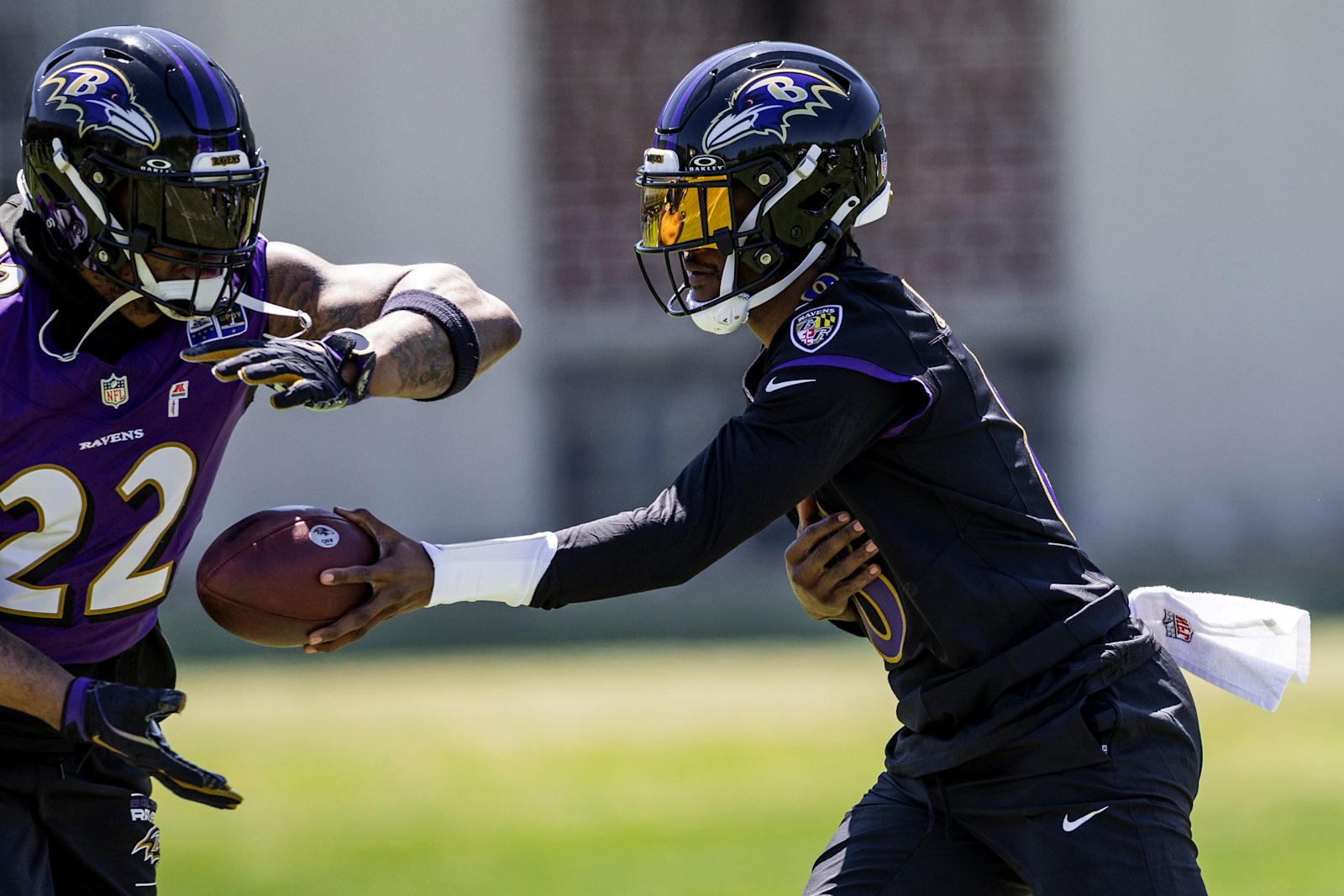
Season previews can easily become cliched, with vague predictions and recycled narratives (we’ll do some of that too).
Predict that Lamar Jackson will be good. Derrick Henry will run for a lot of yards. Kyle Hamilton will make the Pro Bowl. The Ravens will contend for the AFC North. Then come back in January and declare victory because nothing was specific enough to actually be wrong.
That is no fun.
The 2026 Ravens are particularly difficult to forecast because so much of the roster is familiar while so much of the structure around it has changed. Lamar, Henry, Zay Flowers, Mark Andrews, Hamilton and Roquan Smith still give the Ravens the core of a championship contender. Jesse Minter and Declan Doyle are installing new systems. The entire interior offensive line has been replaced. John Harbaugh is gone after 18 seasons.
The broad prediction is easy enough. The Ravens should be good.
Here are five considerably more specific predictions about how they get there.
1. The Ravens will be at least 5-1 after six games
This is the quickest and easiest prediction to evaluate. And the one that may generate early season exuberance.
The Ravens open at Indianapolis, then play New Orleans at home, Dallas in Rio de Janeiro, Tennessee at home, Atlanta on the road and Cleveland on the road. Cincinnati and Buffalo do not arrive until Weeks 7 and 8. Sharp Football Analysis’ Vegas-based strength-of-schedule calculation rates the Ravens’ full schedule as the fifth-easiest in the NFL.
There are complications within that opening stretch. An international game against Dallas is not the same as a normal road game. Atlanta is a Sunday night road game. Division games in Cleveland have occasionally caused the Ravens to forget everything they know about offense.
Still, when you look at the six opponents collectively, there is room for this team to start strong while growing into the season. The Ravens should be able to thrive in this opening stretch even if Doyle’s offense has not found its final form or the defense hasn’t fully grasped every detail of Minter’s disguises and coverage schemes. There should even be some time for the rebuilt offensive line to gel.
The Ravens just need the new systems to be functional while their superior personnel handles most of the rest in the early stretch.
That is an unusually favorable arrangement for a team undergoing this much coaching and schematic change. The Ravens can spend September discovering which parts of Doyle’s enormous offensive menu actually belong in the regular-season offense without simultaneously navigating Buffalo, Kansas City and Cincinnati.
There is a counterargument. New systems usually create exactly the type of early-season mistakes that allow inferior opponents to hang around. Late huddle breaks, protection busts, coverage communication problems, penalties and turnovers can erase a substantial talent advantage quickly. But on a team with considerable veteran leadership, I have confidence they can limit those issues enough for a fast start.
And if that happens, the conversation around this team will quickly focus on just how high the ceiling is. A Ravens team that missed the playoffs at 8-9 last season could enter the Cincinnati-Buffalo stretch at 5-1 or 6-0 looking once again like one of the top Super Bowl contenders.
The biggest early season challenge may be managing expectations and remembering that taking advantage of a favorable opening schedule does not prove the new Ravens have solved the problems that will matter in January.
2. Kyle Hamilton will record at least four sacks and four takeaways
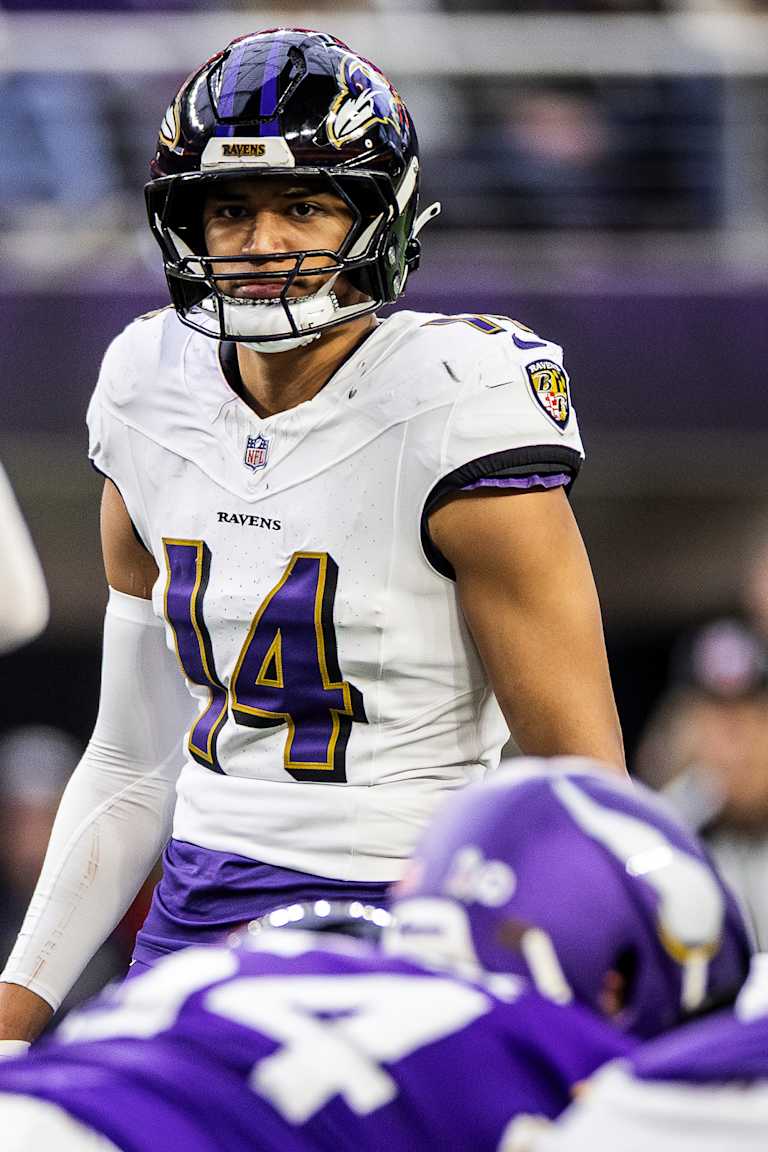
Minter has already provided the best description of how I expect him to use Hamilton.
“Kyle is a weapon.”
Not a free safety. Not a nickel. Not a linebacker.
A weapon.
That distinction should become obvious once the games begin.
Hamilton has spent much of his Ravens career filling whatever hole the defense needed filled. He has covered tight ends, played the slot, aligned deep, fitted the run and attacked the line of scrimmage. Minter should take that versatility a step further by making Hamilton one of the central problems the offense must identify before every snap.
The most obvious comparison is Derwin James. During Minter’s first season as Chargers defensive coordinator, James produced a career-high 5.5 sacks while playing 361 snaps in the slot, 281 in the box and 234 at free safety. Last season Minter again moved him across the formation and second level rather than treating “safety” as a fixed location on the field.
Hamilton is built for the same treatment. He can show pressure off the edge and drop underneath a route. He can walk into an interior gap and force the center to account for him. He can match a tight end in man coverage, rob an intermediate route or rotate deep after initially presenting himself near the line of scrimmage.
Put Hamilton over the B-gap with Trey Hendrickson outside and the protection has a decision to make. Slide toward Hendrickson and Hamilton may have a path inside. Account for Hamilton and Minter can drop him while creating a favorable rush somewhere else. Lamar has spent years forcing defenses to play 11-on-11 football. Hamilton gives Minter a defender capable of creating a similar problem on the opposite side of the ball.
That formula should produce splash plays. Four sacks is aggressive for a safety, but Minter has already demonstrated his willingness to turn a defensive back into a real part of the pressure package. Four takeaways may be even more interesting because I do not expect Hamilton simply to sit deep hunting interceptions. Some should come from playing downhill, attacking the football and appearing in places quarterbacks did not expect him to be when they diagnosed the coverage before the snap.
The prediction could fail because Minter needs Hamilton elsewhere. Unfortunately, Hamilton has been forced into a deep safety role for long stretches in past seasons. However, the addition of Jaylinn Hawkins and emergence of Malaki Starks should reduce that possibility this season. That should provide Minter all the flexibility he needs to use Hamilton as he sees fit.
The best version of this defense makes opponents find No. 14 before every snap and then occasionally discovers that finding him did not actually tell them what he was about to do.
Four sacks. Four takeaways.
And considerably more disruption than either number captures.
3. Nate Wiggins will be the only Ravens cornerback to play more than 75% of snaps
For years, NFL depth charts have encouraged us to think about secondary personnel too neatly.
CB1. CB2. Nickel.
Minter is unlikely to be so rigid in his conception of this unit. While Nate Wiggins will likely lock down one outside corner position whenever healthy, everyone else could be rotated more frequently and used more dynamically.
Marlon Humphrey can play inside or outside and remains valuable around the line of scrimmage. Chidobe Awuzie offers veteran outside experience. T.J. Tampa gives the Ravens length and a different matchup profile. Keyon Martin can factor into nickel packages. Minter has enough options to choose cornerbacks according to the problem presented by the opponent instead of deciding in September that three players own permanent jobs.
That would follow his recent history. Minter heavily rotated corners in his time with the Chargers. Across Minter’s two seasons as Chargers defensive coordinator, no cornerback played even 76% of the team’s defensive snaps. In 2024, Tarheeb Still led Chargers corners at 71.6%, followed by Kristian Fulton at 69.5%, Elijah Molden at 69.5% and Cam Hart at 41.9%. In 2025, Still again led the position at 75.9%, while Hart played 62.9%, Donte Jackson 58.9% and Benjamin St-Juste 35.0%.
Minter has compared building a cornerback room to constructing a basketball team, with different players available for different matchups. Baltimore has enough stylistically different options to apply the same idea.
Against a bigger outside receiver, TJ Tampa’s length may be useful. Against an offense built around slots and option routes, Humphrey’s ability to play inside may matter more. Certain pressure packages may require a specific corner to survive without safety help. Other downs may prioritize tackling or pattern recognition.
Minter can change the question and then change the personnel answering it.
There are costs. Secondary communication is not trivial, particularly when Minter also wants to disguise coverages and rotate safeties late. Constantly changing combinations sounds clever until two defensive backs interpret a switch differently and an opposing receiver is celebrating 50 yards away.
The rotation therefore has to earn its complexity. But Minter’s job is not to identify the three best cornerbacks and play them until December. It is to construct the best five- or six-man coverage group for the situation in front of him.
Wiggins should be the constant.
Almost everything around him can change.
4. Lamar Jackson will post the highest play-action rate of his career
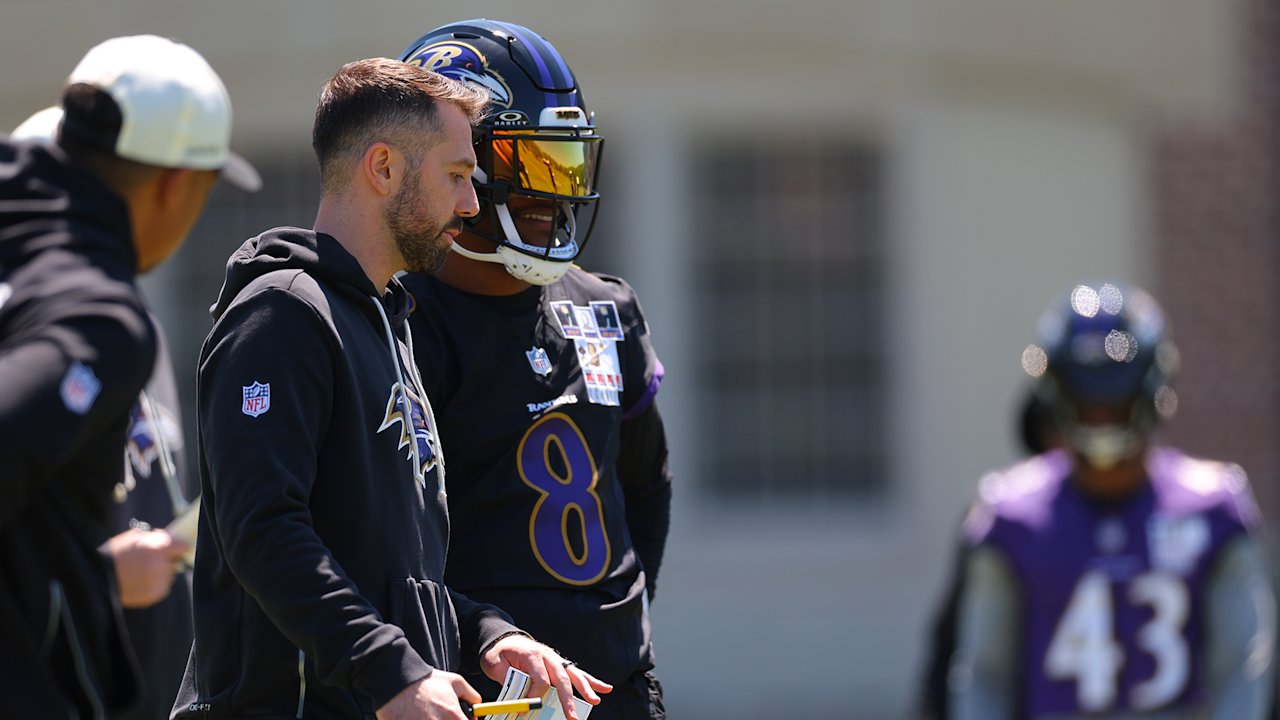
If there is one offensive tendency I expect to become synonymous with Doyle’s first season, this is it. Not because the Ravens need to “establish the run.” Derrick Henry’s existence already accomplishes the more useful part of that cliché. Defenses have to respect him whether he has carried the ball six times or sixteen.
The opportunity is using that respect against them. Doyle’s Bears used play action on 33.1% of their pass plays last season, the second-highest rate in the NFL. Jackson, meanwhile, was dramatically better when the Ravens attached their passing game to a run fake. PFF gave him an 87.9 passing grade on play-action dropbacks, third in the NFL. His grade without play action fell to 58.2, 37th among qualifiers.
While protection issues and injuries factored into that difference, Doyle would be foolish not to explore the split. The Ravens have spent the offseason installing more under-center football, motion, shifts and heavier formations. Those elements should work together.
Put Henry seven yards behind Lamar and linebackers have to respect the downhill run. Bring Andrews across the formation and a defender may have to adjust his run responsibility. Motion Flowers before the snap and the defense has another piece of information to process. Then fake the handoff, move Lamar’s launch point and attack the space behind linebackers who took one false step toward Henry.
That is where Doyle can make the run game and passing game serve each other rather than existing as two good but separate ideas. The defining principle should be to make linebackers step forward, then throw into the space they just vacated.
There is the obvious protection concern. Under-center play action can require Lamar to turn his back to the defense and can give longer-developing routes time to unfold. That becomes dangerous if the rebuilt interior line immediately allows penetration. A beautiful fake accomplishes very little if Lamar finishes it by turning around and discovering a defensive tackle waiting for him.
Doyle will have to balance any deeper concepts with quicker play-action answers and movement passes that change the launch point, but the philosophical fit is too obvious to ignore. Henry creates fear near the line of scrimmage. Lamar creates fear everywhere else.
Doyle should spend the season making defenses choose which one scares them first.
5. The Ravens will protect Lamar substantially better despite becoming worse at center
This one sounds contradictory on the surface.
The Ravens lost Tyler Linderbaum, one of the best run-blocking centers in football and a strong performer by ESPN’s Pass Block Win Rate. He won 97% of his pass-blocking reps by ESPN’s measure last season, fourth among all qualifying interior offensive linemen. PFF graded him above 83 as a run blocker, fourth among centers.
Neither Ethan Pocic nor Jovaughn Gwyn are Tyler Linderbaum. So yes, I expect the Ravens to get materially worse at center. However, I expect the offensive line as a whole to protect Lamar better than last season. Partly that is due to the bar being fairly low to begin with.
Here are the specific predictions:
The Ravens allow 132 or fewer total pressures, roughly a 15% reduction from last season’s 155.
Lamar’s pressure rate falls below 32%, after reaching 37.1% last season.
His sack rate falls below 7%, after reaching 9.8%.
The Ravens again finish in the top 10 of ESPN’s Pass Block Win Rate, at roughly 69% or better.
Henry still averages at least 2.7 yards before contact per carry, essentially preserving the blocking space Baltimore created for him last season.
So how do they do this without their Pro Bowl center?
Start with the guards.
The problem last season was everyone surrounding Linderbaum. Andrew Vorhees allowed 28 pressures and earned a 53.0 PFF pass-blocking grade, 66th among guards. Daniel Faalele allowed another 30 pressures with a 59.9 pass-blocking grade. That is 58 pressures from the two guard spots.
Replacing Linderbaum with Pocic or Gwyn is a downgrade, but replacing those guard performances with John Simpson and Vega Ioane should hopefully balance that out.
Ioane is the player who makes the prediction possible. He allowed four pressures and no sacks across 311 college pass-blocking snaps last season and earned an 87.0 PFF pass-blocking grade.
The NFL will obviously provide a different level of test. Defensive coordinators will attack a rookie guard with movement, simulated pressures and late changes designed to test how quickly he can communicate with a new center and right tackle. There will be losses, but he doesn’t need to be an instant All-Pro to be an upgrade over last season.
Simpson carries a similarly modest assignment. He does not have to transform the line. If he can provide stable veteran play and avoid the repeated immediate losses that disrupted Baltimore’s pocket last year, the Ravens can improve at two positions while declining at one.
Lamar faced pressure on 37.1% of his dropbacks last season, the second-highest rate in the NFL, and was sacked on 9.8% of his dropbacks. The year before, when the protection was dramatically better, the sack rate was just 4.3%.
Now, not every sack was the fault of the offensive line. Lamar sometimes held the ball trying to create the second act that Doyle talks about. At times he retreated from pressure rather than climbing into available space. Injuries reduced the escape ability that often turns pressure into magical plays. Receivers failed to uncover quickly enough. Protection answers were not always available when defenses presented pressure.
That is where Doyle can improve the numbers by giving Lamar a defined answer against pressure, using motion to identify coverage before the snap, and moving the launch point. The shift in offensive philosophy can itself reduce the number of snaps with bad outcomes.
So, the center will likely be worse, but the line as a whole does not have to be.
If the Ravens reach all five benchmarks above, the offensive-line rebuild will have accomplished something more meaningful than replacing Linderbaum individually. It will have produced a better functioning five-man unit around Lamar and Henry.