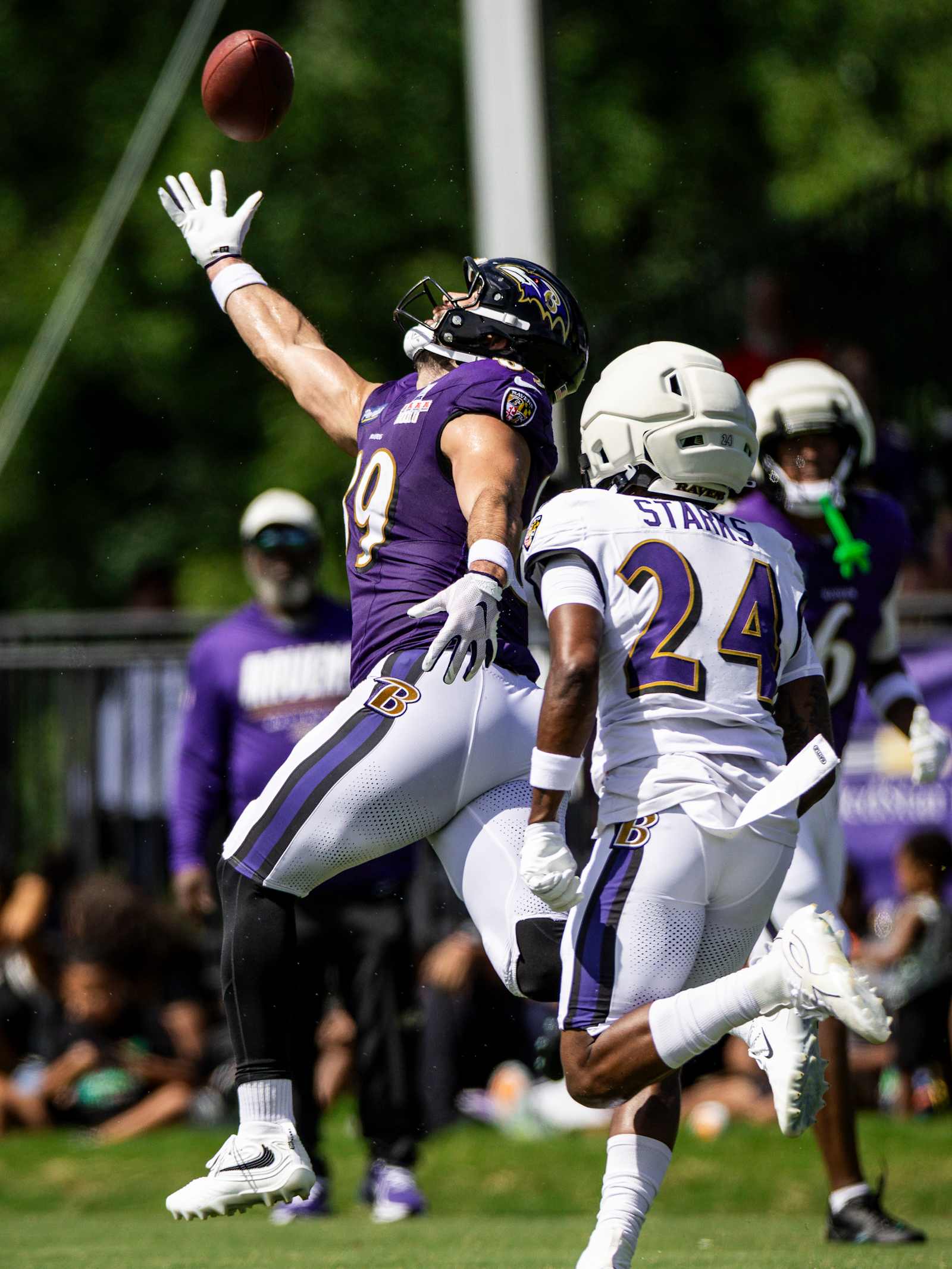
There is no real question whether the 2026 Ravens have the top-end talent to be a contender.
Lamar Jackson is still one of the best quarterbacks in football. Derrick Henry remains an unusual problem for defenses even at this stage of his career. Zay Flowers has developed into a legitimate go-to receiver. Kyle Hamilton and Roquan Smith give Jesse Minter elite players in the middle of his defense, while Trey Hendrickson finally provides the proven edge rusher the Ravens have been missing for years.
IF those players stay healthy, the Ravens star talent can match just about any team in the league.
After an 8-9 season, a missed playoff berth and the first head-coaching change in 18 years, the question is whether the rest of this roster is built to survive January rather than merely return to it. The difference will not come from Lamar finding a new ceiling or Hamilton suddenly discovering another level. It will come from the positions where the Ravens have less certainty and much less margin for failure.
Can Nnamdi Madubuike again collapse the pocket from the inside? Can Vega Ioane make an entirely rebuilt interior offensive line functional immediately? Can Malaki Starks become a weapon in the new Minter defense? Can Mark Andrews carry a tight end room without another proven receiving threat? Can the Ravens find a kicker they trust from 50 yards when a playoff game demands it?
And can Declan Doyle turn an interesting offensive system into a well-called NFL offense?
Those are the swing points between a Ravens team talented enough to make the playoffs and one capable of winning the Lombardi.
- 01Nnamdi MadubuikeInterior disruption
- 02Vega IoaneImmediate stability
- 03Malaki StarksDefensive disguise
- 04Mark AndrewsFormation flexibility
- 05Tyler LoopScoring range
- 06Declan DoyleGame-day answers
Nnamdi Madubuike: Does the dominant version come back?
The Ravens are much better equipped to survive without Nnamdi Madubuike than they were a year ago, but a truly healthy Madubuike could raise the defense to an exciting level.
Trey Hendrickson is here, Mike Green enters his second season with considerably more help around him, Travis Jones has developed into a productive interior defender and Calais Campbell gives the front another useful veteran. Minter should not have to blitz recklessly just to create pressure.
That depth raises the floor.
A healthy Madubuike could change the ceiling.
Before the neck injury that ended his 2025 season after two games, Madubuike had accumulated 19.5 sacks across the previous two seasons. Even more important than the total is just how Madubuike accomplished it. Edge pressure can force a quarterback to climb the pocket. A defensive tackle winning immediately against a guard removes the place he wants to climb into.
Put a player like that between Hendrickson and Green and the Ravens no longer need to create every favorable pass-rush matchup through disguise. An offense can slide protection toward Hendrickson. It can chip an edge rusher with a tight end or running back. Doing that becomes much more difficult when Madubuike is also capable of beating a guard before the quarterback reaches the top of his drop.
Madubuike underwent surgery following a serious neck injury and spent most of the offseason working his way back. His recent progress has been encouraging enough that the Ravens kept him off injured reserve, preserving the possibility of an early-season return rather than automatically losing him for four games.
However, medical availability and football effectiveness are different questions. Madubuike still has to regain the explosion required to win quickly, the strength to hold up when teams run at him and the confidence to absorb repeated contact inside.
If Madubuike is close to his old self by December, Minter can rush four and still create protection problems with multiple legitimate winners. That allows him to save his simulated pressures and blitzes for situations where they create an advantage rather than using them because the front cannot get home otherwise.
If Madubuike returns but never regains that explosiveness, the Ravens can still have a good defensive front, but they are much less likely to have a dominant one.
Vega Ioane: How quickly can a rookie become boring?
There will probably be more exciting ways to describe Vega Ioane’s rookie season if he lives up to being the 14th overall pick.
For September, boring would be just fine.
The Ravens rebuilt the entire interior of their offensive line after losing Tyler Linderbaum. John Simpson returns at left guard, while Ethan Pocic and Jovaughn Gwyn are competing for center. Ioane has stepped straight into the starting right guard job and will make his regular-season debut without the benefit of an established interior combination around him.
The physical talent is there, hence why the Ravens drafted him that high, but NFL defenses will test a rookie guard with games up front, late movement and pressure looks designed to force communication between three players who have barely played together. Ioane has to recognize when to pass a rusher to the center, when to stay attached to a defensive tackle and when a linebacker showing pressure in one gap is actually trying to create a free runner somewhere else.
Getting one of those decisions wrong can ruin a play before Lamar has a chance to solve anything. While Jackson’s mobility and Doyle’s scheme can hide some offensive-line problems, they cannot make immediate interior pressure harmless.
When an edge rusher wins wide, Lamar can often step forward or escape underneath him. When a defensive tackle wins through the middle, Lamar is pushed backward into the edge pressure and the timing of the entire passing concept changes. That becomes particularly relevant if Doyle follows through on his increased use of under-center play action, where Lamar may turn his back to the defense before resetting to find his receivers.
A beautifully designed concept is of limited use if the quarterback finishes the fake with a defensive tackle arriving in his lap. That is why Ioane’s development affects more than his individual grade.
If Doyle repeatedly needs to keep a back in protection, shorten concepts or avoid certain play-action designs because the interior cannot hold up, the offensive line begins dictating what the Ravens cannot call.
However, if Ioane settles quickly, the opposite becomes possible. If he can avoid assignment busts, handle NFL power and gradually become a player Doyle does not have to protect, the offense can operate normally while the rest of the interior sorts itself out.
If he becomes a genuine plus guard by the second half of the season, a position that was a liability last season may be a strength by January.
That would be a major development for a team whose franchise quarterback spent too much of last season dealing with pressure and its lingering effects.
Malaki Starks: The disguise only works if everyone understands it
At a minimum Malaki Starks should allow the Ravens to move Kyle Hamilton around more. The hope is that this season he can take a step beyond that, to become a playmaker in his own right.
Hamilton already moved around the defense last season while Starks played 94 percent of the defensive snaps, mostly working as a deep safety. Starks survived a significant rookie workload, finished with 84 tackles and two interceptions and generally gave the Ravens the reliability they needed from a first-year player.
Minter wants a defense capable of presenting one picture before the snap and playing something different afterward. Hamilton is perfect for that because he can legitimately perform several jobs. Starks has enough range and coverage ability to do the same, while the addition of Jaylinn Hawkins gives Baltimore a third safety Minter should be comfortable putting on the field regularly.
That creates plenty of possibilities.
Hamilton can threaten pressure and bail into coverage. Starks can begin deep and rotate toward the line. Hawkins can take the middle of the field while either of the other two moves elsewhere. The Ravens can alter who is covering the slot, who is fitting the run and who is responsible for the deep portion of the field without changing personnel.
But disguise is not inherently good defense.
If one safety rotates late, a corner expects help that never arrives or a linebacker interprets the coverage differently from everyone behind him, all the pre-snap sophistication has done is make the Ravens harder for themselves to understand.
We saw examples of that problem over the past few years. Starks’ next step therefore is not just making more interceptions. It is demonstrating that Minter can give him more responsibilities without weakening the structure around him.
There is a reasonable argument that Hawkins reduces the urgency. Baltimore could ask Hawkins to handle more of the deep work and let Hamilton remain the movable piece while Starks develops at a normal pace.
The much more interesting version has three interchangeable players who can rotate after the snap without the quarterback receiving an obvious clue from personnel or alignment. Starks becoming a more complete and more aggressive defender is what gives Minter access to that version.
The Ravens already know Hamilton is a weapon.
Starks can help determine how creatively they are allowed to use him.
Mark Andrews: The Ravens have fewer alternatives at Tight End
Isaiah Likely and Charlie Kolar both departed during the offseason. Patrick Ricard is gone as well, removing another player who allowed the Ravens to build heavier formations without simply lining up in conventional three-receiver sets.
The response was to rebuild the position with different kinds of players. Durham Smythe is an accomplished blocker who already understands Doyle’s system from Chicago. Matt Hibner and Josh Cuevas were drafted to provide younger, more versatile options.
There are useful players there, but none is nearly as proven as Andrews or has anything approaching his rapport with Lamar.
One of the more interesting elements of Doyle’s offense is the ability to use personnel without announcing the play. The Chicago offense frequently used multiple tight ends but still threw from those formations. The entire point was to make the defense choose which problem it wanted to solve.
If a defense stays light, run at it. If it puts another linebacker on the field, spread the formation and make that linebacker cover. Andrews is what makes the second part credible.
He can begin attached to the line and block. He can flex into the slot. He can work the seams, settle into space behind linebackers or become Lamar’s immediate answer when the defense brings pressure. His alignment does not have to tell the defense what his job will be after the snap.
Smythe can perform some of the blocking responsibilities. The rookies may eventually provide more receiving value. However, neither is something the Ravens can assume in September.
Andrews is therefore carrying more responsibility than his target total will show. The Ravens need him to make their heavier personnel formations believable as both run and pass looks and they’ll often need him to be the main threat over the middle.
The concern is that Andrews is coming off easily his least productive season since his rookie year, with 48 catches for 422 yards and five touchdowns, after producing 55 catches for 673 yards and 11 touchdowns in 2024. His 8.8 yards per reception was also comfortably a career low.
Some of that occurred inside an offense dealing with Lamar’s injuries, protection problems and a generally disjointed year. It would be too simple to look at one diminished statistical season and declare that a 30-year-old tight end has fallen off a cliff. Andrews has been so reliable for so long that he can’t be written off that easily, and obviously the front office felt the same, allowing Isaiah Likely to leave in free agency.
The Ravens extended Andrews because they believe he has productive football left. This offense is now constructed in a way that requires them to be right. If Andrews remains a dependable middle-of-the-field target, Doyle can move him around and force defenses to account for both the formation and the player.
If his separation or availability declines significantly, there is no proven receiving tight end waiting behind him.
That would not merely mean fewer catches from one position. It could make the entire personnel package easier to diagnose and drag the entire passing game down.
Tyler Loop, or his replacement: The Ravens need to trust their kicker from over 50 yards
Tyler Loop should not be judged forever by one missed kick in Pittsburgh.
However, the larger body of evidence last season was concerning.
Loop made 30 of 34 field goals as a rookie, an 88.2 percent success rate that looks perfectly acceptable until the distribution is examined. He was 1-for-4 from 50 yards and beyond. Then, with the division title and a playoff berth available on the final play of the season, he missed from 44.
The miss was devastating, but the larger concern is that it was not the only evidence that the Ravens had a range problem at kicker.
The preseason has only cast more doubt. Loop made five of eight field goals and missed from 49, 51 and 58 yards. The Ravens subsequently signed Jake Moody to the practice squad, although Minter has continued to identify Loop as the expected Week 1 kicker.
Bringing in Moody was a signal.
The Ravens do not need to stage a theatrical kicking competition to demonstrate how seriously they take the issue. They need an actual alternative if Loop continues to show that 50 yards is near the edge of his trustworthy range.
Imagine the Ravens facing fourth-and-4 from the opponent’s 34-yard line in a playoff game. A team with a reliable long-range kicker has two legitimate ways to leave the possession with points. A team that does not trust its kicker from 52 is effectively making a fourth-down decision with one option already removed.
That affects late-half strategy, third-down play calling and how aggressively the offense has to chase extra yardage at the edge of scoring range.
The problem is having an entire scoring option unavailable before the decision is even made. One season doesn’t need to doom Loop, as kicker performance can fluctuate. His overall rookie percentage was good and treating one high-profile miss as evidence of a permanent psychological problem would be speculation.
But the Ravens can’t pretend it’s not a problem if the long range misses persist. If Loop continues to demonstrate he is limited as an NFL kicker they need to quickly pivot, whether that is Moody or someone else.
They cannot allow their investment in a sixth-round pick, or their desire to show confidence in a young player, to become more important than the position itself.
I do not particularly care who is kicking for the Ravens in January.
I care whether they trust him when the ball reaches the 35-yard line.
Declan Doyle: Can he call the plays?
Almost everything we have learned about Declan Doyle’s offense is encouraging. But implementing the structure of the offense is only part of the responsibilities of an offensive coordinator.
The biggest question still remains. Can Doyle call the game?
Ben Johnson handled that responsibility in Chicago. Doyle helped install and organize an offense that improved dramatically, but he was not the person deciding what came next on third-and-6 after the defense had just changed its pressure plan.
Doyle used the preseason to practice the job and decided he prefers calling games from the booth. The real test begins when another defensive coordinator is actively trying to make his first plan fail.
That is when offensive coordination becomes more than design.
If a defense starts bringing pressure through the interior, does Doyle have the answers ready?
If the opponent commits an extra defender to Henry, can he punish that choice without abandoning the run game entirely?
If a concept works twice, does he understand how to build another play off the defense’s expected response?
If the Ravens repeatedly reach third down without a coherent answer, waste timeouts because the operation is late, struggle to sequence plays in the red zone or watch an effective concept disappear for two quarters while the offense chases something cleverer, that will all fall on Doyle.
Todd Monken left behind a high standard. Doyle is not rescuing a talent-starved offense. He inherited Lamar, Henry, Flowers and Andrews. The Ravens were already capable of creating problems defenses hate solving.
His assignment is to take those pieces to the next level and make Lamar’s life easier. The process may take some time. We shouldn’t expect him to get everything right the first week or two on the job. Every first-time NFL play caller is going to have bad sequences. Doyle will occasionally wish he had a call back, just as experienced coordinators do.
The Ravens can live with that, but what they cannot afford is for his learning curve to become the defining weakness of a roster built to contend now.
They need him to have fully grown into the role by the time the weather starts to turn.
These are the margins that matter
None of these six has to carry the Ravens.
Lamar can play at an MVP level and the Ravens can still lose if the interior offensive line cannot protect him. Hamilton can be the best safety in football and still spend too much of his time solving structural problems around him. Hendrickson can beat tackles and watch quarterbacks escape through a clean pocket if Baltimore cannot create pressure inside.
Andrews can remain productive without being the player he was five years ago, but the Ravens cannot afford for the only proven receiving tight end on the roster to disappear. They do not need another prime Justin Tucker, but they need to trust their kicker from normal NFL field-goal range.
Doyle does not have to invent the next great offensive system, he has to call the one he installed well enough that the Ravens’ best players remain the reason they win rather than the people constantly rescuing it.
The Ravens have spent the offseason adding enough talent that there are few glaring holes on paper. The question now is whether the uncertain pieces can become functional strengths rather than weaknesses an elite opponent can isolate in January.
They probably do not need all six answers to be perfect, but they cannot afford many of them to be wrong.