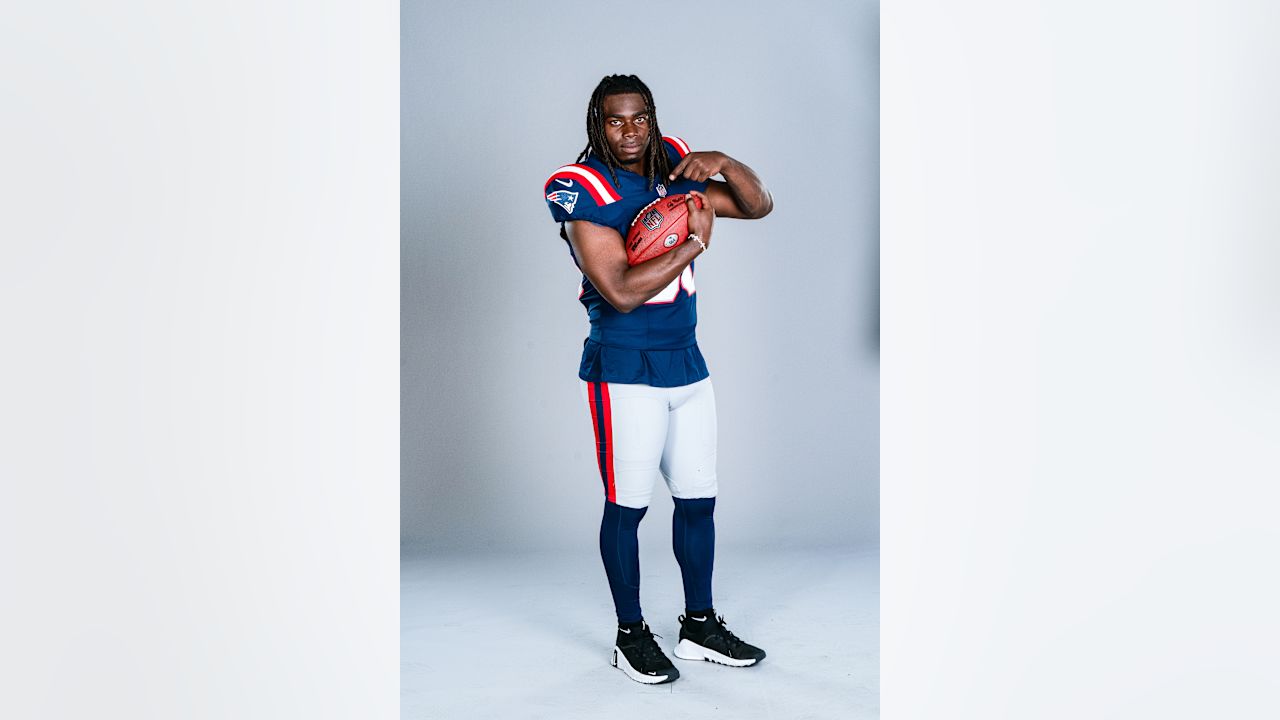
Odds and prices referenced in this article are as of 12:19 a.m. ET on Tuesday, September 8, 2026. NFL markets move quickly, so the number matters just as much as the team or player.
Week 1 card
Two bets. One hunch.
Prices as written · one unit on the bets, smaller on the lean-
Best bet 01
Rhamondre Stevenson under 58.5 rushing yards
Patriots at Seahawks-115 DraftKingsPlay it to 56.5
-
Best bet 02
Dallas Cowboys -2.5
Cowboys at Giants-115 FanDuelPay to about -120 for the 2.5
-
Lean 03
Cardinals-Chargers over 47.5
Cardinals at Chargers+100 theScore BetSmaller stake · pass at 48
Week 1 is the easiest time of the NFL season to convince yourself you know something the market does not.
Every new coordinator is about to revolutionize an offense. Every offseason acquisition fixed a bad defense. Every preseason drive confirmed whatever you already believed in May.
Most of that is noise. And chasing too many hunches on week one is a dangerous proposition.
The better Week 1 bets are usually the ones where there is a specific reason the available price looks wrong. That can mean finding a player prop that has drifted several yards away from the broader market, preserving a valuable half-point on a spread, or occasionally taking a chance that a coaching change has made last season’s numbers less useful than everyone thinks.
That gives me two actual bets and one lean to start the season.
The strongest is Rhamondre Stevenson Under 59.5 rushing yards against Seattle. Dallas -2.5 is more about buying the right number than making some grand declaration about the Cowboys. And Chargers-Cardinals Over 47.5 is the fun one, a Week 1 hunch that Mike McDaniel can change the way Justin Herbert and the Chargers offense function immediately.
Best Bet: Rhamondre Stevenson Under 58.5 rushing yards (-115, DraftKings)
The case for betting Stevenson Under 59.5 begins with the market rather than the matchup.
The broader rushing-yard market has Stevenson mostly in the mid-50s, while Pinnacle’s number is only 53.5. DraftKings hanging 59.5 gives us roughly six yards of breathing room over that sharper baseline.
For a running back prop, that is not trivial.
The reason Stevenson’s number has climbed is obvious. TreVeyon Henderson has been dealing with an ankle injury and has not practiced since August 24. He was officially a non-participant on both Sunday and Monday, making his availability for Wednesday night increasingly doubtful. Stevenson opened around 46.5 before the injury situation pushed his workload projection upward.
The question is whether 58.5 has gone too far.
I think it has.
Seattle was one of the NFL’s best defenses last season and particularly strong against the run, finishing second in defensive EPA per play overall and allowing just 1,563 rushing yards. We also saw this matchup seven months ago in the Super Bowl, when Stevenson managed 23 yards on seven carries. That result means little by itself, but the useful part is how Seattle defended New England.
The Seahawks were capable of controlling conventional rushing attempts without committing so many resources that Drake Maye suddenly received easy answers through the air. New England eventually had to find other ways to move the football.
Stevenson was not particularly efficient last season either. His 4.64 yards per carry looks perfectly healthy, but his -0.17 EPA per rush and 37.7 percent success rate tell a less flattering story. The Patriots were an excellent offense because Maye was exceptional through the air, not because their conventional run game consistently kept them ahead of schedule.
Henderson potentially sitting is the obvious counterargument.
If Stevenson gets 17 or 18 carries, he can clear 60 yards without playing especially well. A 3.6-yard average on 17 carries gets there. New England has also had an entire offseason to figure out what went wrong against Seattle in February.
If this were Stevenson Under 54.5 or 55.5, I would probably leave it alone. At 58.5, we are getting enough cushion to absorb some additional volume before the matchup and Stevenson’s underlying rushing efficiency become the deciding factors.
The bet: Rhamondre Stevenson Under 58.5 rushing yards at -115.
Once this falls to 56.5, most of the advantage disappears.
That distinction is the entire bet.
Bet: Dallas Cowboys -2.5 (-115, FanDuel)
FanDuel still has this one at -2.5, while DraftKings and other parts of the market have spent time at Cowboys -3.
That half-point is the wager.
Three is still the most important key number in NFL point-spread betting. There is a meaningful difference between needing Dallas to win by three and laying three with the possibility of a push. I would much rather pay modest extra juice to stay below it.
There is also a reasonable football case that Dallas should be better than last season’s 7-9-1 record suggests. The Cowboys offense was already good. They finished fifth in EPA per play in 2025 and generated +0.12 EPA per pass. Their passing game from 11 personnel was particularly effective.
The Giants defense presents some resistance through its pass rush, but New York was awful against the run last season, allowing 2,470 rushing yards and +0.11 EPA per rushing attempt. Dallas does not need Dak Prescott to spend four quarters surviving obvious passing situations against the Giants front. It should have multiple ways to remain efficient.
The Dallas defense is less certain. It was dreadful last season, finishing dead last in defensive EPA per play and allowing +0.20 EPA per pass. If that defense still looks remotely like the 2025 version, laying points with Dallas becomes uncomfortable very quickly.
However, there is reason to believe this season could be better. Christian Parker has taken over as defensive coordinator, and the Cowboys changed a large portion of the personnel around him. Rashan Gary, Von Miller, Jalen Thompson and Cobie Durant were among the veteran additions, with Caleb Downs joining through the draft. Quinnen Williams described the defensive changes this offseason as dramatic, while acknowledging that none of it matters until Dallas proves it in games.
If Parker can drag the unit from historically bad toward merely competent, the Cowboys have a much more balanced team around an offense that was already capable of scoring efficiently.
There are reasons for restraint, as Tyler Smith is expected to miss the opener following thumb surgery, leaving T.J. Bass with a difficult assignment against the strength of the Giants roster. New York also has its own reason for throwing out portions of the 2025 data with John Harbaugh taking over and Jaxson Dart entering the season at quarterback.
This is not a spot where I want Dallas -3 at expensive juice and then spend Sunday night yelling because they won 27-24.
At -2.5, the calculation changes.
The bet: Dallas Cowboys -2.5 at -115 on FanDuel.
I would pay up to roughly -120 to keep the 2.5. If the only available number becomes Dallas -3 at -115, I am out.
Buy the number, not the Cowboys.
Lean: Cardinals-Chargers Over 47.5 (+100 theScore Bet)
This is the one I am allowing myself to have some fun with.
The market case for Chargers-Cardinals Over 47.5 is nowhere near as strong as the Stevenson prop. In fact, the market has already moved toward the Over. The game opened closer to 45.5 and now sits around 47 to 47.5. FanDuel’s public board was offering Over 47.5 at -102 early Tuesday morning.
So getting +100 is a decent price, but there is no obvious stale-number advantage.
This is a football hunch.
More specifically, it is a Mike McDaniel and Jesse Minter hunch.
The Chargers finished only 24th in offensive EPA per play last season despite having Justin Herbert at quarterback. Herbert averaged 2.9 seconds to throw, 32nd among NFL quarterbacks, as injuries and protection problems repeatedly forced him to extend plays.
McDaniel has spent this offseason trying to change the process.
He has emphasized getting the ball out around 2.4 seconds, changing Herbert’s footwork and asking him to throw with greater anticipation rather than waiting until receivers visually uncover. Herbert himself has described throwing before receivers turn their heads as one of the biggest differences in the new offense.
The Chargers’ 2025 offensive efficiency is factual. It is also potentially the wrong baseline for projecting what this offense will be now. A quicker Herbert does more than reduce sacks. It lets McDaniel build yards after catch into the passing game, punish pressure before it arrives and put the quarterback’s ridiculous arm talent to use without requiring every explosive play to develop for three seconds.
Arizona is a good opponent for the experiment. The Cardinals finished 28th in defensive EPA per play last season and allowed +0.13 EPA per pass, so I think the Chargers can score this weekend.
On the other side of the ball the Chargers lost defensive whiz Jesse Minter, who left for the Ravens head coach position. While Chris O’Leary looks to continue the system that Minter put in place, there could be some growing pains with a new, inexperienced coordinator.
Arizona may not be a powerhouse offense, but Jacoby Brissett is a competent quarterback, who can take advantage if the Chargers defense is still adapting to new leadership.
The market seems to agree, as the original spread and total implied something around a 28.5-17 Chargers game. As the total climbed while the spread shortened, most of the additional scoring expectation went onto Arizona rather than Los Angeles.
Still, there are real concerns.
Jacoby Brissett missed voluntary offseason work while dealing with his contract before eventually returning to learn Mike LaFleur’s new offense. The Chargers also had a genuinely strong defense last season.
This could easily become a game where Los Angeles scores 27 or 30 and Arizona stubbornly refuses to provide the second half of the bargain.
That is why this remains a lean rather than joining the other two bets.
But Week 1 is one of the rare times I am willing to take a modest position on a coaching thesis before the statistical evidence exists.
McDaniel just needs Herbert to get quicker answers against an Arizona defense that struggled badly against the pass last year.
I want to see what that looks like.
The lean: Cardinals-Chargers Over 47.5 at +100.
At +100, I would keep the stake smaller than the two bets above. If the market gives us +105 or +110 at 47.5, I become considerably more interested. If the total moves to 48 or the price becomes expensive, the whole point of getting ahead of the offense starts disappearing.