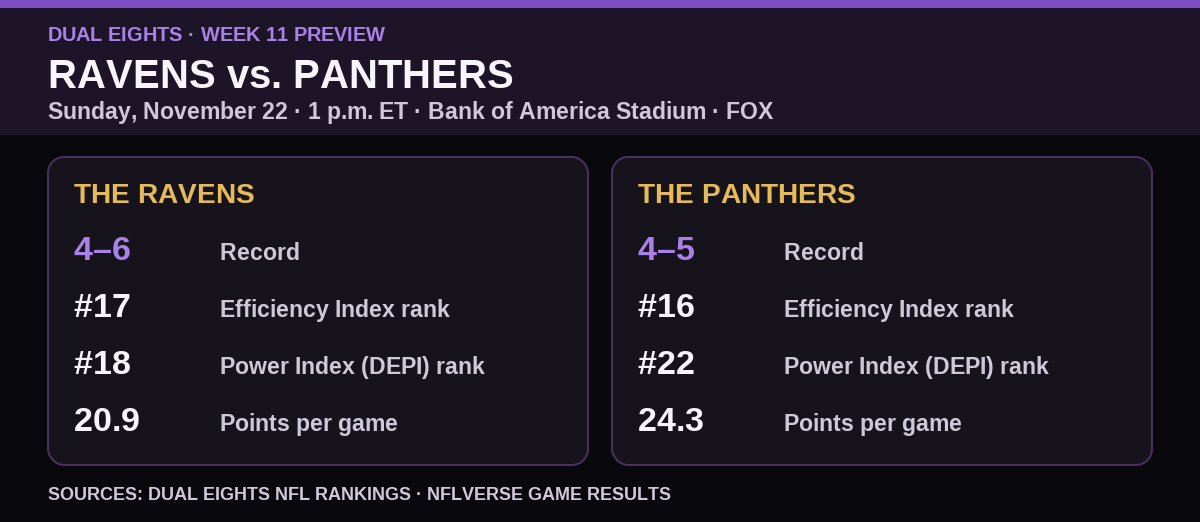
Sunday, November 22, 2026 | 1:00 p.m. ET | Bank of America Stadium | FOX
Get ready for the game with the Ravens Season Dashboard.
The Ravens have seven games left to play, and barring something beyond a miracle, they won’t be playing any more after that.
After five consecutive losses, they sit at 4-6 with a difficult closing schedule that includes Houston, Tampa Bay and four AFC North games. Winning six of those seven games would give the Ravens a reasonable chance of sneaking into the postseason.
Does anyone really believe this team is capable of doing that?
I certainly don’t.
But that doesn’t mean the remaining games are completely meaningless.
The Ravens entered this season with championship expectations, a new coaching staff and a roster they believed was talented enough to compete with anybody. Ten games later, the franchise quarterback is injured, the offensive line is falling apart, the defense is underperforming and the organization faces some difficult decisions about its veteran core.
Those problems aren’t going to disappear over the next seven weeks. But the Ravens can begin figuring out which ones are fixable, which players belong in their plans for 2027 and whether Jesse Minter and his staff are capable of building something better.
Sunday’s trip to Carolina offers an interesting opportunity to begin that process.
The Panthers are 4-5, yet somehow lead the NFC South. They’re playing for a division title, while the Ravens are looking for their first victory since October 11.
Carolina isn’t a particularly good team, though it has shown improvement in several areas recently. Its defense still has weaknesses the Ravens may be able to exploit, and its offense presents some useful tests for a Ravens defense that has struggled with consistency.
This might also be the Ravens’ best remaining opportunity to win another game.
A victory wouldn’t rescue the season. But how they perform could tell us quite a bit about what comes next.
Here are the five things I’ll be watching Sunday.
1. Can the Ravens fix the running game, or is the offensive line beyond repair?
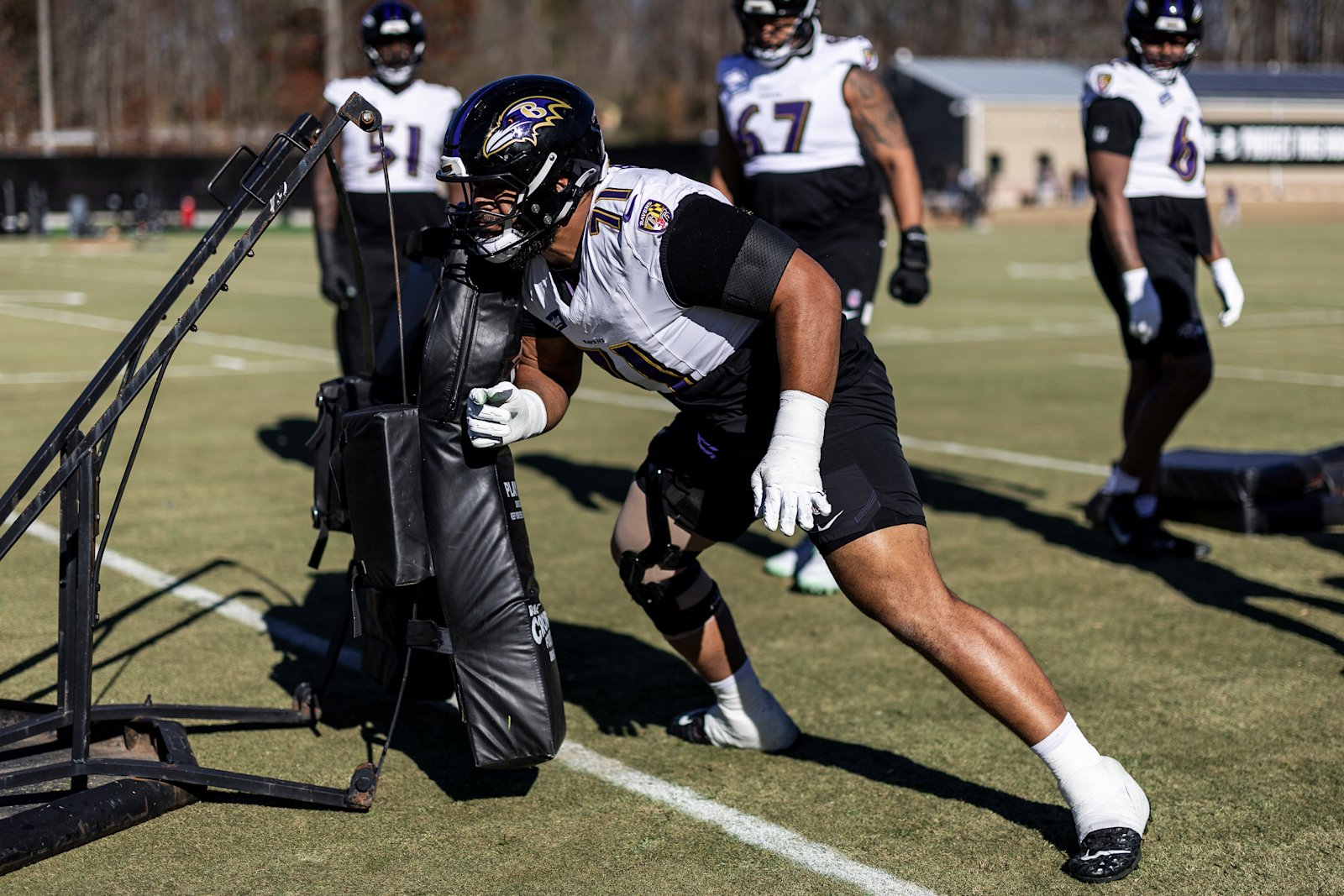
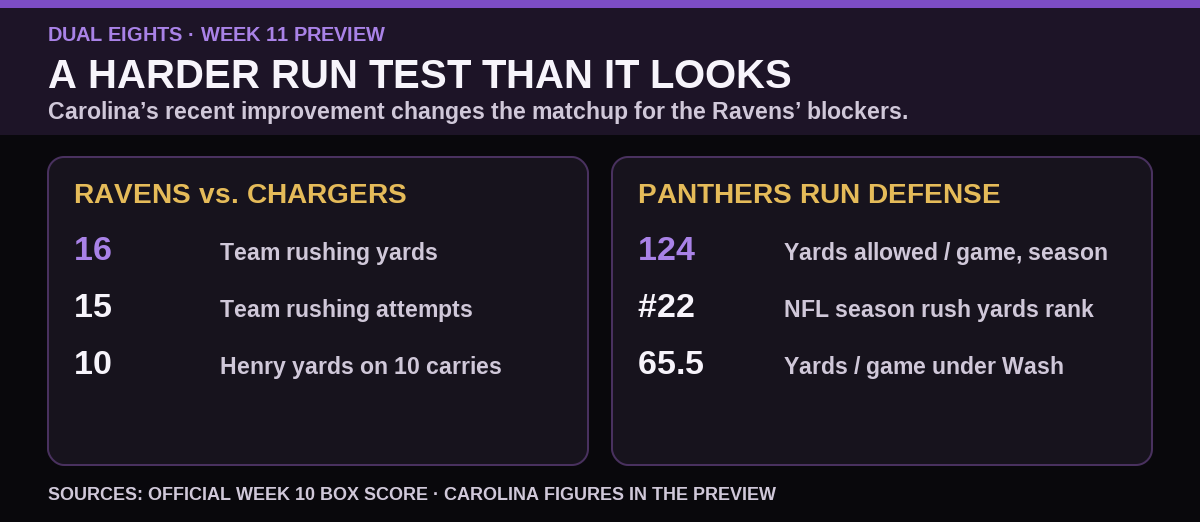
At some point, the Ravens need to find some consistency from the offensive line. The loss to the Chargers was the latest example of a problem that has gradually consumed the offense. Baltimore’s blockers couldn’t consistently create running lanes, handle penetration or execute the assignments necessary to give Derrick Henry a reasonable chance.
The Ravens have invested significant resources in rebuilding their interior offensive line. Cam Jurgens arrived in October to stabilize the center position, while first-round pick Vega Ioane has demonstrated considerable promise when healthy. Yet the group has continued to struggle with fundamental blocking assignments.
Carolina allows 124 rushing yards per game, ranking 22nd in the league. At first glance, that sounds like exactly the kind of defense the Ravens need.
Unfortunately, the Panthers have improved considerably over the past two weeks.
After firing defensive coordinator Ejiro Evero, Carolina promoted Todd Wash, who immediately made stopping the run a priority. His approach involves bringing additional defenders near the line of scrimmage and challenging offenses to beat a more physical front.
The early results have been impressive, as Carolina has allowed just 131 combined rushing yards in its two games under Wash, an average of 65.5 per contest. The Panthers have also improved their tackling and become considerably more disciplined about maintaining their run fits.
The most important individual matchup will be Derrick Brown against Jurgens and the Ravens’ guards. Brown is capable of controlling blockers at the point of attack, penetrating into the backfield and disrupting runs before they develop. With linebacker Devin Lloyd and safety Tre’von Moehrig attacking behind him, the Panthers have the personnel to make life miserable for an offensive line that has struggled against aggressive fronts.
Declan Doyle needs to help his blockers. That could mean more pulling guards and gap-blocking concepts, using misdirection to influence linebackers or moving the point of attack rather than repeatedly challenging Brown’s preferred gaps. Quick perimeter throws could also discourage Carolina from crowding the middle.
But eventually, the linemen have to win some assignments. Ioane’s return to full practice Thursday was encouraging, and his development remains one of the most important individual stories of the season. The Ravens selected him to become a cornerstone of their offensive line, and he has demonstrated enough ability to justify that expectation.
The rest of the interior remains much less convincing. These final games should help determine whether Jurgens can become the long-term answer at center, whether the guards can develop consistent chemistry and how much additional investment the offensive line will require.
The Ravens cannot spend another offseason assuming Lamar’s mobility will compensate for inadequate blocking.
They need to build an offensive line that can function without requiring their quarterback to be extraordinary.
2. Declan Doyle needs to prove he can adjust when the initial plan doesn’t work
One of the most encouraging parts of the Ravens’ early season was watching Declan Doyle discover creative ways to manufacture offense.
Against Atlanta, he used unusual backfield alignments, misdirection and an expanded role for Justice Hill to generate production without Lamar. The offensive design was thoughtful, and Doyle demonstrated that he understood how to create favorable matchups with the players available.
Unfortunately, those performances have become increasingly difficult to find. Injuries have obviously complicated his assignment. But there is a difference between recognizing personnel limitations and allowing them to define everything the offense can accomplish.
Too often recently, the Ravens have failed to develop effective answers when opponents disrupt the running game or take away their preferred passing concepts.
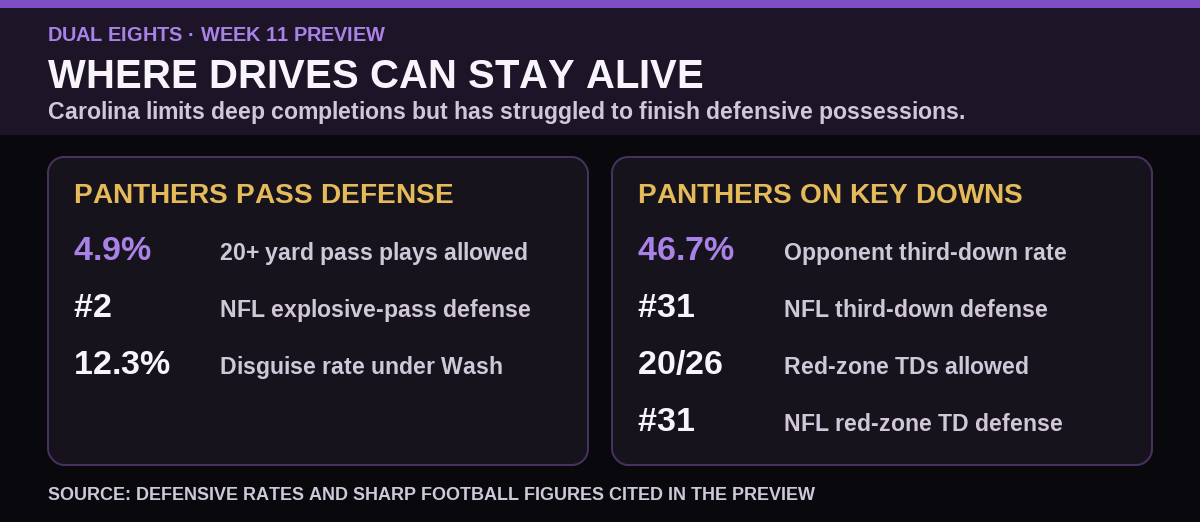
Carolina presents an unusual challenge because its defensive philosophy has changed so dramatically. Under Evero, the Panthers blitzed on nearly 40% of opposing dropbacks through eight weeks while using extensive coverage disguises. Under Wash, those blitz rates have fallen sharply, reaching just 11.6% in the most recent game.
The defense is generally presenting a simpler picture before the snap, relying more heavily on sound coverage and a conventional pass rush. According to Sharp Football Analysis, Carolina's coverage-disguise rate has fallen from 42.5% under Evero to 12.3% in its first two games under Wash.
That should theoretically help Jacoby Brissett.
The veteran quarterback demonstrated Monday that he can identify intermediate passing windows and deliver throws against coverage rather than requiring every receiver to be wide open. He also showed a useful connection with Mark Andrews, who finally looked much more comfortable catching the football after dealing with his hand injury.
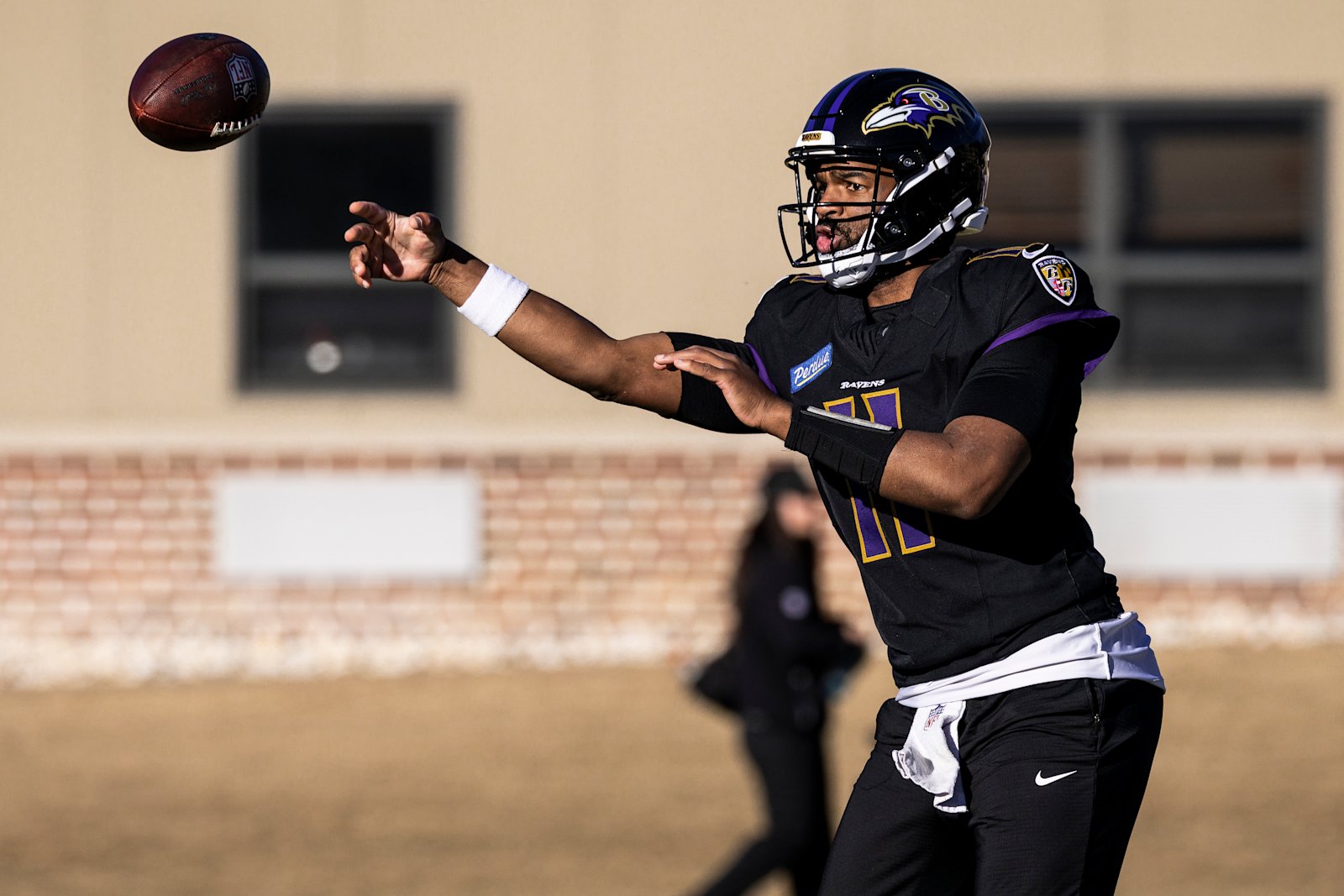
Doyle should build upon those strengths.
Carolina has been exceptionally effective at limiting explosive passes, allowing 20-yard gains on only 4.9% of opposing pass plays, the second-lowest rate in football. But the Panthers have been much less successful at preventing ordinary completions from turning into sustained drives.
They rank 31st in third-down defense, allowing opponents to convert 46.7% of their opportunities. They also rank 31st in red-zone touchdown defense, surrendering touchdowns on 20 of 26 trips.
That creates a reasonable opportunity for the Ravens to move the football methodically.
The Panthers will also be without linebacker Bobby Okereke, potentially weakening their ability to defend those intermediate areas.
The Ravens will need to account for Jaelan Phillips, who just earned NFC Defensive Player of the Week honors against New Orleans. Carolina’s season-long sack total is unimpressive, but Phillips gives the Panthers a legitimate individual threat against a Ravens offensive line that cannot afford another week of protection breakdowns.
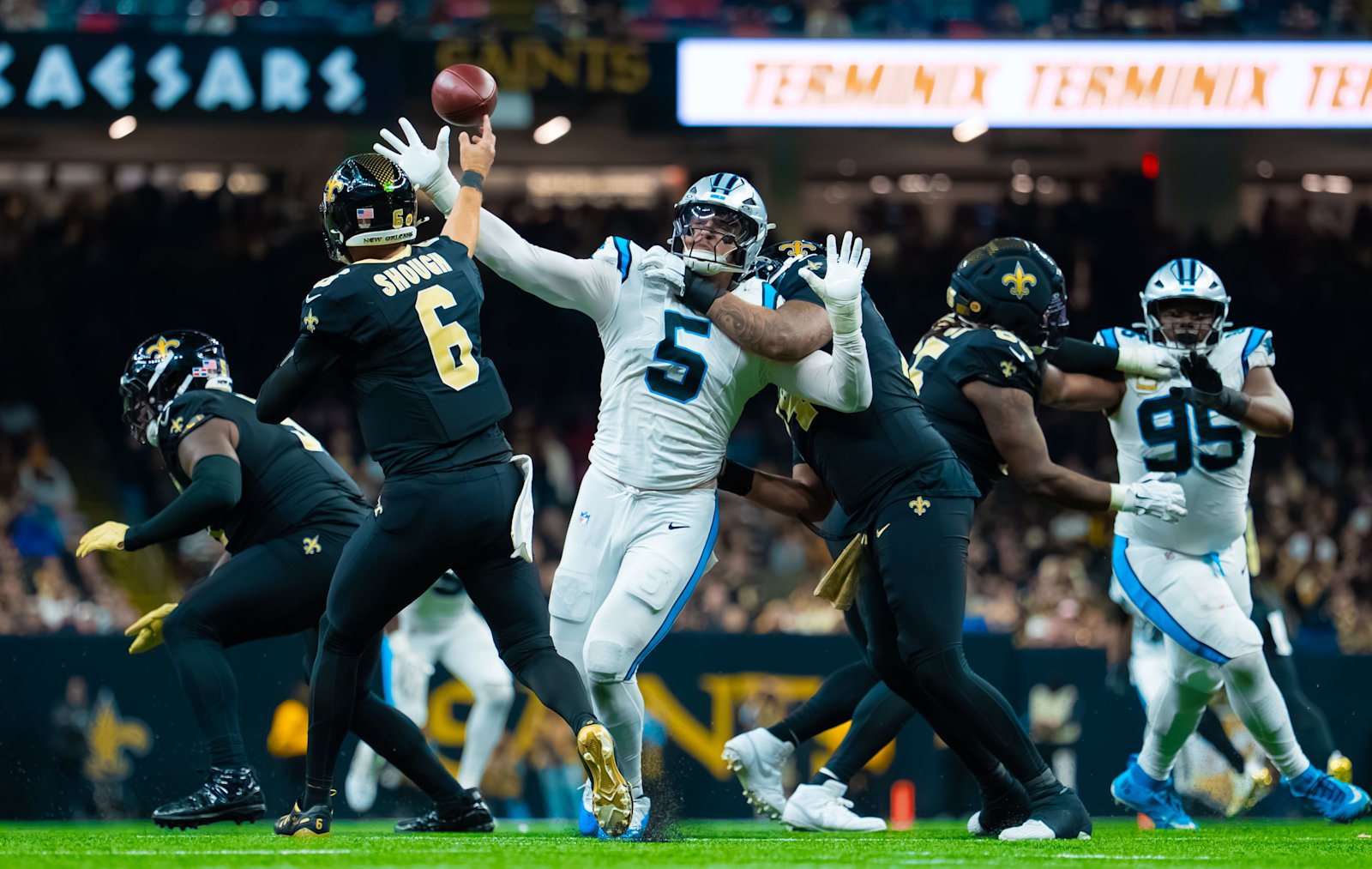
Doyle needs to balance protecting Brissett with giving him opportunities to attack. Doyle has shown creativity. Now he needs to demonstrate that he can consistently organize an offense, identify what’s working and adjust without requiring a spectacular play from Lamar Jackson to rescue everything.
Those are skills the Ravens will need long after this season is over.
3. What exactly is Jesse Minter going to fix?
Jesse Minter has received considerable patience during his first season as an NFL head coach.
Much of that patience is understandable. The injuries have been extraordinary, the quarterback situation has become a disaster and the offensive struggles have frequently placed additional pressure on the defense.
But Minter was hired because the Ravens believed he could turn an already talented defensive roster into one of the best units in football.
That simply hasn’t happened.
The most troubling problem has been the defense’s inability to adjust consistently once opponents identify something they can exploit. We’ve watched strong opening performances deteriorate after halftime. We’ve seen defensive backs lose leverage, defenders miss tackles and pass rushers fail to maintain their assignments.
Carolina provides another interesting test because its offense has been evolving in a way that should challenge Minter’s defensive structure. Bryce Young began the season throwing frequently and producing some impressive passing numbers. Recently however, the Panthers have leaned more heavily on running back Chuba Hubbard and formations featuring multiple tight ends.
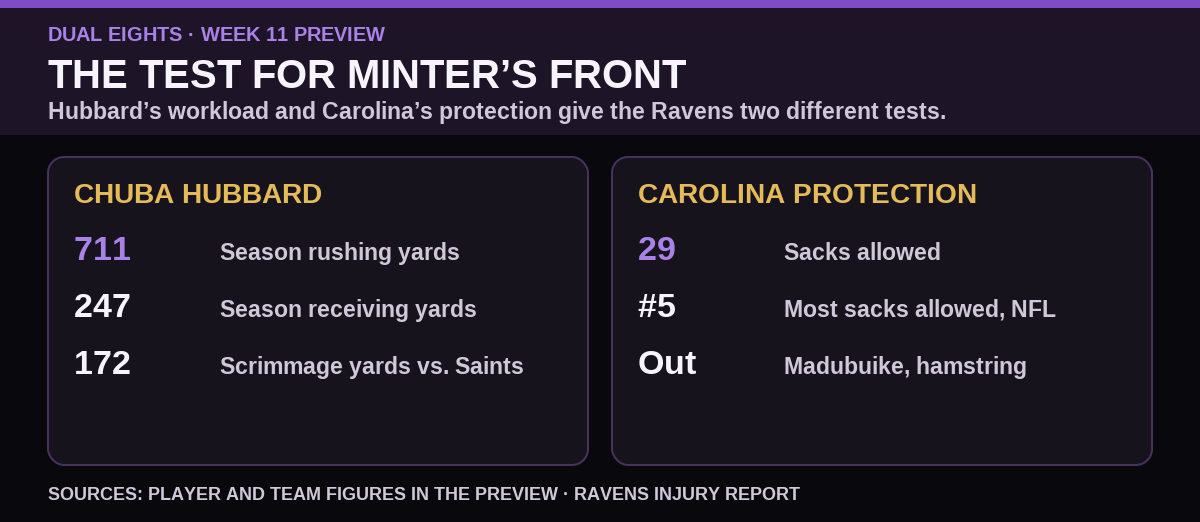
Hubbard has 711 rushing yards and another 247 receiving yards this season. Against New Orleans, he produced 172 yards from scrimmage while scoring twice. The Panthers have been among the league’s more frequent users of three-tight-end formations, with Darren Waller, Tommy Tremble and Mitchell Evans providing different combinations of blocking and receiving ability. Both Waller and Tremble are questionable with knee injuries this week though, potentially forcing Carolina to scale back those heavy formations.
Those formations force defenses to make decisions. Stay in nickel with smaller defenders, and Carolina can attack the running game with additional blockers. Bring bigger personnel onto the field, and Young can use play action to find tight ends working behind linebackers or crossing through the middle of the defense.
That creates a challenge for Roquan Smith, Trenton Simpson and Kyle Hamilton. The Ravens need to fit the run properly without allowing Young to exploit the space vacated by overaggressive defenders. Minter also needs to decide how frequently Hamilton should play near the line of scrimmage. Last week he was used more on the back end. It’s hard to tell if that is a move to provide better coverage or simply to preserve Hamilton from excessive contact around the line.
The injury situation makes this assignment more difficult. Nnamdi Madubuike and Jaylinn Hawkins were ruled out Friday, and Marlon Humphrey was sent home from practice and won’t play. Madubuike’s absence is particularly damaging against this type of offense.
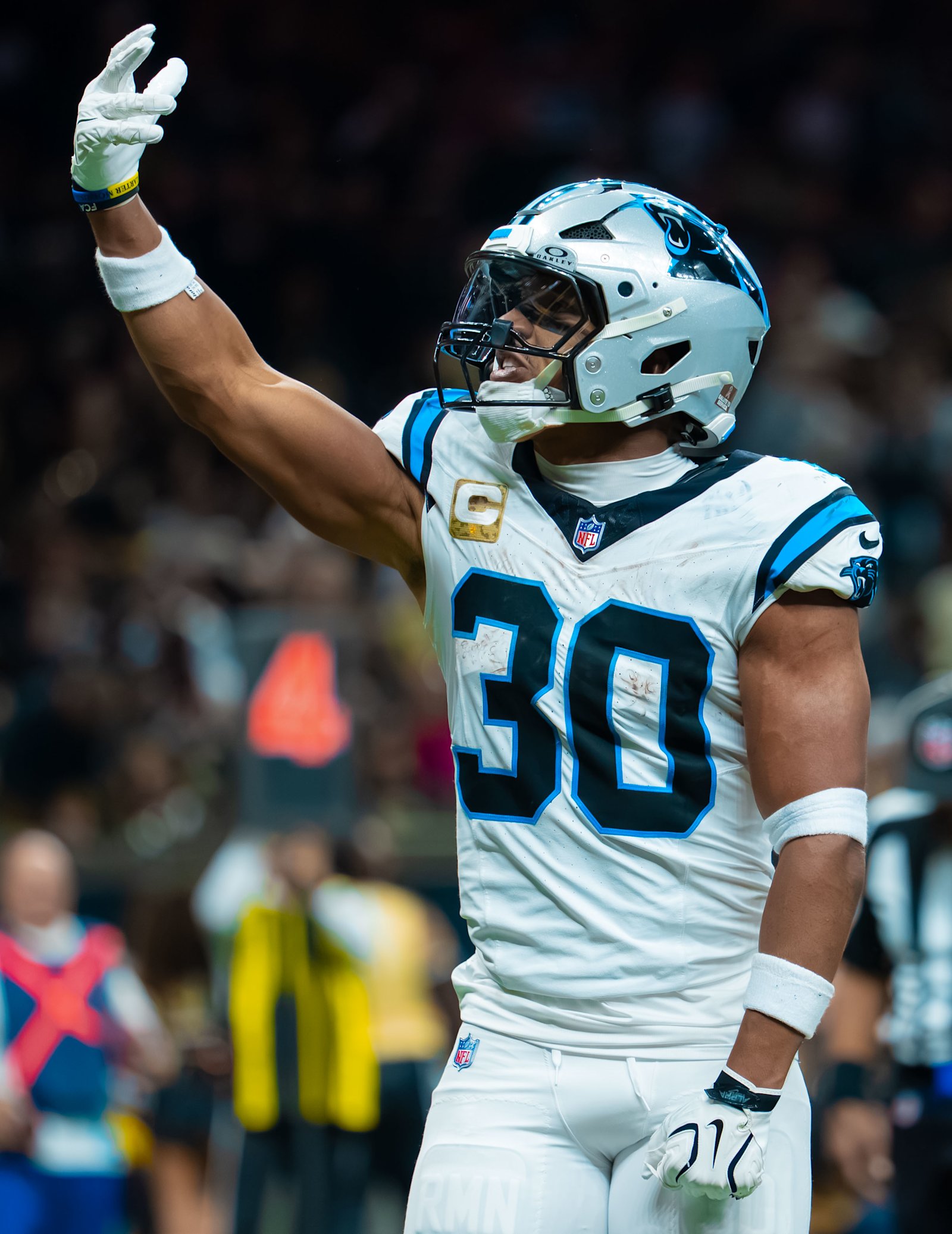
The bigger question is what happens when Carolina begins finding success. If Hubbard is consistently reaching the second level, will Minter change his fronts or alter the responsibilities of his linebackers? If Young begins finding tight ends behind the defense, can the Ravens adjust their coverage without exposing the receivers outside?
Minter needs to start demonstrating he can find solutions with the personnel at hand and make the needed adjustments as the game progresses so the defense doesn’t collapse after halftime.
4. Which young Ravens are earning bigger roles in 2027?
For all the disappointment surrounding this season, there have been a few encouraging individual developments.
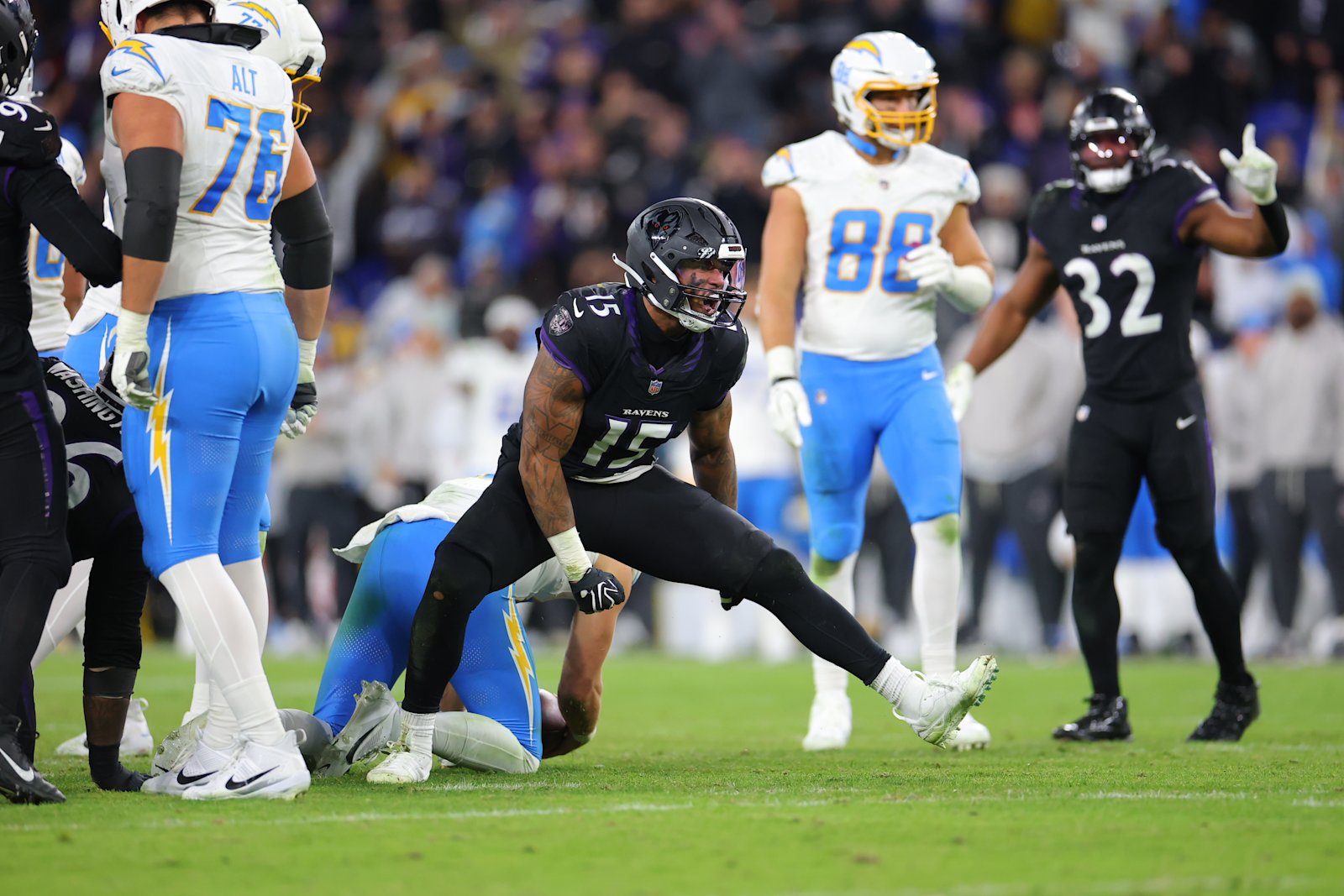
Mike Green might be the most important. The second-year edge defender has steadily developed into a more complete player, becoming increasingly effective attacking offensive tackles while also contributing against the run. His improvement has been particularly noticeable as the veteran pass rush has struggled to produce consistent results.
Carolina should provide another favorable matchup. The Panthers have allowed 29 sacks, fifth most in the league, and have been playing without starting right tackle Taylor Moton. Rookie Monroe Freeling has taken over on the right side, providing a potential opportunity for Green to create pressure.
The important thing is whether Green can consistently win through different techniques, remain disciplined in his rush lanes and contribute without requiring Minter to manufacture favorable matchups through blitzes.
Those details determine whether a young pass rusher is becoming an occasional contributor or a player capable of anchoring the defense for several seasons. Green increasingly looks like the latter.
The absence of Marlon Humphrey presents an opportunity in the secondary. Minter has indicated that Chidobe Awuzie and T.J. Tampa will receive additional playing time. Nate Wiggins should also have a substantial responsibility against Carolina’s larger receivers.
Tetairoa McMillan has 660 receiving yards, while Jalen Coker has added 393. Both are capable of winning contested catches and creating problems for defenders who lose leverage. The Panthers have recently been experimenting with stacks and motion to prevent opponents from consistently disrupting those receivers at the line of scrimmage.
That will test the Ravens cornerbacks in ways that go beyond simple one-on-one coverage.
Can Wiggins maintain his positioning when McMillan moves around the formation? Can Tampa recognize route combinations and communicate effectively with the safeties? Can the secondary handle crossing routes without losing track of its responsibilities?
Tampa is particularly interesting because the Ravens have not given him enough regular opportunities to establish whether he can become a dependable starter. Sunday should provide some useful evidence.
There are also younger offensive players worth monitoring. Josh Cuevas has demonstrated receiving ability and could become an increasingly important part of the tight-end rotation. Ja’Kobi Lane has shown flashes of potential, but needs to improve his reliability and develop beyond being an occasional downfield target. And, of course, Ioane’s development will remain central to any evaluation of the offensive line.
The Ravens don’t need to turn the final seven games into an extended preseason. They should still be trying to win, and young players shouldn’t receive unlimited opportunities simply because of their draft status.
But if two players are producing similar results, there is little reason to prioritize an established veteran with a questionable future over a younger player who might become part of the solution.
The Ravens need to discover what they actually have before deciding what they need to acquire.
5. Who will lead the next version of the Ravens?
Perhaps the most important question over the remainder of the season has less to do with the offensive or defensive schemes.
Who is going to lead this team?
The Ravens have spent years relying upon an established group of veterans to define the standards of the organization. Players like Marlon Humphrey, Roquan Smith, Derrick Henry and Mark Andrews have carried considerable influence within the locker room.
But that group may look very different next season.
Humphrey seems almost certain to be somewhere else next season (if not next week). Smith carries an enormous salary-cap commitment, while Henry is approaching the stage of his career where even his remarkable production cannot make his long-term future automatic. The Ravens have significant salary-cap decisions ahead, and several expensive veterans are no longer performing at a level that makes those decisions straightforward.
Minter announced on Thursday that the Ravens had sent Humphrey home and would deactivate him for Sunday’s game following derogatory comments about Baltimore on his podcast.
The decision is officially for one game, not a permanent dismissal from the roster. Minter said Humphrey was remorseful and explained that the remarks did not reflect how the organization wanted to operate, but it’s a significant moment.
Humphrey has been one of the most recognizable Ravens of the past decade, a former All-Pro and someone who has represented the franchise through considerable success. But that history doesn’t exempt him from accountability, and his declining performance on the field makes it much harder to tolerate his antics off it.
Minter deserves credit for making an uncomfortable decision involving an established veteran rather than allowing his status within the organization to shield him from consequences. He reportedly discussed the decision with the team’s leadership council, which includes Smith. The players now have to demonstrate that the standards they’re discussing actually mean something beyond the press conference room.
Kyle Hamilton made headlines Monday night by saying the Ravens were disgracing the standards established by the franchise.
No one is going to argue with him, but recognizing the problem is only the first step. The Ravens have spent much of this losing streak talking about accountability, preparation and the importance of playing to the organization’s standards. Then they go out and commit another series of procedural penalties, miss important assignments and make mistakes that should have been corrected weeks earlier.
At some point, the speeches become background noise.
What matters is whether players are actually improving.
Smith has long been one of the defense’s most vocal leaders, but he also needs to help restore the communication and discipline that have been missing. Henry can set an example through his preparation and professionalism, but the offense needs more than an accomplished veteran demonstrating how seriously he takes his work.
Andrews needs to remain a dependable target. Flowers needs to protect the football. The offensive linemen need to eliminate penalties that undermine otherwise promising possessions. Those things are more valuable than another collection of postgame declarations about being disappointed.
The larger question is who emerges behind the established veterans. Hamilton seems like the most obvious candidate to become the defining leader of the next Ravens defense. He’s already one of its best players, and his willingness to speak candidly about the team’s failures suggests he understands the standard that should exist.
But leadership will require more than calling out problems.
Can he help younger defenders understand their assignments, communicate effectively and remain composed when opponents begin finding success?
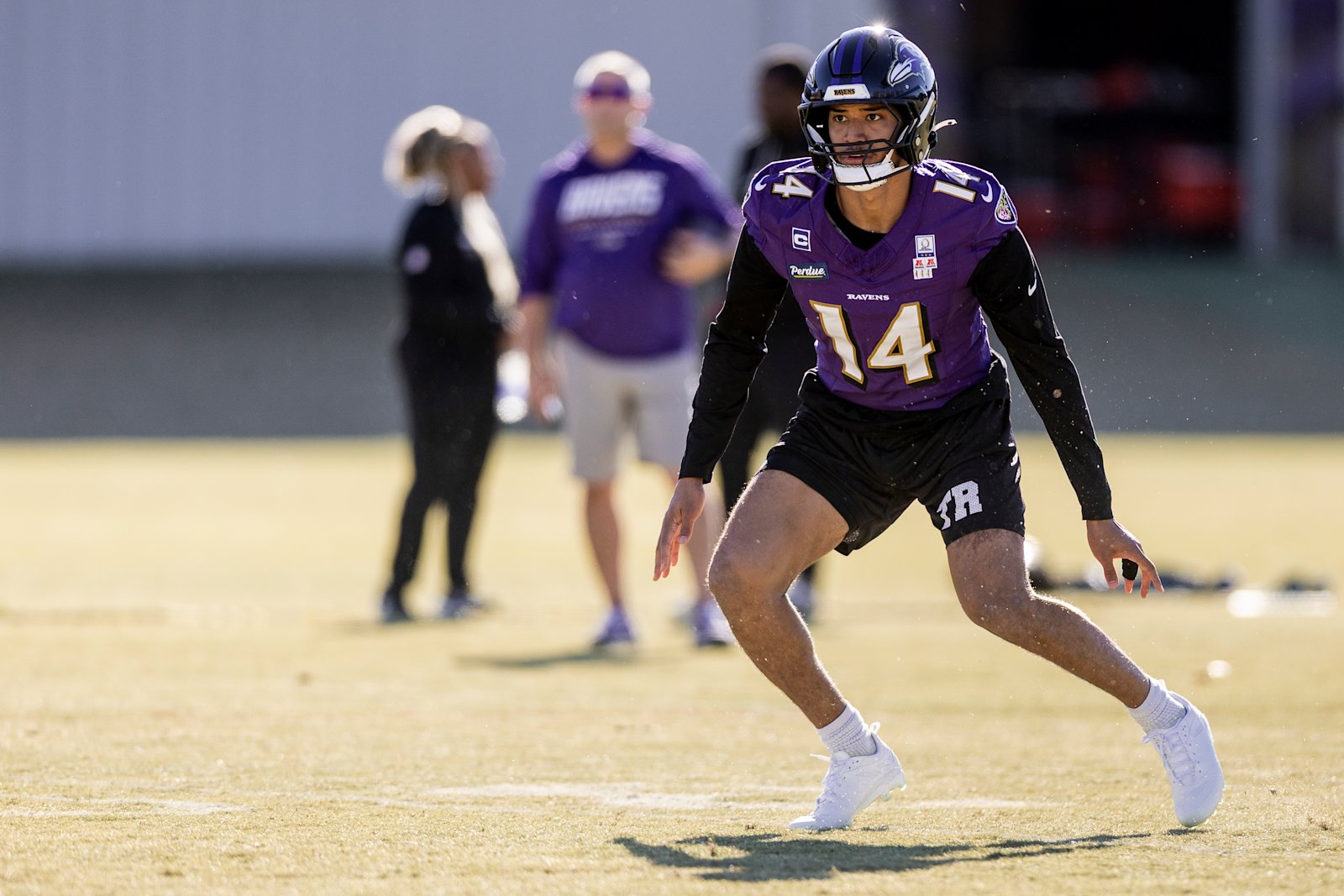
Can Wiggins and Green develop into dependable veterans who reinforce those expectations? Can Flowers become the kind of offensive leader whose consistency matches his exceptional talent? Could Ioane eventually provide the kind of stability and example the offensive line has lacked?
Not everyone needs to deliver an emotional speech. Some of the most effective leaders establish credibility through preparation, execution and the willingness to hold teammates accountable.
The Ravens need more of those players.
They replaced John Harbaugh because they believed a different coaching staff could take a talented roster further.
Now they also need to reshape the leadership structure that developed under the previous regime.
The final seven games should help reveal who is ready to take responsibility for that transition.
Prediction: Can the Ravens begin building something for next season?
There is an interesting contradiction surrounding Sunday’s game.
From a long-term organizational perspective, the Ravens might benefit more from securing a premium draft selection than from winning a handful of otherwise meaningless games.
However, the players and coaches still have important responsibilities, and the organization needs to learn whether its problems can be corrected.
The Panthers have struggled to finish defensive possessions, their offensive line can be attacked and Young has become less consistent as the season has progressed. The Ravens have a reasonable path to victory Sunday.
Brissett can attack the intermediate passing game, Doyle can create enough uncertainty to give Henry some running room, and Green has an opportunity to make life difficult for Young. Minter’s defense also has enough talent to limit Hubbard and force Carolina into passing situations that expose its protection problems.
Unfortunately, at this point it’s difficult to predict the Ravens will actually execute that plan. We’ve watched too many games where the initial approach looked promising before penalties, missed assignments or poor adjustments changed everything.
Carolina has its own problems, including an extraordinary collection of penalties, but the Panthers are playing for something meaningful and have demonstrated an ability to make adjustments during the season.
The Ravens haven’t earned that same confidence.
Prediction: Panthers 27, Ravens 24.