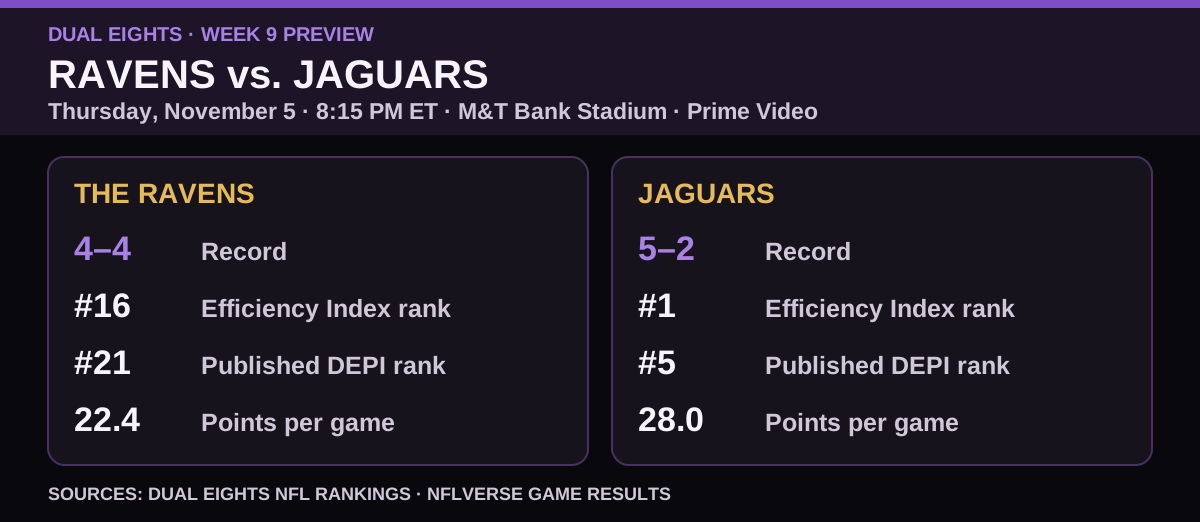
Thursday, November 5, 2026 | 8:15 p.m. ET | M&T Bank Stadium | Prime Video
Get ready for the game with the Ravens Dashboard.
Things have gone downhill remarkably quickly for the Ravens.
Three weeks ago, they were 4-1, sitting atop the AFC North and looking capable of surviving Lamar Jackson’s ankle injury long enough to get its franchise quarterback back for the second half of the season.
Now the Ravens are 4-4, have lost three straight games, and find themselves preparing to face one of the best teams in football with an undrafted rookie making his first NFL start.
Lamar’s return in Buffalo lasted exactly one offensive snap. His right hand collided with Greg Rousseau on his follow-through, injuring his thumb badly enough to require surgery and a trip to injured reserve. Tyler Huntley followed him to the sideline with a toe injury and is also lost for the season. Even Joe Fagnano, the emergency third quarterback who finished the game, managed to injure his ankle.
And now Fagnano gets to start on a Thursday night against a Jacksonville defense that ranks among the NFL’s best.
Terrific.
The Jaguars arrive at 5-2, leading the AFC South and coming off a 42-7 demolition of Indianapolis. They are at the top of our Dual Eights Efficiency Ranking, third in offensive EPA per play and fourth in defensive EPA allowed. They’re averaging 28 points per game while surrendering just 15.9.
The Ravens, meanwhile, have been outscored 71–23 over their last two games and have surrendered an astonishing 134 second-half points this season.
Jacksonville is favored by approximately ten points. Considering the quarterback situation, it’s difficult to argue with that number.
But there are some interesting matchups here, particularly with Jacksonville losing a critical piece of its run defense. The Ravens still have Derrick Henry, plenty of defensive talent and a coaching staff that has occasionally demonstrated an ability to create favorable matchups despite significant injuries.
The question is whether any of that can overcome the enormous disadvantage at quarterback.
Here are the five matchups that will determine whether the Ravens can make Thursday night competitive.
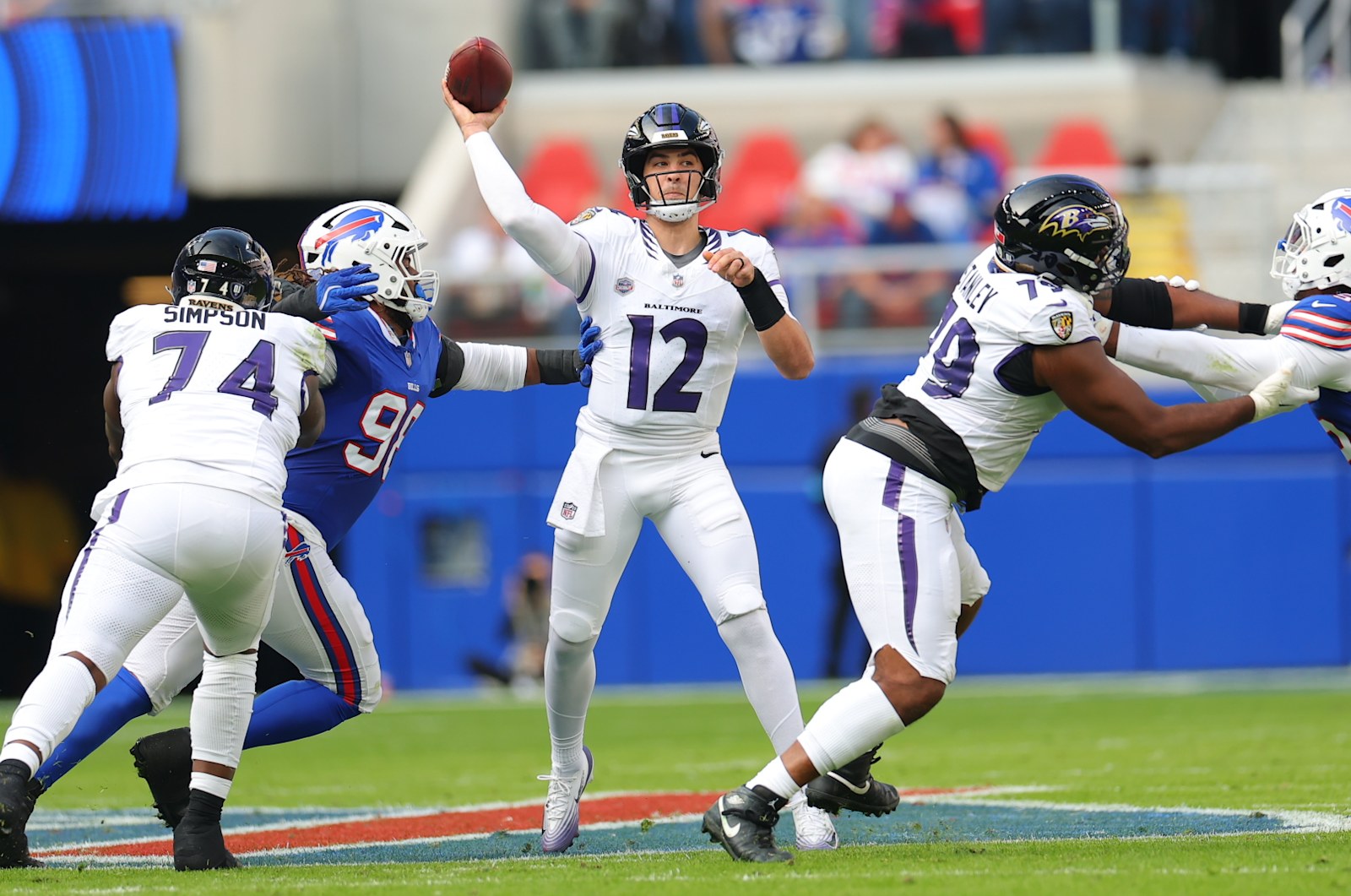
1. Joe Fagnano’s biggest challenge might be surviving his own offensive line
It would be easy to look at Fagnano’s numbers against Buffalo and conclude that the Ravens are in serious trouble.
He completed 10 of 21 passes for 91 yards, threw an interception, lost a fumble and was sacked three times. Baltimore finished with just 144 total yards and converted three of 13 third downs.
That was not encouraging.
But it also wasn’t a particularly fair introduction to NFL football.
Fagnano entered after two quarterbacks had already been injured, with virtually no preparation as the starter, against a Buffalo defense that quickly realized the Ravens had almost no ability to handle its pressure packages.
According to Next Gen Stats, the Bills blitzed on 64.5% of Ravens dropbacks, generating 11 blitz pressures and seven quick pressures.
The offensive line offered very little protection.
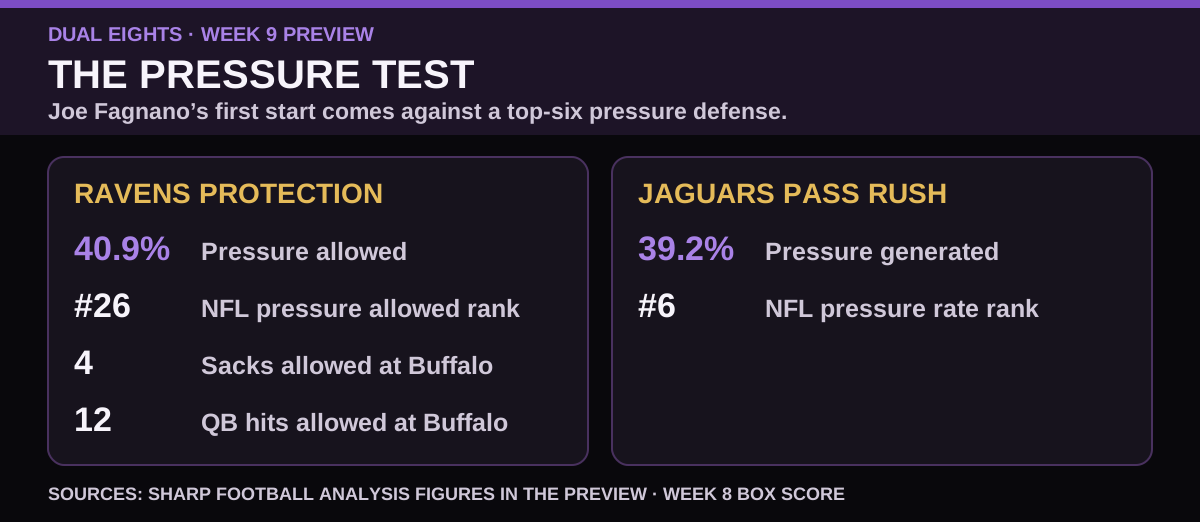
They allowed 12 quarterback hits and 15 pressures according to Pro Football Focus. Every starting offensive lineman except Ronnie Stanley received a pass-blocking grade below 62.
Fagnano deserves responsibility for his decisions, ball security and accuracy. But evaluating an inexperienced quarterback while defenders arrive almost immediately after the snap tells us relatively little about what he might accomplish with a functional offense around him.
Unfortunately, Jacksonville presents another difficult assignment.
The Jaguars generate pressure on approximately 39.2% of opposing dropbacks, sixth-best in the league according to Sharp Football Analysis. Josh Hines-Allen, Travon Walker and Arik Armstead provide legitimate threats across the defensive front, while coordinator Anthony Campanile has demonstrated a willingness to use pressure and coverage disguises to force mistakes.
Walker is questionable with a rib injury, but Jacksonville has enough talent to create problems even if he’s limited.
The Ravens have allowed pressure on approximately 40.9% of their own dropbacks, ranking 26th.
That’s not a particularly comforting combination.
The good news is that the offensive line might finally be moving toward something resembling a stable configuration.
Cam Jurgens played all 51 offensive snaps at center against Buffalo after arriving in the October trade with Philadelphia. Rookie Vega Ioane, who missed that game with a knee injury, was a full estimated practice participant Wednesday and appears set to return at right guard.
That would allow the Ravens to field Ronnie Stanley, John Simpson, Jurgens, Ioane and Roger Rosengarten across the line, assuming everyone is available.
Still, Jurgens is learning an entirely new protection system, Ioane has been shuffled between guard and center because of injuries, and the unit has struggled with communication and individual blocking even when its preferred players have been available.
Declan Doyle has to recognize those limitations.
Fagnano demonstrated enough in the preseason, leading the NFL with 509 passing yards, to suggest he can operate an offense when given time. His college experience at UConn also suggests he is more comfortable functioning within structure than trying to improvise his way out of trouble.
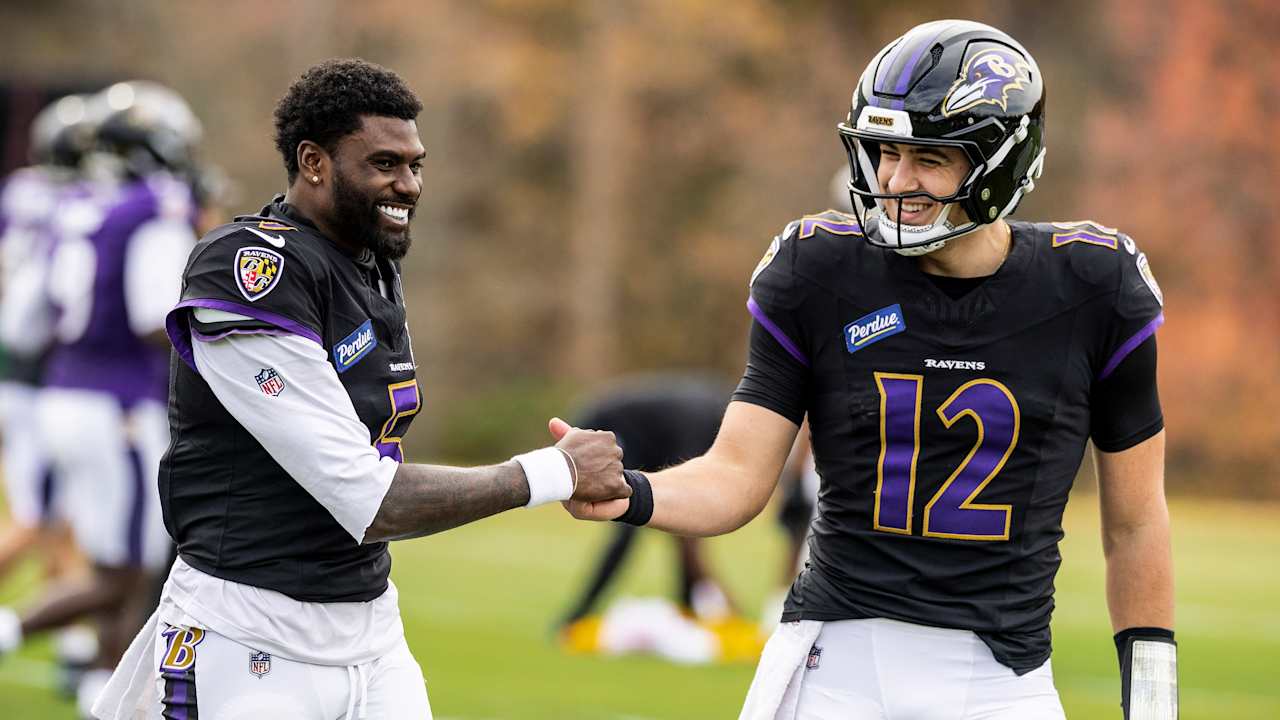
That’s how the Ravens should approach this game.
Get the ball out quickly. Use condensed formations and additional tight ends to provide protection. Move Zay Flowers around to create cleaner releases. Give Fagnano simple answers against pressure, particularly through running backs and tight ends.
But Doyle cannot become so conservative that Jacksonville knows every pass is going to travel five yards.
There needs to be enough play action and intermediate passing to prevent Campanile from simply crowding the line of scrimmage.
The objective shouldn’t be asking Fagnano to replace Lamar Jackson.
It should be creating an offense where he doesn’t have to.
2. Derrick Henry is the obvious answer. Jacksonville knows that, too.
If the Ravens are going to win this game, Derrick Henry almost certainly needs to be a significant part of the offense.
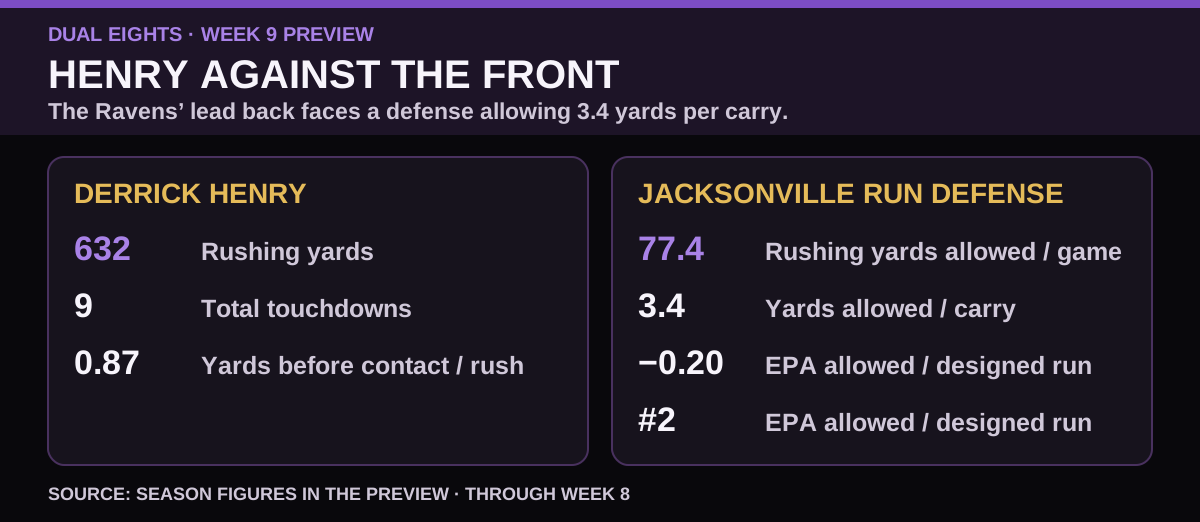
Henry has rushed for 632 yards and scored nine total touchdowns through eight games. He’s still capable of punishing defenses, and without Lamar or Huntley available, the Ravens have even more reason to put the football in his hands.
There is one rather significant problem.
The Jaguars allow just 77.4 rushing yards per game and a league-low 3.4 yards per carry. Their defense ranks second in EPA allowed per designed run at approximately -0.20.
That number accounts for down, distance and game situation rather than simply measuring rushing yards. Jacksonville isn’t just limiting big gains. It’s consistently putting opponents into worse situations when they attempt to run.
And that’s exactly what the Ravens can’t afford with Fagnano.
Jacksonville did lose starting nose tackle DaVon Hamilton to a season-ending quadriceps injury against Indianapolis. Hamilton is a 335-pound interior defender whose value extends well beyond his tackle totals. He occupies blockers, controls gaps and prevents offensive linemen from working up to the linebackers.
His absence changes the physical structure of Jacksonville’s defense.
Matt Dickerson is expected to take on a larger role, with Ruke Orhorhoro and Albert Regis providing additional depth. None is necessarily incapable of replacing Hamilton, but the Jaguars are losing a player who has been central to their run-defense success.
That should present opportunities for Jurgens and Ioane, particularly on combination blocks where two linemen initially work together against the defensive tackle before one releases toward a linebacker.
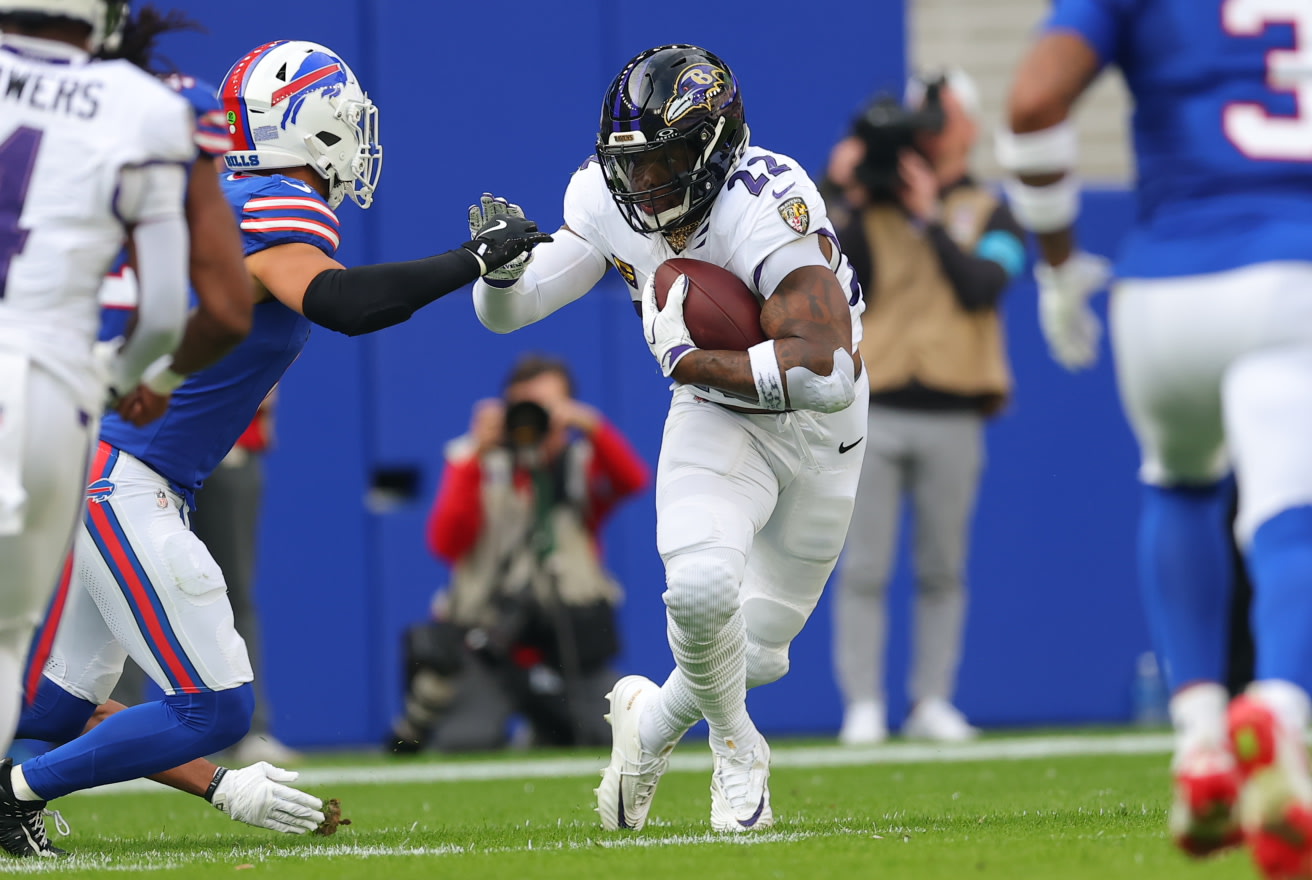
If they can generate some movement inside, Henry can get downhill before encountering the first defender.
That has not been happening nearly enough.
Henry is averaging only 0.87 yards before contact per rushing attempt, placing him around 33rd among measured running backs. He has finished with 60 or fewer scrimmage yards in three consecutive games, but the offensive line hasn’t consistently created running lanes, and Baltimore has frequently fallen behind badly enough to abandon the rushing attack.
The Ravens just aren’t giving Henry many opportunities to do what he does best.
There is also a predictability problem.
They run the ball on 62.3% of Henry’s offensive snaps. Without Jackson threatening to keep the football, defensive coordinators can be even more aggressive about attacking Henry’s likely running lanes.
Doyle needs to find ways to make those tendencies less obvious.
Hamilton’s absence creates an opportunity, but it doesn’t magically turn Jacksonville into a bad rushing defense. The Jaguars allowed just 3.6 yards per carry across 48 runs without him on the field this season, although that’s a limited sample.
The Ravens should test the middle of that defense early.
If they can consistently create second-and-5 rather than second-and-9, Fagnano has a fighting chance.
If Henry is repeatedly stopped after one or two yards, the game could get ugly very quickly.
3. Trevor Lawrence is playing exceptionally well, and the Ravens have some dangerous matchups
Jacksonville’s defense gets plenty of attention, but its offense has been every bit as impressive.
Trevor Lawrence is enjoying one of the most efficient stretches of his career.
Through seven games, he’s completed 65.7% of his passes for 1,690 yards, 17 touchdowns and just four interceptions. He’s averaging 8.5 yards per attempt with a 112.6 passer rating.
His 8.6% touchdown rate leads the NFL, and Jacksonville ranks third in EPA per dropback at +0.27.
Those numbers aren’t simply the product of throwing constantly.
The Jaguars have been winning comfortably enough that Lawrence rarely needs to play aggressive football for four quarters. He has averaged just 5.1 fourth-quarter dropbacks per game, partly because Jacksonville has pulled him early in multiple blowouts.
Against Indianapolis, Lawrence needed only 14 passes to produce 210 yards and three touchdowns.
The Ravens need to prevent that kind of efficiency, not merely limit his total passing yards. The receiving matchups are particularly interesting.
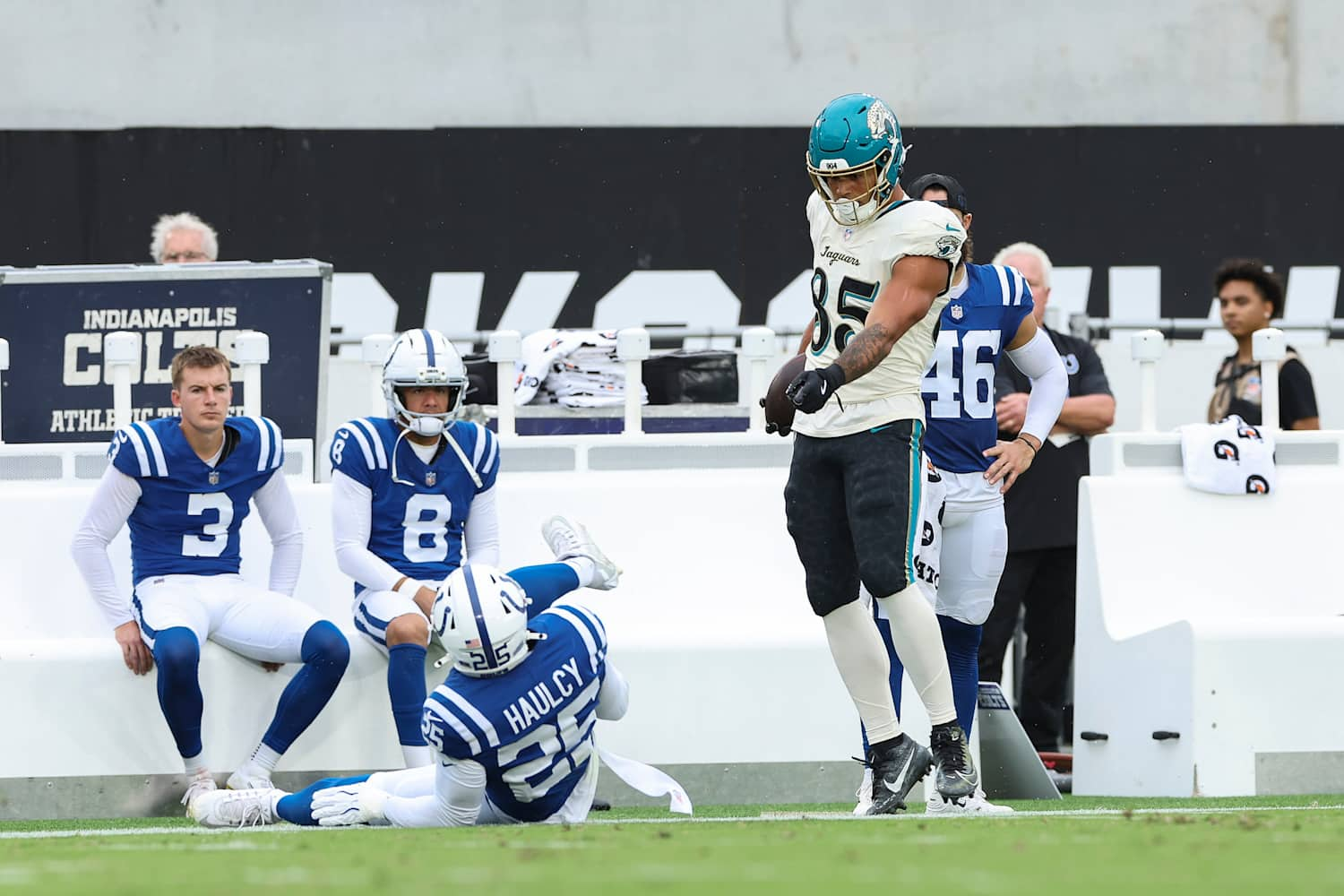
Parker Washington has emerged as Jacksonville’s most productive wide receiver, catching 27 passes for 432 yards and four touchdowns. He’s averaging 16 yards per reception and has become Lawrence’s primary explosive threat.
Brenton Strange has added 28 receptions for 334 yards, while Jakobi Meyers has 22 catches for 309 yards. That distribution means the Ravens cannot simply key in on one go-to receiver.
Washington presents a particularly difficult matchup for a Baltimore secondary that has repeatedly been vulnerable to explosive passes.
His ability to threaten vertically forces cornerbacks to protect against the deep ball, creating additional space underneath.
The problem becomes more complicated with Nate Wiggins questionable after dealing with a stinger and illness. Wiggins did not participate in Wednesday’s estimated practice, while Jaylinn Hawkins has already been ruled out with a knee injury.
Chidobe Awuzie could be extremely important.
Awuzie played 43 defensive snaps against Buffalo after seeing just seven over the previous three games combined. He received an encouraging 81.2 PFF grade and may be asked to handle an even larger role if Wiggins cannot play.
The Ravens also have to decide how to deploy Kyle Hamilton. Hamilton has eight tackles for loss this season, the most among NFL defensive backs. His ability to function as a linebacker, safety, slot defender or blitzer remains the most interesting part of Baltimore’s defensive personnel.
Against Jacksonville, that versatility could be especially valuable in defending Strange.
The tight end is averaging 2.11 yards per route and has been targeted on more than 22% of his routes. He’s much more dangerous than his single receiving touchdown suggests.
Hamilton can help disrupt those underneath and intermediate routes, particularly when Lawrence expects Strange to settle into openings between linebackers and safeties.
But moving Hamilton toward the football creates another decision.
Who protects the deep middle against Washington?
If the Ravens devote extra coverage resources to limiting Jacksonville’s vertical passing game, Strange can attack the space underneath. If Hamilton stays closer to the line, Lawrence may get favorable opportunities outside.
That’s where Minter and defensive coordinator Anthony Weaver need their coverage disguises to work.
The Ravens have demonstrated that they can confuse quarterbacks before the snap, rotating safeties and changing which defenders are responsible for different parts of the field.
The problem has been sustaining that effectiveness once opposing offenses adjust.
Lawrence is experienced enough to recognize those adjustments, particularly when Jacksonville can remain efficient on early downs.
And simply blitzing more isn’t necessarily the solution. Jacksonville has produced positive EPA against the blitz this season and has been even more efficient when opponents don’t send additional rushers. The Ravens need to vary where pressure comes from without consistently sacrificing coverage.
There is one potential advantage.
Starting running back Bhayshul Tuten is questionable with a foot/ankle injury after missing all three practices this week. He has 492 rushing yards and has added 181 receiving yards, providing Jacksonville with another explosive option.
If Tuten cannot play, Chris Rodriguez Jr. would likely handle more of the rushing workload.
Rodriguez is averaging 4.6 yards per carry himself, so losing Tuten doesn’t eliminate Jacksonville’s running game. But it would remove some of the speed and receiving versatility that makes Coen’s offense difficult to defend.
The Ravens could certainly use that break.
| Final availability | The Ravens | Jacksonville |
|---|---|---|
| Out | Lamar Jackson, Tyler Huntley, Jaylinn Hawkins | — |
| Questionable | Nate Wiggins, Adam Randall* | Bhayshul Tuten, Travon Walker |
| Key injured reserve | Tyler Loop | DaVon Hamilton, Eric Murray |
*Randall still requires activation from injured reserve. Official game designations · Jaguars update.
4. Can Minter and Weaver finally solve the second-half collapse?
This is the most concerning trend of the Ravens season that has nothing to do with Lamar Jackson.
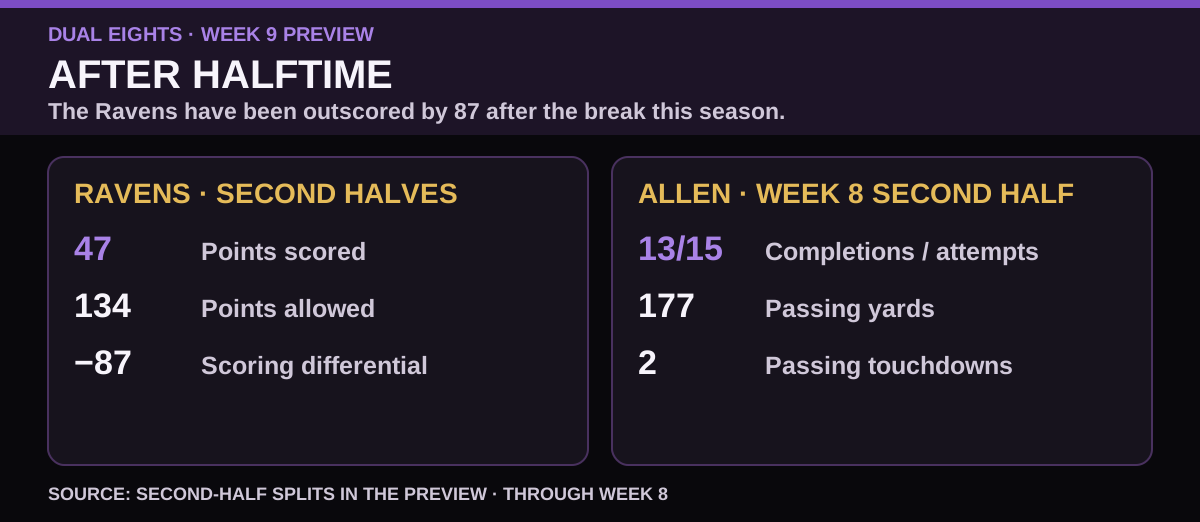
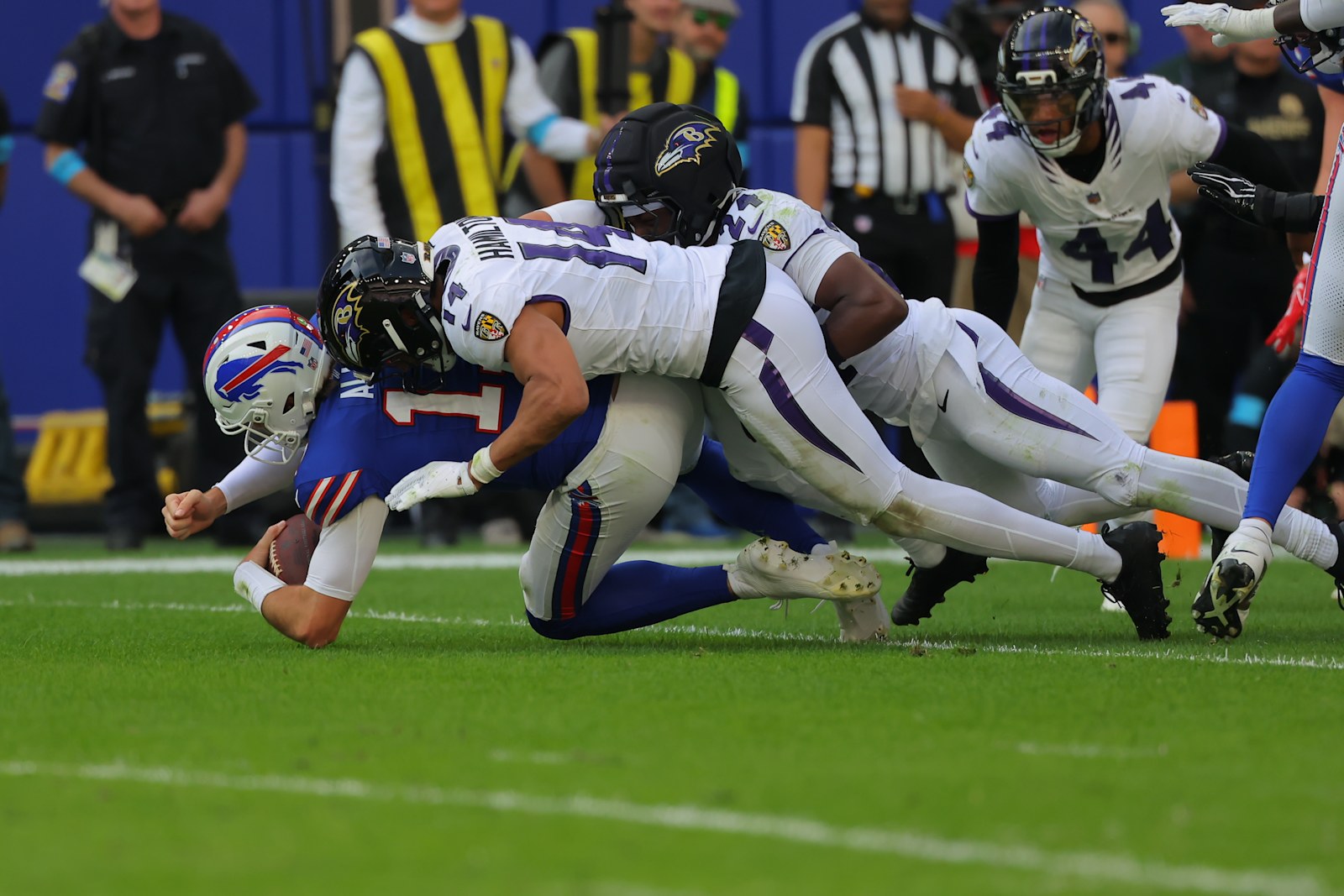
The Ravens have been outscored 134-47 after halftime. That’s an 87-point deficit, the worst second-half scoring differential in the NFL.
It’s difficult to comprehend how a team with this much defensive talent can consistently perform so well early in games and then become almost helpless.
Last week in Buffalo, Josh Allen completed just eight of 19 first-half passes for 112 yards with an interception. After halftime, Allen went 13-of-15 for 177 yards and two touchdowns.
Those are astonishing transformations against a defense that frequently looks capable of controlling games for 30 minutes.
There are legitimate explanations that extend beyond the defensive coaching.
The offense has been dreadful without Lamar, and repeated three-and-outs create enormous problems for the defense. Against Buffalo, the Ravens defense played 82 snaps while the offense managed just 51.
That’s an exhausting workload, particularly when the defense is constantly returning to the field after short possessions.
Poor field position, fatigue and injuries can all make an otherwise competent defense look considerably worse.
But those explanations only go so far.
The Ravens were leading Cincinnati at halftime when the Bengals began dismantling the defense. They had enough healthy players and enough preparation to control the first 30 minutes.
Something changed.
Minter and Weaver cannot dismiss every second-half collapse as a product of offensive injuries.
Opponents are recognizing their pressure looks, improving protections, identifying coverage weaknesses and finding ways to get their best players into favorable positions.
The Ravens aren’t consistently finding corresponding answers.
Against Jacksonville, this becomes an especially dangerous problem.
Liam Coen has built an offense that can attack defenses through formations, motion, play action and quick passing. The Jaguars can run the ball effectively, but Lawrence has also demonstrated that he can punish defenses through the air without needing exceptional passing volume.
If Jacksonville identifies something it likes against the Ravens’ coverage structure, Coen has enough flexibility to repeatedly attack it.
The Ravens need to do more than produce a clever opening defensive script.
They must recognize what Jacksonville changes and have answers prepared before Lawrence begins moving the ball effortlessly.
The Ravens replaced John Harbaugh partly because they believed a new coaching staff could get more from a talented roster and eliminate the late-game problems that had become painfully familiar.
Halfway through the season, those problems look worse.
And unfortunately, Jacksonville doesn’t seem like an especially forgiving opponent.
5. The Ravens cannot afford to give Jacksonville extra possessions or short fields
Jacksonville’s defensive profile has one particularly interesting contradiction.
The Jaguars allow approximately 254 passing yards per game, ranking 29th.
At first glance, that sounds like a defense Baltimore might be able to attack through the air, especially with its injuries at safety.
But raw passing yardage tells a very different story from actual defensive effectiveness.
Jacksonville ranks sixth in EPA allowed per dropback. The Jaguars have intercepted nine passes while surrendering just eight passing touchdowns.
They allow a touchdown on only 3.3% of opposing pass attempts, one of the best rates in football.
And opponents average just 3.17 points per scoring opportunity against them, third-best in the league.
That is a defense willing to concede some yardage without consistently allowing those drives to turn into touchdowns.
Some of the passing totals are also influenced by game script. Opponents trailing Jacksonville by multiple scores naturally throw more frequently, generating yardage without necessarily creating much danger on the scoreboard.
The Jaguars also create turnovers.
They have a +7 turnover differential and have scored 55 points directly following takeaways, tied for the most in the league.
That’s a serious problem for an inexperienced quarterback who could be under constant pressure. Fagnano cannot afford to turn a failed third-down play into a disastrous turnover.
There are situations where taking a sack or throwing the ball away is considerably better than trying to manufacture something that isn’t available.
But protecting the football alone isn’t enough.
The Ravens rank 27th in third- and fourth-down conversion rate at 37.8%. Jacksonville’s defense allows conversions on just 38.5% of those opportunities, eighth-best.
If the Ravens are repeatedly facing third-and-7 or longer, the Jaguars can pressure Fagnano without worrying much about Henry. That’s when the sacks, interceptions and short fields become most likely.
The Ravens need to stay ahead of the chains, keep their offense on the field and avoid forcing a tired defense to defend repeated possessions in poor field position.
They also need to finish the few scoring opportunities they create.
That brings another injury into the picture.
Tyler Loop has been placed on injured reserve with a groin injury, leaving Jake Moody to handle the kicking duties.
Moody has made 64 of 82 field-goal attempts in his NFL career. He has experience, but he’s hardly an automatic replacement for a kicker who has demonstrated the ability to make difficult long-range attempts this season.
Minter could face some challenging fourth-down decisions if the Ravens move the ball into the area between reasonable field-goal range and punting territory.
Against a team averaging 28 points per game, settling for field goals may not be enough.
On the other hand, aggressively going for fourth downs without a credible conversion plan could repeatedly hand Jacksonville excellent field position.
The answer isn’t automatically to be conservative or aggressive.
It’s to recognize that the Ravens’ normal offensive expectations no longer apply and make decisions based on what this particular offense can realistically accomplish.
With Fagnano, Henry and a compromised line, those decisions may look very different from the ones Minter would make with a healthy Lamar Jackson.
Prediction: Can the Ravens keep this competitive?
The main hopes for the Ravens this week in circumstances and words like pride, grit, will, and hope.
The home game on a short week should theoretically provide them some advantage, but obviously a banged up third string quarterback undoes most of that.
There’s a vision where Henry finds enough room against Jacksonville’s interior without Hamilton to make the running game efficient. Doyle protects Fagnano with a sensible game plan while giving him a few opportunities to attack downfield. Flowers creates a couple of explosive plays.
The defense limits Lawrence’s big gains, forces Jacksonville to sustain long possessions and finally produces the kind of complete performance that has been missing for several weeks.
If the Ravens can do all of that, they have enough talent to keep this close.
But that’s an awfully long list of things that need to go right.
Jacksonville has the better quarterback, the more consistent offensive line, the stronger defense and considerably more continuity on both sides of the ball.
Its offense is particularly well equipped to attack the weaknesses Baltimore has displayed throughout the season. Lawrence doesn’t need to force throws or wait for deep routes to develop. He can attack underneath, move defenders with play action and punish coverage mistakes when opportunities appear.
The Jaguars also have the kind of defensive front that can turn an inexperienced quarterback’s first start into a miserable evening.
And as much as I want to believe Baltimore’s defense can rescue this game, we’ve watched too many promising first halves dissolve into second-half disasters.
The Ravens need an exceptional performance from their defense and running game just to create a manageable situation for their rookie quarterback.
That’s asking a lot against one of the best teams in football.
Prediction: Jaguars 37, Ravens 17.