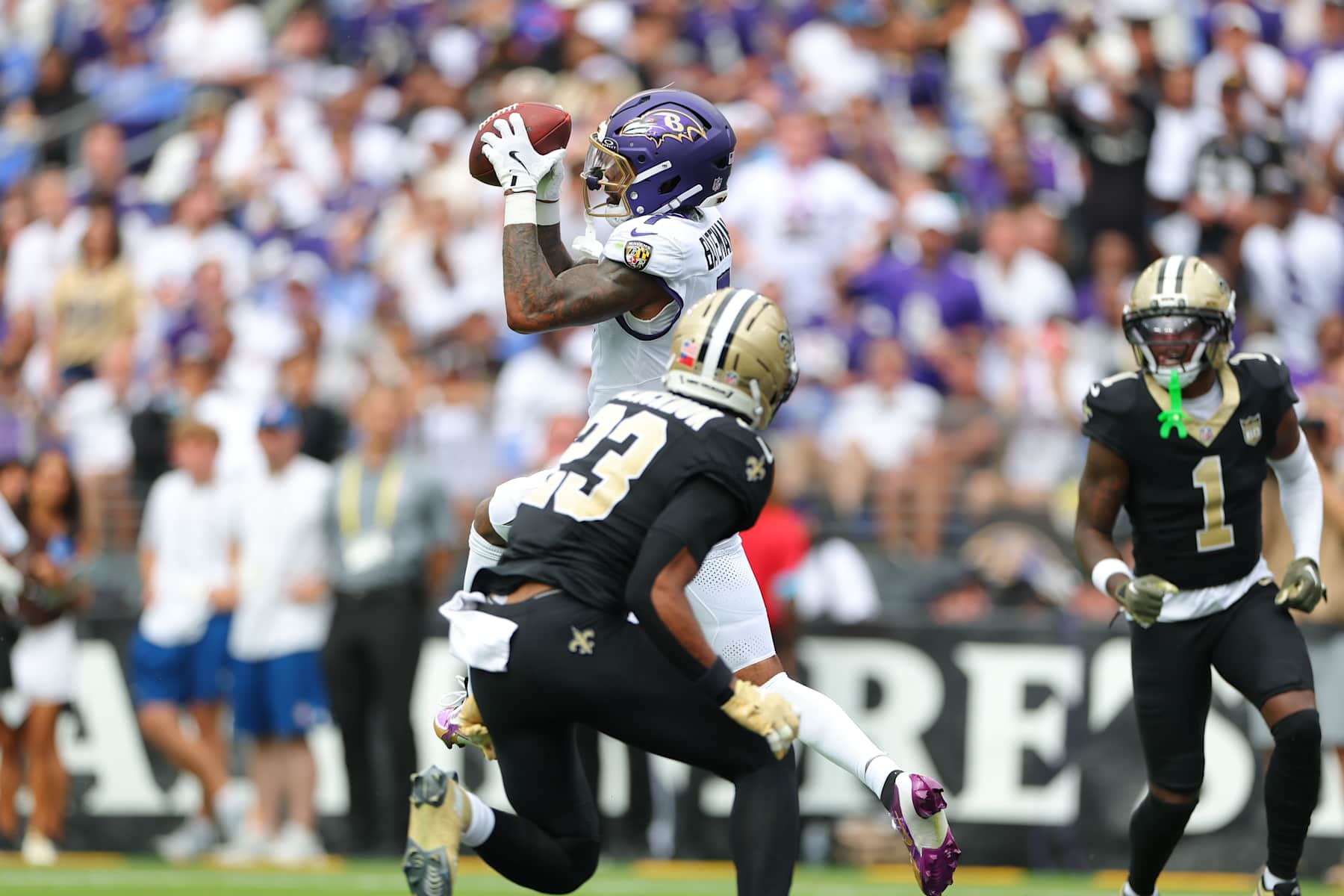
Five immediate takeaways from the Ravens’ 24-17 loss to the Saints, before any rewatch.
Follow the season: The Ravens Season Dashboard tracks the record, advanced team metrics, unit trends, injuries and what comes next.
A tale of two weeks.
Seven days after the Ravens opened the Jesse Minter era by doing almost everything right in a 41-23 win over Indianapolis, they did just enough wrong to lose a game they had no business losing at home to New Orleans.
The Ravens were not outplayed for the entire game, but they failed in the key moments.
The Ravens averaged 5.6 yards per play to New Orleans’ 4.7. They held the Saints to 65 rushing yards on 27 attempts. Lamar Jackson completed 21 of 31 passes for 235 yards. Derrick Henry averaged 4.3 yards per carry. Rashod Bateman gave them 88 yards and a touchdown with Zay Flowers unavailable.
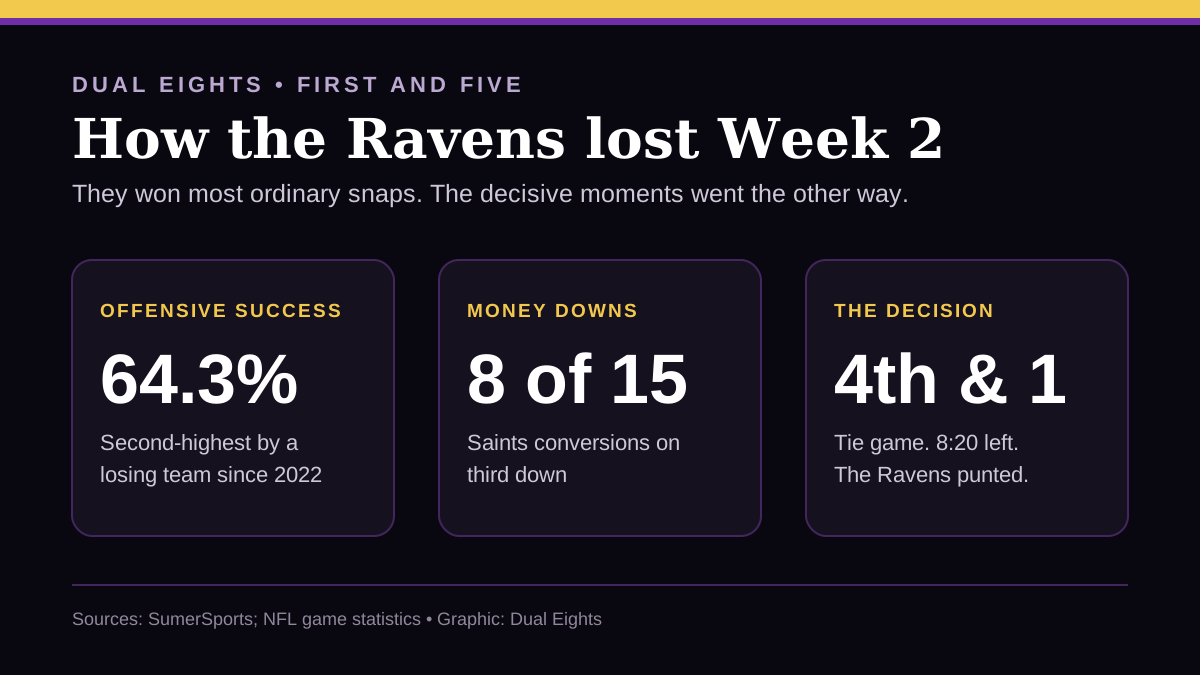
According to SumerSports, the Ravens had a 64.3% offensive success rate, the second-highest by a losing team since 2022.
And yet, they lost 24-17.
A tipped field goal. A huge kick return. Penalties at the wrong times. A squandered short field. Third-down conversions that never seemed to end. A questionable challenge. An even more questionable fourth-down decision. One final miscommunication and interception.
Week 1 showed what this team can look like when nearly everything fits together.
Week 2 showed what happens when the margins go the other way.
Here are my first five takeaways.
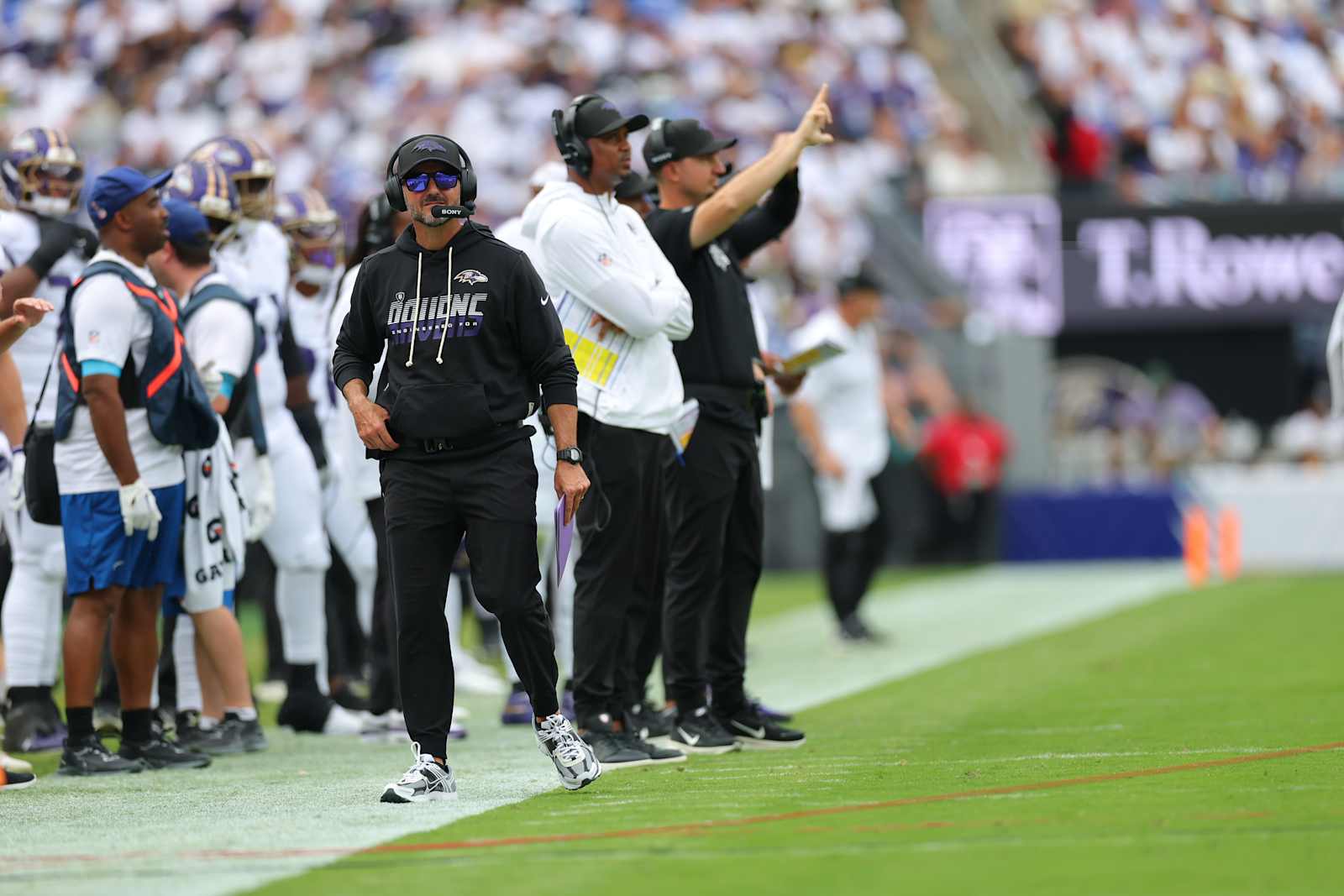
1. Jesse Minter lost the game with his decisions
Of course it’s not that simple, and there are many plays and players that could have removed the need for those critical moments. But Minter made the wrong call on several crucial decisions late in the game that prevented the team from having its best chance to win.
The sequence that will get the most attention came after New Orleans tied the game at 17 in the fourth quarter. The Ravens faced third-and-1 from their own 37 with 8:20 remaining.
Declan Doyle dialed up a deep shot to Chris Moore that nearly connected but for a great play by Kool-Aid McKinstry.
I don’t have a problem with the deep shot in a vacuum. It makes perfect sense if you treat it as two shots to get one yard. If the Ravens already knew they had two downs to gain one yard, taking a calculated shot there is completely defensible.
The problem is that apparently they did not.
On fourth-and-1, Minter punted.
That is where the sequence becomes indefensible.
The precise recommendation varies slightly depending on the public model and assumptions, but the fourth-down math is not particularly close. Generic Next Gen Stats data puts the league conversion probability on a true fourth-and-1 at roughly 72%. Ben Baldwin’s public nfl4th framework, which evaluates the expected win probability of going, punting and kicking, puts a situation like the Ravens’ firmly in go-for-it territory. Using the game state at the time, the public models put the advantage of going for it at roughly four percentage points of win probability over punting.
Four percentage points may not sound enormous. In one NFL decision, it is.
And that is before adjusting for the actual personnel involved. The Ravens had Lamar Jackson and Derrick Henry standing next to him. Henry had gained 68 yards on 16 carries and had been stopped for a loss only once.
They needed one yard.
If they convert, it keeps the ball with about eight minutes remaining in a tie game. If it fails, New Orleans gets a short field, but even that downside is not as catastrophic as it initially sounds. The Saints would still need to score, and a short field would preserve more time for Lamar to answer.
Instead, Minter chose field position.
Ryan Eckley punted 40 yards. Barion Brown returned it nine. New Orleans took over at its own 32.
Net gain: 31 yards.
Two offensive snaps later, Tyler Shough hit Chris Olave for 15 yards and the Saints were already at their own 47. The field position Minter had surrendered possession to protect was essentially gone.
In 2026, there really is no excuse for getting this type of decision wrong. Anyone can carry a math supercomputer around in his pocket for $20 a month. An NFL team can probably scrape together the budget.
The poor challenge decision was less consequential but almost as frustrating.
On the Saints’ previous drive, Olave caught a short pass that left New Orleans facing third-and-5. Minter challenged whether Olave maintained possession, trying to turn it into third-and-8. The replay was never especially promising, the potential gain was modest and the cost was a timeout.
That timeout became extremely valuable when the Saints eventually reached the goal line. The Ravens used their final two timeouts at 1:40 and 1:32. After Shough scored on fourth down, Lamar got the ball with 1:28 remaining and none left.
Minter explained afterward that he wanted to force New Orleans into a longer conversion because the Saints were likely in four-down territory anyway.
I understand the thought process. The expected benefit still did not justify the risk.
It was the kind of emotional challenge Ravens fans spent years getting furious at John Harbaugh for making.
Minter is two games into his career as a head coach. There are going to be learning moments.
This needs to be one of them.
2. Tyler Shough impressed me
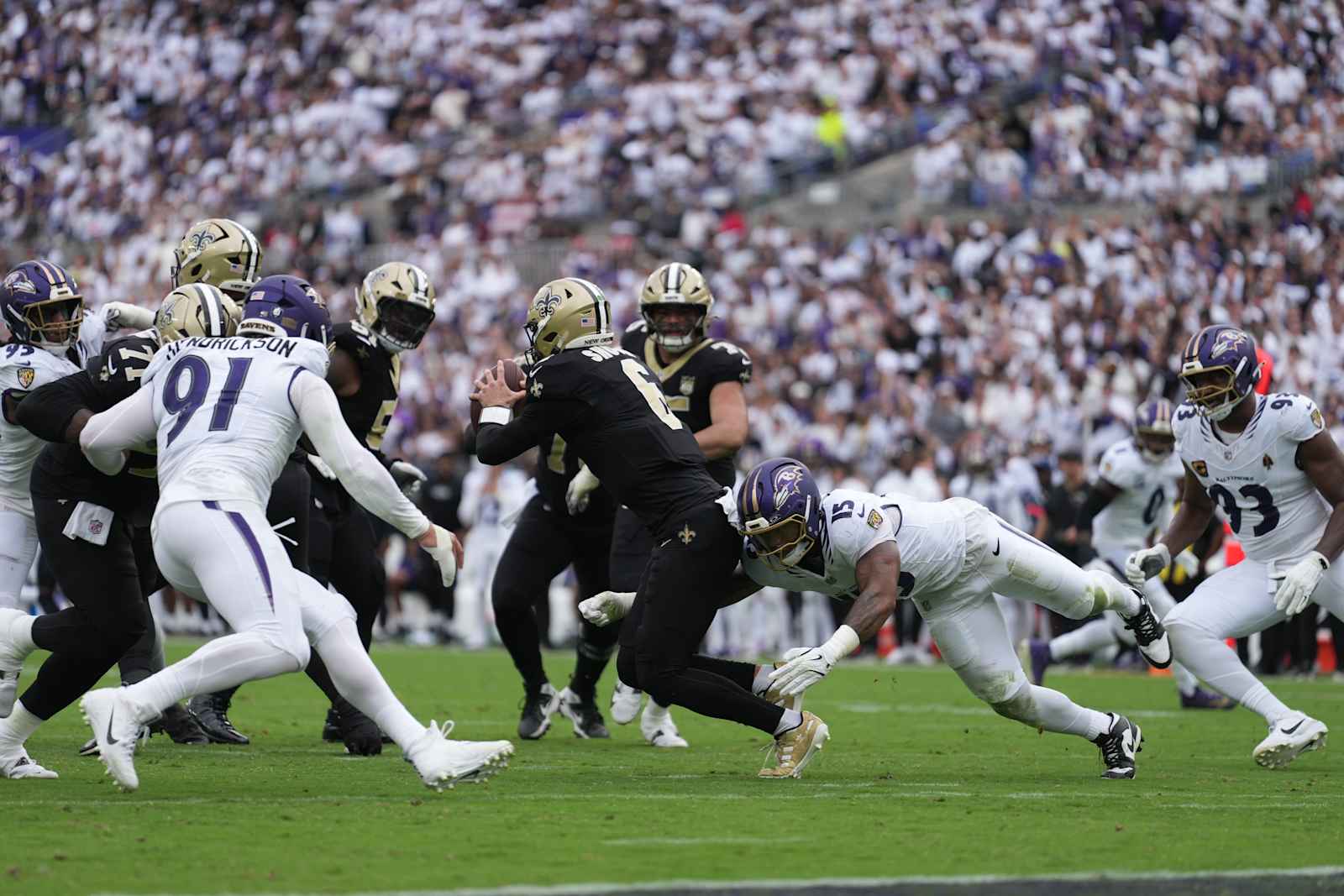
Tyler Shough won’t be mistaken for peak Josh Allen or Lamar Jackson. But he repeatedly made quick decisions to beat the Ravens’ pass rush and showed enough pocket awareness and mobility to extend several key third-down conversions.
Shough finished 27-of-34 for 252 yards, a touchdown and no interceptions, completing 79.4% of his passes. He added another touchdown on the controversial quarterback sneak that ultimately won the game.
The Ravens did have moments where their pass rush affected him. Trey Hendrickson and Mike Green each recorded sacks during a third-quarter series, forcing New Orleans backward and setting the Ravens up at the Saints’ 49 with a chance to put the game away.
New Orleans adjusted by getting the ball out faster, and the Ravens never found the corresponding answer. Minter acknowledged afterward that the Saints sped up Shough’s process and that the Ravens failed to get their coverage and pass rush working together.
He was surgical in the fourth quarter, going 12-of-14 for 119 yards and a touchdown in the final period. Olave caught all five of his fourth-quarter targets for 54 yards and the tying score. New Orleans converted three of its five third downs in the quarter and both of its fourth downs.
The defense limited the big plays, but the Saints kept paper-cutting them to death.
On the final drive, New Orleans started at its own 32 and methodically worked down the field. Shough found Devaughn Vele for five yards on third-and-6 before converting fourth-and-1 himself on a sneak. The biggest play came later, when Shough hit Juwan Johnson for 25 yards on third-and-8, with a roughing-the-passer penalty moving the Saints even closer to the goal line. Shough eventually converted another fourth-and-1 with the touchdown sneak.
Shough rarely gave the Ravens the opportunity to create the negative play they were looking for.
3. The injuries made a difference
The Ravens were nowhere close to full strength Sunday, with Zay Flowers out with a hamstring injury, Ja’Kobi Lane on injured reserve after wrist surgery and Nnamdi Madubuike still on his path back to full health. Trey Hendrickson played with his hand heavily wrapped. Ronnie Stanley tried to play through his toe injury before leaving late in the third quarter, forcing Carson Vinson into the game at left tackle.
Those absences mattered, but they don’t entirely excuse the way the Ravens let this game slip away.
The Ravens still had plenty of talent. They had an eight-point lead late in the third quarter. They were in position to win the game despite the stars missing. And then they didn’t.
The injuries simply left them with less margin for error, and they lost on those margins.
Offensively, Flowers’ absence was particularly obvious. Last week he turned five catches into 150 yards and consistently gave Doyle a player capable of converting normal completions into explosive plays. Without him and Lane, the Ravens had fewer ways to create something outside the structure.
Bateman deserves significant credit for filling the void.
After being virtually invisible in Indianapolis, he caught seven passes for 88 yards and a touchdown, his highest yardage total in any game since October 30, 2025. His 22-yard touchdown catch was exactly the type of contested, high-value play the Ravens need from him while Flowers is unavailable.
Andrews added six catches for 49 yards. Devontez Walker produced a 47-yard reception.
The supporting cast was not nonexistent, but it was definitely thinner.
The offensive line was a bigger issue, especially once Stanley could no longer continue. Jackson was sacked three times for 31 yards, and the Ravens’ most damaging offensive series came after the defense handed the offense the ball at the New Orleans 49 with a 17-9 lead.
This was the opportunity to end the game.
Instead, Chris Moore false-started. A pass to Henry lost three yards. Jackson was sacked. The Ravens eventually punted.
A possession that began in Saints territory ended 16 yards behind where it started.
A healthy Flowers might make one extra play. Stanley might prevent one pressure. Lane might be the big receiver targeted on that third-and-1 shot instead of Moore.
However, none of them would have made the fourth-down decision for Minter.
None explains allowing New Orleans to convert eight third downs.
The injuries made the Ravens less capable of surviving their mistakes.
They did not excuse them for making so many.
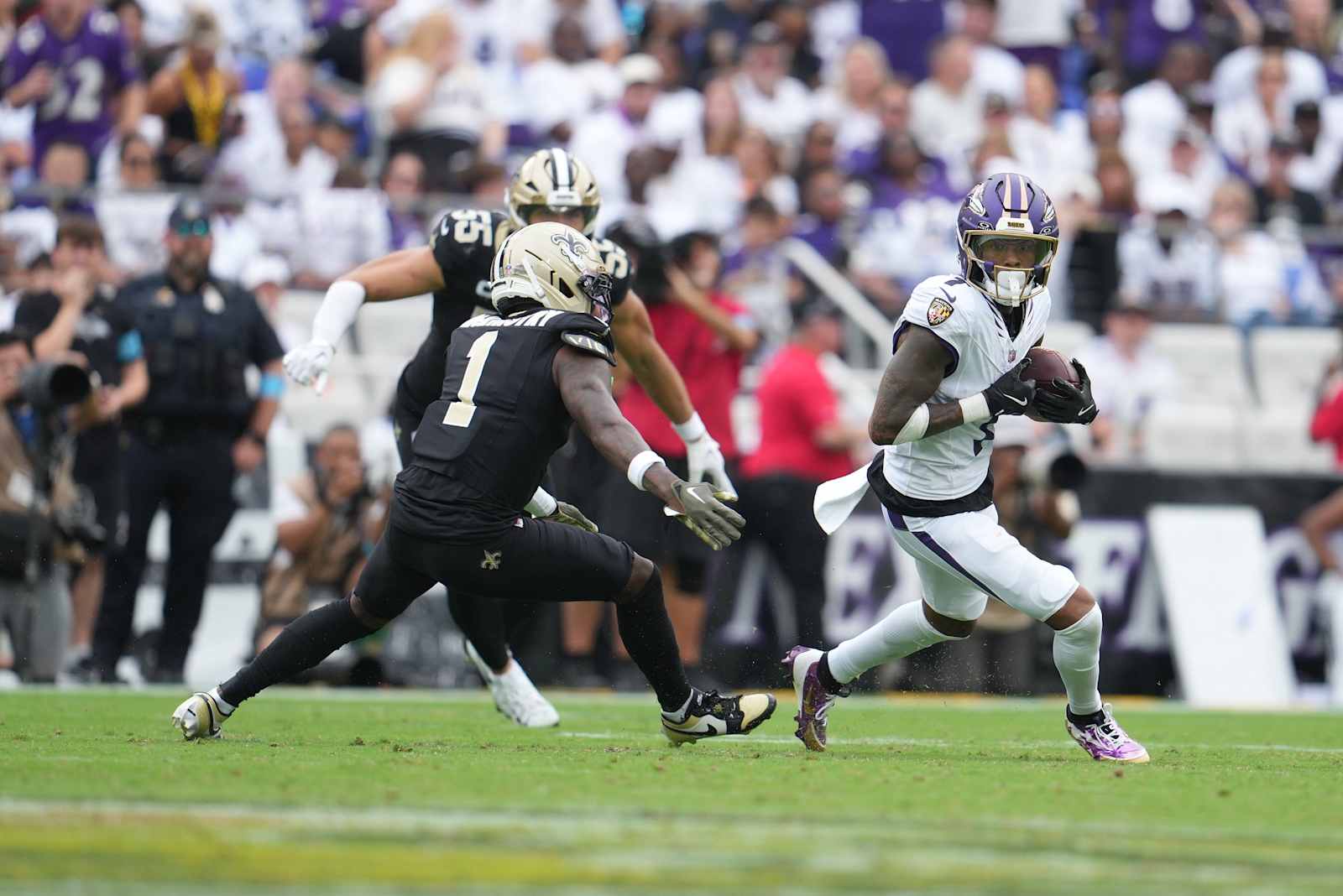
4. The defense could not get off the field
If you looked only at New Orleans’ traditional offensive numbers, you might assume the Ravens played pretty well defensively. The Saints finished with 298 total yards, averaged just 4.7 yards per play and ran for only 65 yards on 27 carries, a miserable 2.4 yards per attempt. The Ravens sacked Shough three times.
That usually wins.
Instead, the Saints scored on four of their final five meaningful possessions and controlled the ball for 32:45 because the Ravens could not finish drives.
New Orleans converted 8 of 15 third downs and both of its fourth downs. The Ravens, by comparison, were 4-of-9 on third down and never attempted a fourth.
That was the game.
Minter said afterward that the Ravens repeatedly lost leverage on checkdowns, missed potential turnover opportunities and failed to match their coverage with their rush. Calais Campbell pointed to missed tackles that allowed routine plays to become conversions.
All of that was visible.
They often had enough defenders around the football, but they did not make the plays.
Shough would find the outlet. A defender would arrive from the wrong angle. A tackle would be missed. Someone would lose Olave underneath. Suddenly a manageable third down had become another first.
Malaki Starks had a particularly rough afternoon.
That is notable after Week 1 because Minter leaned heavily into his dime package against Indianapolis, frequently using six defensive backs with Kyle Hamilton functioning almost like a second linebacker next to Roquan Smith. It looked like a natural way to take advantage of the Ravens’ secondary depth while maximizing Hamilton’s versatility.
Sunday demonstrated the other side of that equation.
Dime only works if the additional defensive backs can execute the responsibilities the package creates. Starks struggled in space and was involved in several of the plays where New Orleans found room underneath. Trenton Simpson, meanwhile, made several useful plays when the Ravens had a more traditional linebacker presence on the field.
One bad game from Starks won’t cause Minter to alter his scheme or approach, but it’s worth watching.
5. How do you lose with a 64.3% offensive success rate?
This might be the weirdest statistic of the afternoon.
According to SumerSports, the Ravens posted a 64.3% offensive success rate, the second-highest rate by a losing team since 2022.
On nearly two-thirds of their qualifying offensive plays, the Ravens accomplished what the situation required to keep the offense on schedule.
And they scored 17 points.
That is almost difficult to do.
The explanation is that success rate treats the steady accumulation of positive plays as valuable, while the scoreboard can swing on a handful of disproportionately important ones.
The Ravens won a lot of snaps, but they lost too many key moments.
Tyler Loop had a 49-yard field goal tipped and pushed wide before later making from the same distance.
New Orleans got a 53-yard kickoff return before halftime that helped produce three points.
Moore nearly fumbled a kickoff away, surviving only because his knee had touched before the ball came out.
The Ravens took possession at the Saints’ 49 with an eight-point lead and moved backward 16 yards.
Seven penalties did not produce a massive yardage total, only 34 yards, but several arrived at especially damaging moments.
The defense repeatedly won first and second down before surrendering third down.
Put it all together and the strange success-rate number makes sense.
The Ravens were good at staying on schedule, but not at converting that efficiency into points.
They did too many of the little things wrong, and that was their ultimate demise in a game where their margins were thinner than normal.
Which Ravens team is real?
So Week 2 was as bad as Week 1 was good.
This loss was exactly the kind Ravens fans spent years wanting to run John Harbaugh out of town over.
A home game against an inferior opponent. An eight-point second-half lead. Questionable game management. Special-teams mistakes. Penalties. An offense that failed to put the game away. A defense that could not get one final stop.
New coach. Very familiar feeling.
At the end of the day, it’s just one football game.
If Sunday ends up being one of the worst losses of the Minter era, we will barely remember it by December. A first-time head coach made some bad decisions, a first-time NFL play caller had an uneven afternoon, an injured roster left itself too little margin and the Ravens learned a lesson without it costing them anything more than one game.
If the same problems continue, the interpretation changes quickly.
The standard for this team is not merely making the playoffs. The Ravens believe they can win a Super Bowl. Teams with those aspirations cannot repeatedly give away games to seemingly inferior opponents.
We’ll see how Minter’s staff and the team regroup for an odd (maybe) trip to Brazil next week. As of Sunday night, the Ravens are still scheduled to travel to Rio de Janeiro to face the Cowboys next Sunday at Maracanã Stadium. The condition of the Maracanã pitch has generated enough concern that a relocation to Dallas has been discussed publicly, but the NFL has not moved the game yet. The league’s official schedule, Rio event page and game-week materials continue to list Ravens-Cowboys for Sunday, September 27 at 4:25 p.m. ET in Rio.
They will arrive 1-1, with one week that made everything about the new era look exciting and another that brought back almost every old frustration at once.
Which one is the real 2026 Ravens?
Two games in, we still don’t know.
Dallas should help us learn a little more.