
Barcelona came into this week with the most dangerous attack in Europe. By Saturday night, it somehow looked even more ridiculous.
The 7–2 demolition of Racing Santander on Wednesday was the kind of scoreline that turns a good start into a story. The 3–1 win at Sevilla three days later mattered more. Barcelona is now eight-for-eight in all competitions, seven-for-seven in La Liga, and has scored 31 league goals. The run has come without a conventional starting striker.
Raphinha has nominally played through the middle, but “through the middle” is doing a lot of work. He drifts, presses, combines and attacks the box rather than holding a center-back in one place. Lamine Yamal stays high and wide until the moment he does not. Karim Adeyemi gives the left side real depth. Pedri, Fermín López and Dani Olmo can all arrive in the same spaces, while João Cancelo steps inside and Rodri holds the structure underneath them.
That is a lot of movement around an open center. It is also starting to look as if Barcelona may not need a traditional No. 9 as badly as it thought it did.
Barcelona 7–2 Racing Santander: 6.74 xG Is Absurd
Barcelona’s 6.74 expected goals against Racing was the highest total in a La Liga match since Opta’s data begins in 2010–11. Three penalties helped, and that caveat matters. It does not make the performance any less extraordinary.
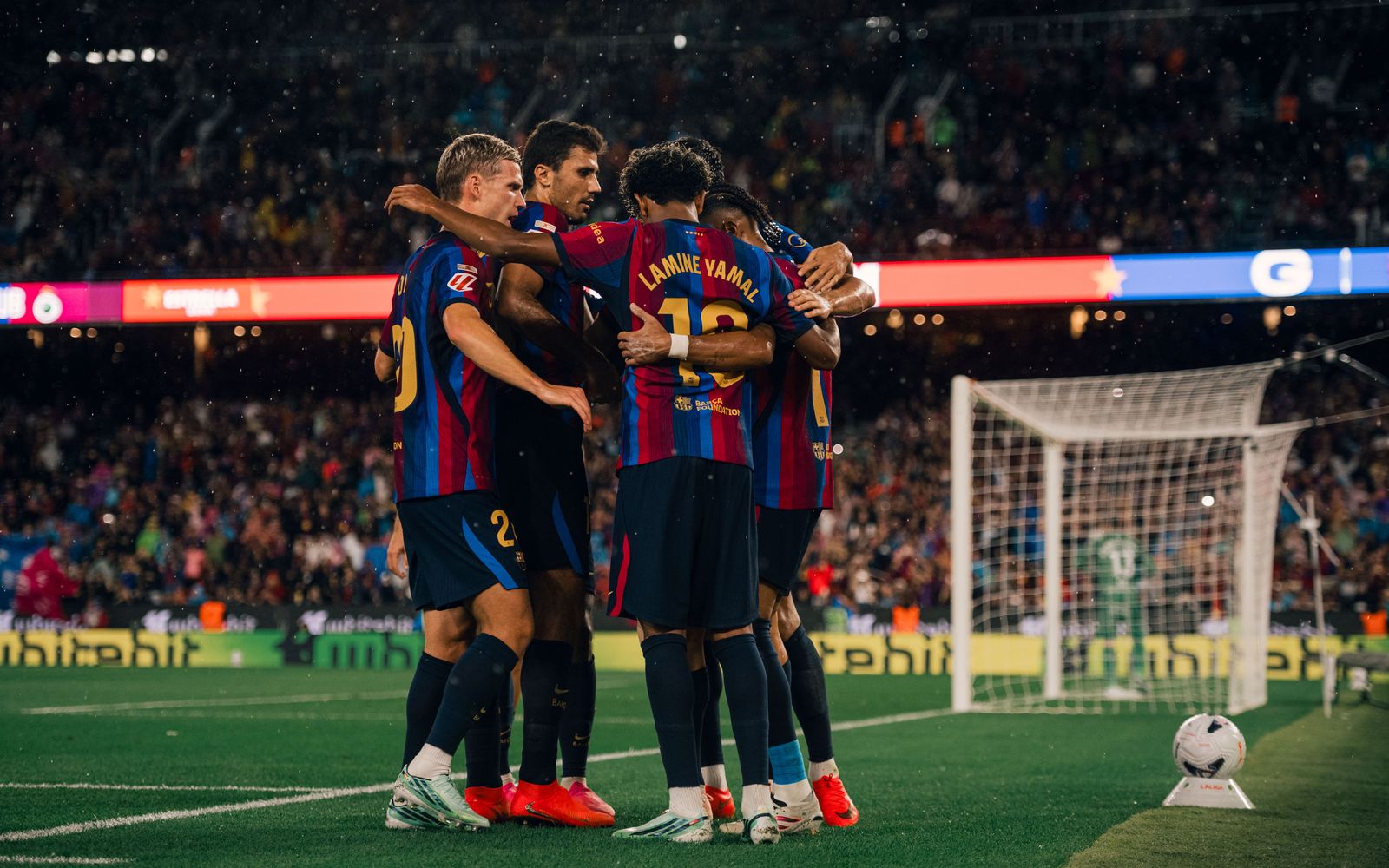
Raphinha began centrally, with Adeyemi on the left and Lamine on the right. Rodri, Pedri and Dani Olmo ran the midfield. Barcelona’s counterpress turned the game into a series of traps: Racing tried to play through the first wave, Rodri or Pedri met the next pass, and the front three were suddenly attacking an unsettled defense.
Adeyemi gave the attack a different kind of stress. His pace and width forced Racing’s back line to stretch, and his willingness to run at defenders produced two penalties before he set up Lamine. Cancelo’s aggressive movement inside created another extra player in the middle. Raphinha supplied a hat trick, but the more striking part was how often Barcelona reached the box with a new combination of runners.
Racing offered a useful warning, too. A promoted opponent that kept trying to play through Barcelona’s press is almost perfectly designed to make this version of the team look overwhelming. The ceiling was obvious. The next match would tell us more about the floor.
Sevilla 1–3 Barcelona: The More Impressive Win
Sevilla entered the weekend with 13 points from six matches and one of the better defensive records in the league. Barcelona lost 4–1 at the Sánchez-Pizjuán last season. This was a much more awkward setting than Racing, and Sevilla made it feel that way early.
The home side crowded the interior spaces, challenged Barcelona’s rest defense in transition and took the lead. Raphinha answered quickly, but the first half was messy enough to make the match a real test rather than another procession. Rodri’s recoveries became increasingly important as Sevilla tried to turn loose possessions into attacks.
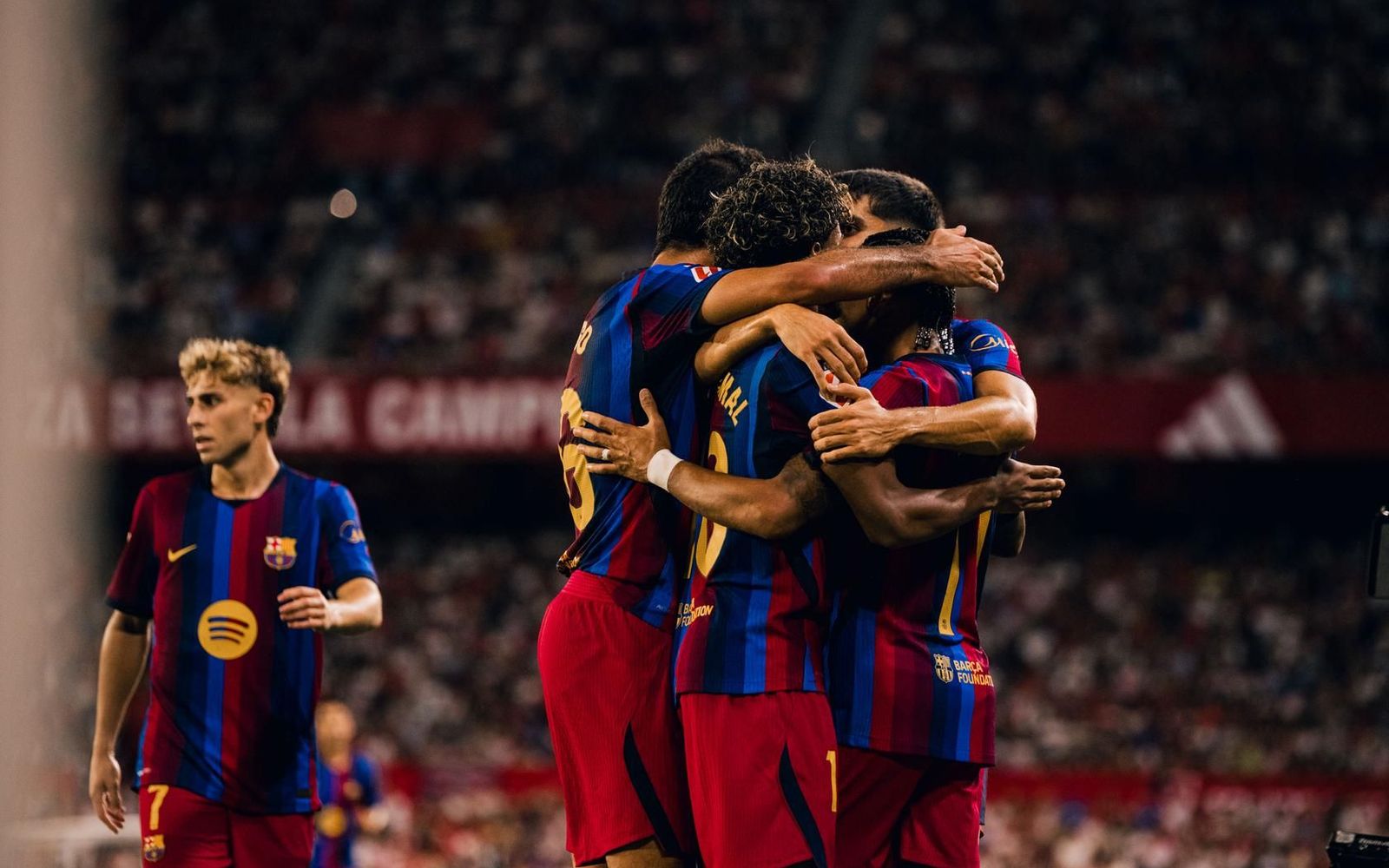
Flick’s adjustments changed the shape of the second half. Barcelona used more width, let Pedri take greater control of the rhythm and made Sevilla defend the full field. Lamine created the second goal with a cross that Raphinha headed home. Then he released Raphinha into space for the third, a composed chip that completed a perfect hat trick: right foot, header, left foot.
The Racing match showed what this attack can do when everything opens. Sevilla showed it can solve a real problem. That distinction is why the latter was the more impressive result.
How Historic Is This Start?
Barcelona has never begun a competitive season with eight straight wins. The club’s previous best starts were six in 1929–30, 1960–61 and 2018–19. Seven league wins also put the team one short of the club record, set under Tata Martino in 2013–14, with Getafe waiting after the international break.
The scoring pace is every bit as extreme. Thirty-one goals in seven league matches is more than four per game. Raphinha has 12 of them, the third-best start to a La Liga season on record: only Echevarría’s 14 in 1943–44 and Cristiano Ronaldo’s 13 in 2014–15 were higher through seven matches.
Barcelona scored 95 league goals and collected 94 points on the way to last season’s title. This pace will not hold for nine months; no reasonable attack should be expected to score at this rate. But “unsustainable” and “historically good” can both be true. The start has already earned the second description.
Are Barcelona and Real Madrid This Good, or Is La Liga That Bad?
There is a schedule caveat. Racing is newly promoted and followed the Barcelona loss with a 5–0 defeat to Celta. The gap in money and depth between Spain’s biggest clubs and much of the league remains enormous. Barcelona and Real Madrid should be expected to win a lot of games by overwhelming opponents who cannot rotate at the same level.
Madrid has looked excellent, but not untouchable: it lost 1–0 at Betis and needed to work through an uncomfortable two-goal deficit at Elche. The larger league is not a reason to dismiss Barcelona’s run, either. Spain still sits third in UEFA’s coefficient ranking behind England and Italy, and the early European results have included Barcelona’s 5–1 win over Feyenoord, Madrid’s 2–1 win over Inter and Real Betis’ 3–2 victory over Lille.
The better answer is that Barcelona is very good, while La Liga’s unevenness helps make the good weeks look even bigger. Sevilla was the useful corrective: a capable opponent, a difficult road environment and a game Barcelona had to actively solve.
The schedule will sharpen the argument soon enough. El Clásico arrives late in October, and the Champions League phase includes Paris Saint-Germain, Aston Villa and Manchester City. The current sample is not the final verdict. It is more than a flattering opening fixture list.
Raphinha Is the Early Player of the Season in Europe
Six goals in four days moved Raphinha from excellent form into early Player of the Season territory. Twelve league goals in seven matches, consecutive hat tricks and that company in the historical table are the loudest parts of the case. The more interesting part is how he is doing it.
As the nominal center forward, Raphinha does not simply wait for cutbacks. He drops toward playmakers, makes the next run into the box, helps lead the press and creates space for the wide players by refusing to give defenders one fixed reference point. Against Sevilla, every part of the perfect hat came from a different version of that movement.

There are more naturally gifted dribblers in the squad and players with bigger long-term ceilings. Raphinha is the attacker making the entire structure cohere right now. Barcelona’s attack is fluid because it trusts him to do several jobs at once.
Lamine Still Doesn’t Look Completely Right, Which Is Terrifying
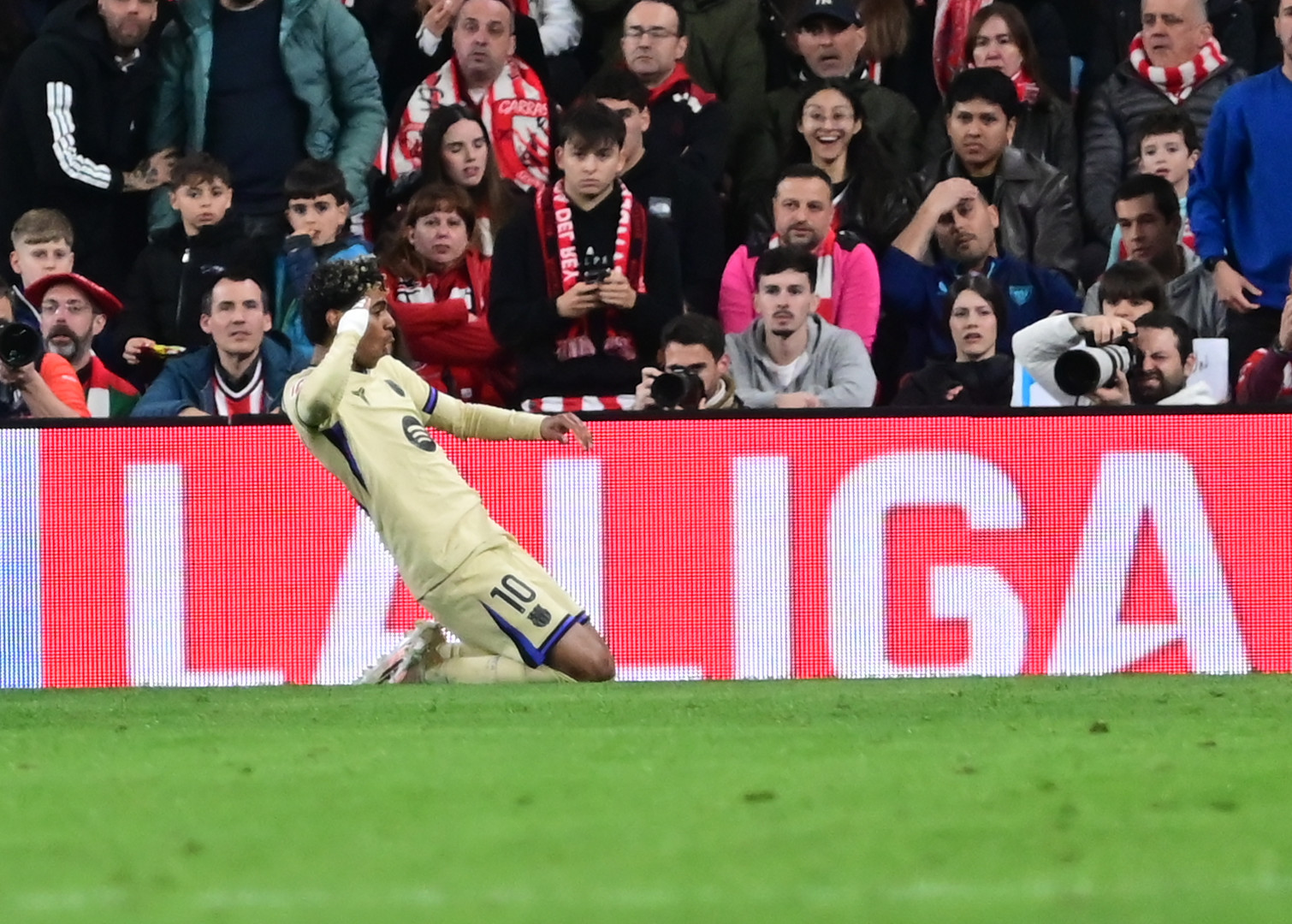
Lamine has been slightly loose by his own standards. He has forced a few actions, missed a penalty against Racing and has not looked completely free in every exchange. The numbers still point to a player controlling games: he created 21 open-play chances before the Sevilla trip, more than anyone in Europe’s five biggest leagues, then created the final two goals there.
The important thing is the geometry. When Lamine receives wide, opponents have to shade toward him. That opens the central lane for Raphinha, creates a later run for Pedri or Dani Olmo, and leaves the weak-side winger with room to attack. He can have a quiet spell by his standards and still bend the entire defense around him.
If this is what Barcelona looks like while Lamine is still searching for his cleanest individual rhythm, the next version of the attack is a little frightening.
Adeyemi Is Making a Strong Case Over Gordon
Anthony Gordon remains the more reliable structural option. He presses, holds the width and has already produced four assists. Adeyemi, though, is becoming hard to leave out.
He has two league goals and two assists, but the more valuable contribution is the panic he creates. Adeyemi attacks space in a way few players in the squad can match. He stretches the field before the ball reaches him, carries through a broken shape after the ball does, and makes a defense pay when it finally has to open up. The Racing performance—two penalties won and an assist for Lamine—was the clearest illustration.
That does not mean the choice has to be permanent. It does mean Barcelona can vary the front line without losing its identity, and it gives Flick a different weapon for the Champions League matches that will ask for a more direct transition threat.
Does Barcelona Actually Need a Striker?
The question shaped the summer. Robert Lewandowski left. Ferran Torres is leaving. Julián Álvarez did not arrive. Gabriel Jesus adds versatility, but not a conventional successor to the old No. 9 role.
Through the Racing match, Raphinha had played 91 percent of his minutes at center forward after essentially never doing so last season. Barcelona was creating 0.20 expected goals per shot, the best rate in Europe’s five major leagues. It is a small sample, but the signal is clear: the team has not merely survived without a target striker. The space created by the absence of one has become part of its attack.
There will be matches when Barcelona faces a deep block and needs a more traditional option around the penalty spot. Gabriel Jesus, or a different bench profile later in the season, could still matter a great deal. The point is not that the roster could never use another striker.
It is that Barcelona entered the year wondering where the goals would come from without Lewandowski. Eight games later, it may have asked the wrong question.