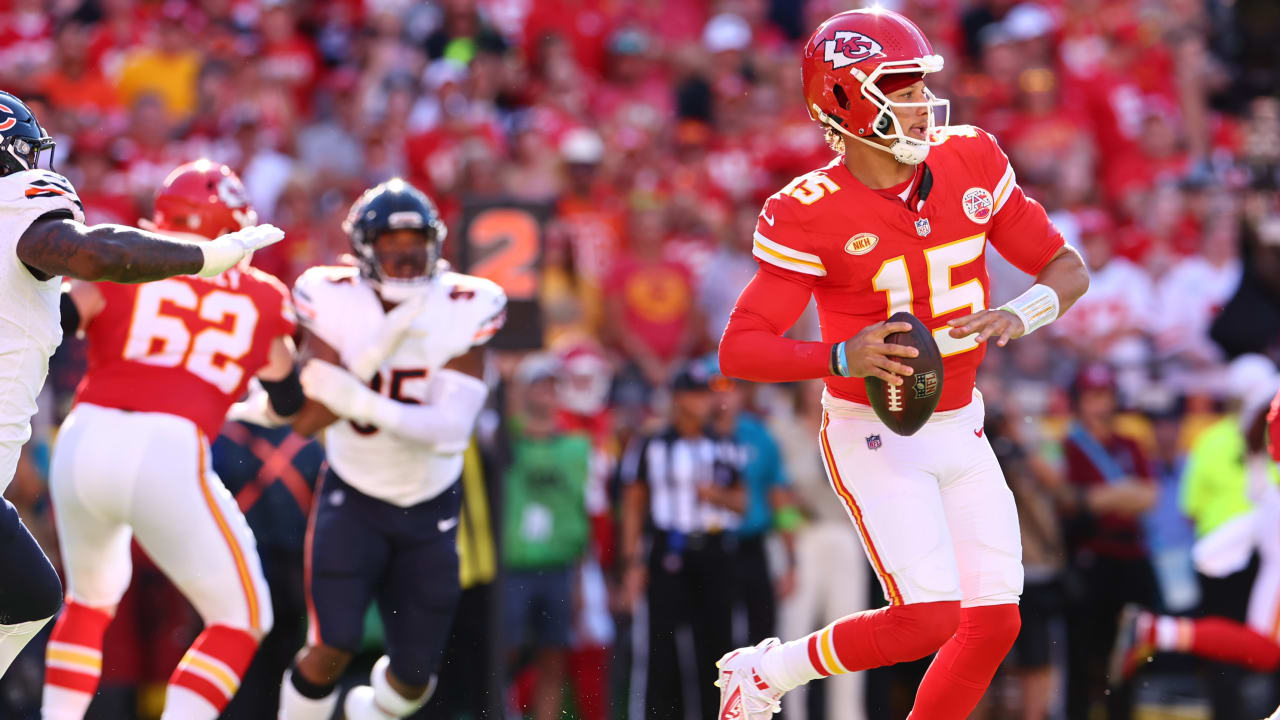
After three weeks we can start to get a fuzzy picture of which teams are consistently executing on one or both sides of the ball and start identifying some emerging trends.
The Week 3 Dual Eights Efficiency Index has a new top team, with Kansas City jumping four spots to take the top position at 86.7. The Jags made an even larger move, climbing from seventh to second. Cincinnati and Chicago surged into the top seven. Meanwhile, the Ravens slipped from third to fifth despite winning in Brazil, and San Francisco fell five spots despite remaining undefeated.
And then there are the Buffalo Bills.
Buffalo is 3-0, has perhaps the best offense in football and sits at or near the top of most conventional power rankings.
The Dual Eights Efficiency Index has them tied for 13th.
If that looks strange, it’s kind of the point.
This is not a power ranking.
The Dual Eights Efficiency Index measures what teams have actually done on a play-by-play basis through three weeks. The score is the equal-weight average of league percentiles in offensive EPA per play, offensive success rate, defensive EPA allowed per play and opponent success rate. It does not adjust for opponent strength, injuries, preseason expectations or whether we think a team is “better” than its performance so far.
That distinction becomes particularly useful this early in the season, when records, reputation and actual efficiency can tell very different stories.
Week 3 Dual Eights Efficiency Index Top 10
| Rank | Team | Record | Index | Week 2 | Change |
|---|---|---|---|---|---|
| 1 |  Kansas City Chiefs Kansas City Chiefs | 3-0 | 86.7 | 5 | +16.4 |
| 2 |  Jacksonville Jaguars Jacksonville Jaguars | 2-1 | 82.8 | 7 | +18.7 |
| 3 |  Seattle Seahawks Seattle Seahawks | 2-1 | 81.2 | 2 | +5.4 |
| 4 |  Cincinnati Bengals Cincinnati Bengals | 2-1 | 72.7 | 9 | +11.0 |
| 5 |  Baltimore Ravens Baltimore Ravens | 2-1 | 71.1 | 3 | -2.3 |
| 6 |  San Francisco 49ers San Francisco 49ers | 3-0 | 70.3 | 1 | -14.9 |
| T-7 |  Chicago Bears Chicago Bears | 2-1 | 69.5 | 13 | +14.8 |
| T-7 |  Los Angeles Rams Los Angeles Rams | 1-2 | 69.5 | 6 | +1.5 |
| 9 |  Atlanta Falcons Atlanta Falcons | 1-2 | 60.9 | 23 | +17.9 |
| 10 |  Carolina Panthers Carolina Panthers | 1-2 | 60.2 | 9 | -1.5 |
1. Kansas City Chiefs, 86.7
The Chiefs are the team which the standings, power rankings and efficiency index all seem to agree.
They were 2-0 entering Week 3 but sat fifth in the index at 70.3. Their 24-10 win over Miami pushed the score up 16.4 points and moved them into first. Again, this ranking has no opponent adjustment (at least not yet), so they don’t get penalized for beating perhaps the worst team in the league.
The first-place ranking comes entirely from their three-week efficiency profile. At 3-0 and 86.7, they currently have the cleanest combination of results and underlying play in the league.
2. Jacksonville Jaguars, 82.8
Jacksonville produced the largest index gain of any team this week, climbing 18.7 points from 64.1 to 82.8.
Unlike a normal ranking, there is no need to slowly move the Jaguars upward because we entered September with doubts about them. They beat New England 35-6 and the underlying performance was every bit as dominant as the score.
Put that performance on top of Jacksonville’s first two games and the Jaguars suddenly own the second-best efficiency profile in football.
Whether they can sustain it is a separate question. Three games remain a small sample and the index does not adjust for schedule.
For now, though, Jacksonville has earned its spot.
3. Seattle Seahawks, 81.2
Seattle offers our first useful reminder that the index is measuring more than wins and losses.
The Seahawks lost 33-31 to Washington, yet their index increased from 75.8 to 81.2. They remain third.
A metric built around snap-to-snap efficiency is naturally going to view a close loss differently than the standings do, particularly when turnovers and other high-leverage plays disproportionately affect the final score.
Seattle is 2-1.
The index is essentially arguing that its three-week body of work has looked considerably better than a generic 2-1 record.
4. Cincinnati Bengals, 72.7
Cincinnati lost 30-27 in Pittsburgh but climbed from ninth to fourth and gained 11 index points.
Again, that is not a mistake. The Bengals’ overall efficiency profile improved even though the game result did not.
This is where the index becomes more interesting than simply sorting teams by record. A three-point road loss does not automatically erase efficient football played within that game or during the previous two weeks.
The Bengals now enter Week 4 with the fourth-best score in the league.
That will matter again shortly.
5. Baltimore Ravens, 71.1
The Ravens won in Week 3 and fell two places.
The 34-31 escape against Dallas was valuable in the standings and enormously entertaining, particularly when Lamar Jackson found Zay Flowers for 27 yards in the final seconds and Tyler Loop drilled a 56-yard walk-off field goal.
But this wasn’t a performance that should erase the concerns created by the previous week.
The Ravens fell from 73.4 to 71.1, a relatively modest 2.3-point decline, and remain fifth overall. Their offense is doing much of the work required to keep them there. The defense remains much harder to trust.
Dallas repeatedly stressed a Ravens defense still searching for the consistency Jesse Minter expected his talented group to produce.
The Ravens survived anyway.
Lamar threw two touchdown passes, added 50 rushing yards and created the play that put Loop in range at the end. Zay’s return immediately restored an element that was missing from the passing game against New Orleans. Even on an afternoon when Derrick Henry averaged only 3.4 yards per carry, the offense generated enough answers to score 34.
There is a fairly obvious early identity forming here.
When the offense is intact, the Ravens have enough firepower to remain one of the league’s most efficient teams even when other parts of the roster are not functioning particularly well.
The problem is that “intact” is becoming harder to assume.
Baltimore finished the Dallas game after losing both Jovaughn Gwyn and Ethan Pocic, forcing rookie first-round guard Vega Ioane to play center. That makes the offensive line an even larger variable as the Ravens move into October.
So fifth feels like a pretty accurate description of the Ravens after three weeks.
They have played like one of the better teams in football. They have also shown enough defensive inconsistency and accumulated enough offensive-line uncertainty to leave lingering questions moving forward.
The encouraging part is that a 71.1 after three very different games still puts Baltimore firmly among the league’s early efficiency leaders.
6. San Francisco 49ers, 70.3
Here is one of the strangest top-10 results.
San Francisco is 3-0. It beat Arizona 36-30 in Week 3. And it dropped from first to sixth while losing 14.9 index points.
This is mostly a reflection of their outstanding 85.2 efficiency score through two weeks. That was always likely to regress a bit and its third performance pulled the cumulative efficiency numbers closer to the rest of the league.
That is exactly the sort of movement we should expect in September. One game still represents a third of the entire sample.
The 49ers remain sixth. The early gap between them and everyone else simply disappeared.
T-7. Chicago Bears, 69.5
Chicago produced one of the week’s largest moves, gaining 14.8 points and climbing six places after beating Philadelphia 27-7 on Monday night.
That result also helps illustrate why early index movement can be so violent.
Chicago has already experienced radically different performances through three weeks. Those games are being compressed into one number.
Right now, the composite is good enough for seventh.
T-7. Los Angeles Rams, 69.5
The Rams might be the most interesting record-versus-performance team in the top 10.
They are 1-2 after blowing a 16-0 halftime lead in a 30-26 loss to Denver, yet their efficiency score actually increased slightly from 68.0 to 69.5.
That doesn’t excuse the losses. Games are ultimately decided by points, not EPA spreadsheets.
It does suggest that treating the Rams as a typical 1-2 team would miss something about how they have actually played.
9. Atlanta Falcons, 60.9
No team climbed more places this week.
Atlanta jumped from 23rd to ninth, a 14-position rise, after beating Green Bay 35-14 at Lambeau Field. The index increased 17.9 points, second only to Jacksonville.
After losing 34-3 to Carolina in Week 2, Atlanta desperately needed a performance that changed the early picture.
It got one.
The Falcons still have only a 1-2 record, but they no longer have a bottom-third efficiency profile.
10. Carolina Panthers, 60.2
Carolina rounds out the top 10 despite losing 21-18 to Cleveland.
Its index dropped only 1.5 points, leaving the Panthers essentially where they were a week ago.
A 1-2 Carolina team sitting tenth is another useful reminder of what this exercise is and is not. Nobody is awarding playoff spots based on success rate in September. The index is simply telling us that, over the eligible offensive and defensive plays through three games, Carolina has performed better than its record suggests.
That is worth knowing.
Wait, the Bills Are 13th?
Yes.
Buffalo is 3-0 and tied for 13th in the Dual Eights Efficiency Index at 57.0. The Bills actually fell only 0.8 index points from last week, when they were 11th, so this is not a one-game collapse after their messy 24-16 win over the Chargers.
It is also almost comically different from the consensus view of Buffalo.
CBS Sports has the Bills No. 1 entering Week 4. The New York Post also has them first. NFL.com, apparently the skeptic of the group, has them third.
So why does Dual Eights dislike them so much?
It’s their defense.
Buffalo’s offense ranks second in EPA per play at +0.22 through three weeks. Josh Allen is fourth among quarterbacks in EPA per play, James Cook has been one of the league’s most efficient runners, and the Bills have generally looked every bit as dangerous with the football as their reputation suggests.
Then you flip the field.
The Bills are 25th in defensive EPA per play, allowing +0.075 EPA per snap, and 27th in defensive success rate, with opponents succeeding on 47.2 percent of their plays.
That matters enormously in this particular metric.
Dual Eights does not ask whether an elite quarterback can compensate for a bad defense. It simply takes four components and gives each exactly 25 percent of the score. Buffalo’s outstanding offensive EPA percentile receives no more weight than its poor defensive EPA percentile. Offensive success rate cannot overwhelm opponent success rate.
Power rankings do something very different.
A human ranking Buffalo first can reasonably consider Allen’s presence, a 3-0 record, preseason expectations, the likelihood that a shaky defense improves and the very relevant fact that the Bills have already beaten Houston, Detroit and the Chargers. An analyst can decide that an elite quarterback and offense make Buffalo more dangerous than a team with a more balanced three-week statistical profile.
The index does not know Josh Allen exists.
That is both its limitation and the point of the exercise.
There is even an argument that 13th undersells Buffalo’s underlying performance. Another nflverse-based efficiency model has the Bills ninth in net EPA per play through Week 3, with the second-ranked offense overcoming a below-average defense. Different play filters and weighting systems produce slightly different answers.
But the larger signal is consistent.
Buffalo’s offense has been excellent.
Buffalo’s defense has not.
That is enough to keep the Bills out of the Dual Eights top 10, even while just about everybody watching them would still consider Buffalo one of the NFL’s most dangerous teams.
Honestly, that disagreement is more interesting than if the index had simply put them first.
The Biggest Risers
| Team | Week 2 | Week 3 | Rank change | Index change |
|---|---|---|---|---|
| Atlanta | 23 | 9 | +14 | +17.9 |
 Tampa Bay Tampa Bay | 27 | 17 | +10 | +10.2 |
 Cleveland Cleveland | 29 | 21 | +8 | +9.4 |
| Chicago | 13 | T-7 | +6 | +14.8 |
| Jacksonville | 7 | 2 | +5 | +18.7 |
| Cincinnati | 9 | 4 | +5 | +11.0 |
| Kansas City | 5 | 1 | +4 | +16.4 |
Jacksonville made the largest numerical improvement, but Atlanta made the biggest move in the actual rankings.
Jacksonville deserves the headline because its 18.7-point gain was the largest in the league and pushed it all the way to second.
Atlanta’s jump might be even more dramatic conceptually. A team that ranked 23rd last week is now inside the top 10.
Chicago’s movement is another one worth tracking.
We still do not know which version is normal.
That’s September.
And the Biggest Fallers
| Team | Week 2 | Week 3 | Rank change | Index change |
|---|---|---|---|---|
 Green Bay Green Bay | 18 | 31 | -13 | -19.5 |
 Washington Washington | 15 | 25 | -10 | -10.5 |
 New York Jets New York Jets | 4 | 12 | -8 | -14.1 |
 New England New England | 13 | T-21 | -8 | -10.9 |
| San Francisco | 1 | 6 | -5 | -14.9 |
 Philadelphia Philadelphia | 25 | 29 | -4 | -10.6 |
Green Bay suffered the week’s most severe correction.
The Packers dropped 19.5 points and 13 places after Atlanta beat them 35-14.
San Francisco’s fall is more interesting because the 49ers actually won. The index is not punishing them for a loss. There wasn’t one. It is responding to a game that was less efficient than their dominant opening two-week profile.
Meanwhile, the Jets fell out of the top four, New England’s demolition in Jacksonville sent it eight places lower and Philadelphia dropped another four spots after Chicago handled it on Monday night.
Miami did not technically fall at all.
It was already 32nd.
Its index still dropped from 21.1 to 11.7, creating even more separation between the Dolphins and everyone else at the bottom.
Week 4 Game of the Week: Jaguars at Bengals
The index points to a pretty clear Week 4 matchup.
Jacksonville travels to Cincinnati on Sunday with the No. 2 Jaguars facing the No. 4 Bengals.
Jacksonville carries an 82.8 index. Cincinnati sits at 72.7. Their combined 155.5 score is the highest of any Week 4 matchup, while the 10.1-point difference between them is the fourth-smallest gap on the schedule.
It gives us an immediate test for two of this week’s biggest risers.
Jacksonville’s demolition of New England pushed the Jaguars nearly to the top of the league. Cincinnati rose five places even while losing in Pittsburgh.
Now they get each other.
Kansas City at Las Vegas offers another interesting contrast, with the No. 1 Chiefs facing a 3-0 Raiders team ranked only 11th. Jets-Bears matches one of this week’s biggest fallers against one of its biggest risers.
And locally, Tennessee comes to Baltimore.
The Titans are 0-3 and tied for 18th at 44.5, compared with the Ravens at No. 5 and 71.1. That 26.6-point gap makes the Ravens a substantial efficiency favorite on paper. The more interesting part will be what Baltimore looks like after another week of reshuffling an offensive line that might now have a rookie guard playing center.