
The first month of the new club season and the opening international window of the 2030 World Cup cycle have provided plenty of new information about the USMNT player pool. The established stars remain firmly at the top of the Project 2030 Big Board, but several young prospects are beginning to make a legitimate push toward the senior team.
The biggest movers in our October 9 update are Cavan Sullivan and Neil Pierre, two Philadelphia Union teenagers whose increasingly prominent MLS roles are finally giving us meaningful first-team performances to evaluate. Several other young Americans have made substantial gains, while a handful of established national-team players have slipped.
The top of the board, however, looks familiar.
Antonee Robinson and Weston McKennie share the highest Current Score at 66.2, followed by Chris Richards (65.6) and Christian Pulisic (65.2). When projecting toward the 2030 World Cup, Richards remains the leader at 73.2, followed by Folarin Balogun (70.7) and McKennie (68.0).
That’s probably about right. The US has a relatively young group of established international players, many of whom should still be in their primes four years from now. The next generation doesn’t need to replace the entire team. It needs to provide genuine competition for those players and, ideally, introduce a few difference-makers who can raise the team’s ceiling.
One significant change also came away from the field. Noahkai Banks has been removed from the board after choosing to represent Germany.
The updated rankings incorporate club performances through October 5 and the four senior international friendlies through October 6. The Current Score is weighted primarily toward club performance (65%), with club playing time and role (15%) and national-team evidence (20%) completing the evaluation. The 2030 projection then adjusts for age, recent development and market value.
The Biggest Risers
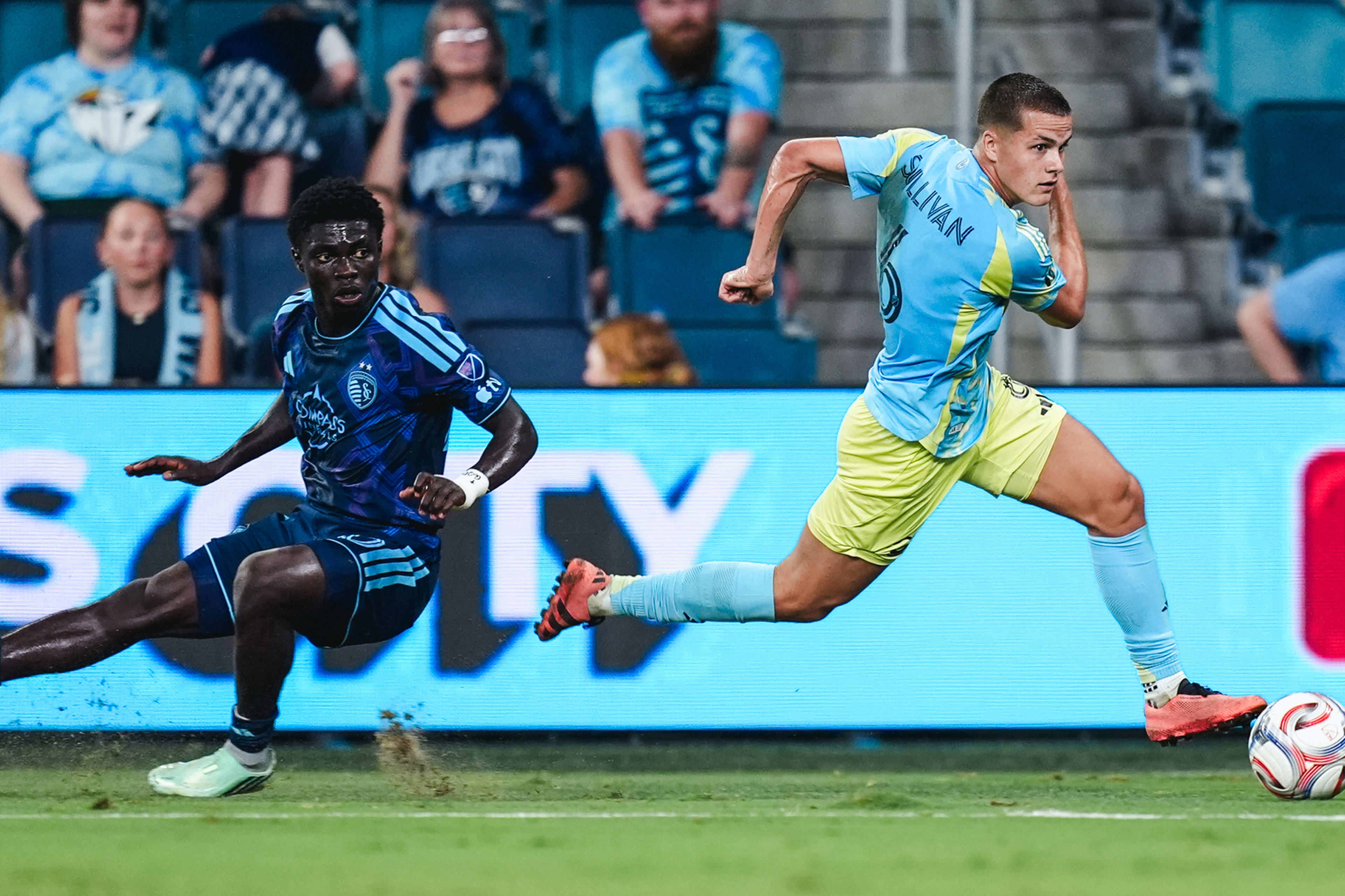
Cavan Sullivan: From Hyped Prospect to Legitimate USMNT Contender
Nobody has made a stronger case for a rapid rise than Cavan Sullivan.
The 17-year-old Philadelphia attacker jumps from No. 48 to No. 28 in the Current rankings, with his score improving from 36.3 to 45.8. His 2030 projection climbs to 56.5, putting him among the top 20 players in the pool.
Using club performances from May 1 through October 5, Sullivan has accumulated 1,382 expanded minutes, including stoppage time, with seven goals and three primary assists. That is a meaningful sample of senior soccer for a player who was barely featuring regularly when the year began.
More importantly, the performances increasingly justify the enormous expectations that have followed Sullivan for years.
His ability to recognize passing lanes, combine in tight spaces and beat defenders off his first touch has always been unusual for an American prospect. What has changed is that those qualities are now producing goals and chances against professional defenders.
We’ve seen him create from the right wing, drift into central attacking positions and make runs into the penalty area. His recent scoring streak has included everything from a spectacular individual finish against Red Bull New York to a clever backheel goal against San Diego.
There is still reason for restraint. MLS is not the Premier League, Sullivan remains physically immature and a few months of exceptional performances don’t establish him as an international star.
But, I would be surprised if Sullivan is not on the move to Europe as early as this January. While he can’t join Manchester City until he is 18 (if they aren’t relegated), an earlier move to a club in Spain, France or Germany would depend on meeting FIFA’s rules for international transfers of minors and receiving the required approval.
For me, that makes him the most exciting story in the American player pool right now.
Neil Pierre: Another Philadelphia Prospect Making His Case
Sullivan isn’t the only young Philadelphia player making an enormous leap.
Center back Neil Pierre climbs from No. 43 to No. 25 in the Current rankings, improving from 37.7 to 46.2. His 2030 projection rises to 56.2, placing him just behind Sullivan.
Pierre presents a very different developmental profile.
At 6-foot-5, he has the physical tools to become an imposing presence in the middle of the defense. But what makes him especially intriguing is his combination of size and mobility. He can defend in the air, cover substantial space behind the back line and step forward to challenge attackers before they get into dangerous positions.
His recent performances for Philadelphia have also featured some ridiculous attacking production from set pieces.
His playing-time component jumps from 31.6 to 67.7, reflecting his increasingly established first-team role. The updated evaluation also incorporates a much more substantial sample of his performances specifically at center back.
With Banks no longer available to the US, the competition for future center back roles becomes even more important. Richards is firmly established, but there are opportunities for younger players to force their way into the conversation.
Pierre is beginning to look like one of the more promising candidates.
The Next Group: Cowell, Che, Miller and Ellis
There were several other substantial improvements among younger MLS players.
Cade Cowell recorded an eight-point increase from 33.2 to 41.2, moving from 59th into the mid-30s. Justin Che gained 6.3 points, Justin Ellis 5.8 and Peyton Miller 6.1.
Miller’s improvement is particularly interesting because it involves a positional change.
Although he has often been discussed as an attacking left back, Miller has spent most of the current MLS season playing farther forward. Of his 18 starts, 15 came in attacking positions and only three at left back.
The new board evaluates him as a winger rather than a fullback, applying the performance standards appropriate to the role he has actually been playing.
That doesn’t settle where Miller ultimately fits with the USMNT. His versatility remains one of his more appealing characteristics, particularly for a national team that could use attacking options on the left.
Another young midfielder, Niko Tsakiris, climbs from No. 68 to just outside the top 50. His improvement comes partly from properly excluding seven matches he missed through injury and evaluating him as an attacking midfielder, where he has played 17 of his 18 league starts.
Sebastian Berhalter is another player whose updated club record improves his evaluation. His Current Score rises 2.5 points to 55.3, supported by a Middlesbrough sample that includes eight starts in eight eligible matches and encouraging passing-creation numbers.
Unlike the teenage prospects, Berhalter is already well established in the senior-team conversation. The more relevant question is whether his developing club role can make him an increasingly reliable midfield option for Pochettino.
The Biggest Fallers
Brenden Aaronson and Joe Scally Slide
Two of the more notable established USMNT fallers are Brenden Aaronson and Joe Scally.
Aaronson drops from a 58.4 Current Score to 55.2, falling from No. 10 to No. 14. His 2030 projection declines four points to 57.2.
The primary reason is a decline in his performance component, while his club-role score remains relatively stable. Aaronson hasn’t suddenly lost his place in the professional game. The recent evidence simply hasn’t been as strong as the previous evaluation suggested.
It’s consistent with the concern that has followed him throughout his Premier League career. Aaronson contributes plenty through pressing, movement and quick combinations, but he has struggled at times to translate that activity into consistently dangerous attacking production.
For a player who could be approaching his prime in 2030, the next step needs to involve more influence on the actual creation of chances.
Scally falls from 59.5 to 56.6 in the Current rankings, while his 2030 projection drops from 63.3 to 58.9.
He still has a strong club-role score, but his recent performance evaluation and projected trajectory are less encouraging.
Scally remains a useful national-team defender with significant experience at a high level. However, the emergence of Alex Freeman, combined with Sergiño Dest’s continued development, gives the US more interesting alternatives at right back than it had a few years ago.
Scally’s value increasingly rests on providing defensive reliability and tactical flexibility. Those are legitimate strengths, but they may not be enough to keep him near the top of the depth chart if the other options continue improving.
Current Form vs. 2030 Potential
One of the more useful features of the Big Board is the distinction between a player’s current standing and his projection for the next World Cup. They are not always moving in the same direction.
Julian Hall is a good example. His Current Score increases by only 2.9 points to 37.6, but his 2030 projection climbs 8.6 points to 53.2.
The improvement comes from a more accurate picture of his first-team role, corrected comparisons with previous playing time and the significant developmental runway he still possesses as a teenager.
At the opposite end of the age spectrum, Tim Ream improves his Current Score by 5.2 points to 50.4. But his 2030 projection remains only 35.3, as the model appropriately recognizes the enormous age-related uncertainty involved in projecting him four years into the future.
Auston Trusty illustrates another variation. His Current Score declines 1.8 points, yet his 2030 projection increases slightly to 53.7 following updated defensive evidence.
Rank changes can also be misleading. Gianluca Busio and Rokas Pukštas each lose 11 places in the initial October ranking, despite Busio’s Current Score declining only 0.4 points and Pukštas’s remaining unchanged at 39.8. Other players passed them; they didn’t necessarily get substantially worse.
The numbers provide a useful framework for comparing players, but they shouldn’t be mistaken for precise measurements of development. Particularly with young prospects, playing time, tactical role and the quality of the available data can change substantially over a relatively short period.
What Comes Next
The next few months should provide a clearer picture of which early-season breakthroughs are sustainable and which players can translate their club performances into meaningful national-team contributions.
Pochettino faces a balancing act. He needs to build chemistry among the established core without allowing those players to assume their positions are guaranteed. Bringing younger players into camp is useful, but the real objective is determining whether they can improve the team against stronger opposition.
The more significant checkpoint will come in 2028, with a potential Copa America offering the kind of competition that can expose weaknesses that friendlies and CONCACAF matches often don’t.
For now, the early returns are encouraging. The US doesn’t need to overhaul its roster before 2030, but it does need more than the same group of players returning four years older.
The next generation is beginning to give Pochettino some interesting decisions to make.
Build your own 2030 squad
The updated roster selector includes all 76 players on the live Big Board, with FotMob headshots and both their Current and 2030 scores. Pick a 26-player squad, arrange your starting XI and compare today’s strongest options with the players who could grow into the next World Cup team. The three players without a model score remain available and display “Unrated.”
Explore the full Big Board or open the roster selector.
Comparison note: changes in this article use the previously published July board as their baseline. The initial October ranking preceded Banks’ removal; the live board now contains 73 scored players and three unscored players. Scores are unchanged by that pool correction or the subsequent club-label corrections. Sullivan’s age is current at publication; any move before 18 is subject to FIFA’s rules for transfers of minors.