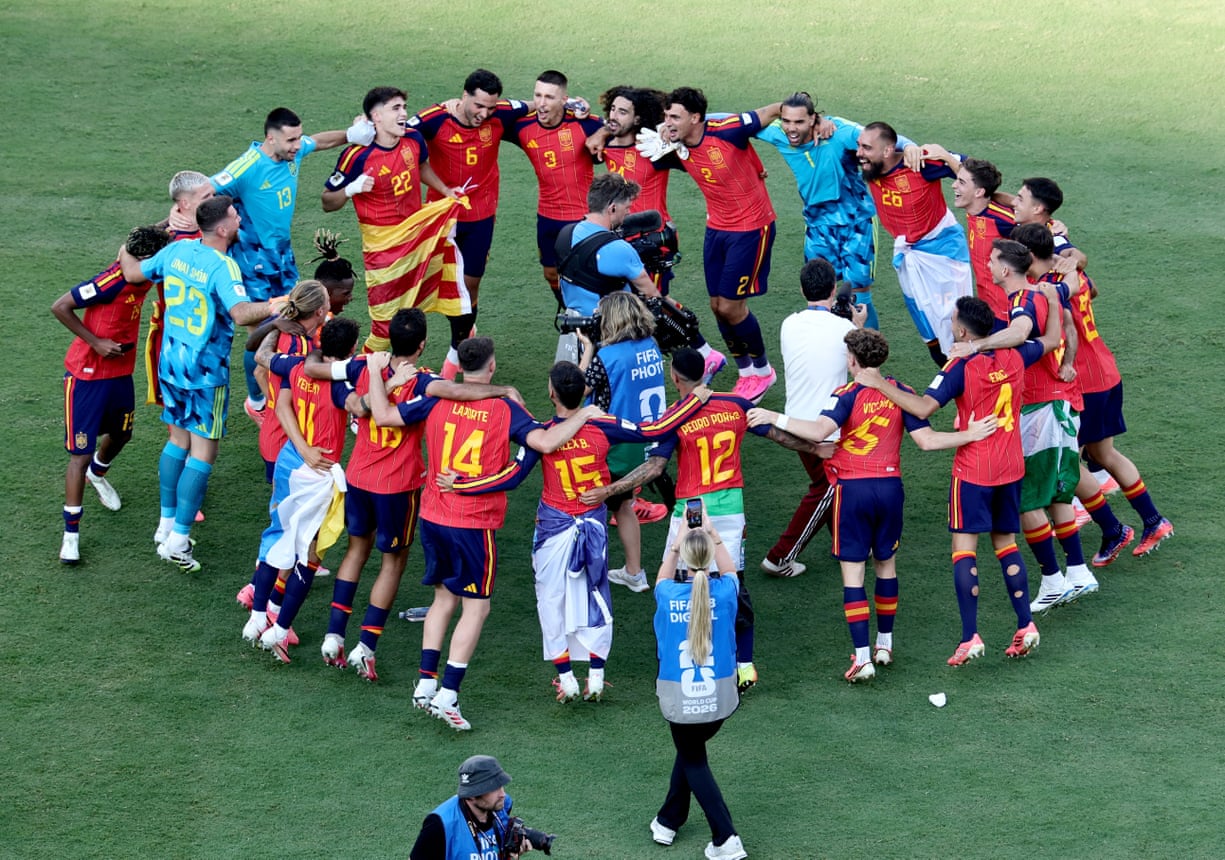
Machine versus magic had a winner, and it was the machine.
Spain beat Argentina 1-0 in extra time at MetLife Stadium on Sunday to claim its second World Cup title, and they did it the exact same way they played the entire tournament. They sucked the oxygen out of the game. Argentina, the escape artists of this World Cup, didn’t register a single shot until extra time. The defending champions went the full 90 minutes of a World Cup final without one attempt at goal, becoming the first team on record to go shotless through the opening 70 minutes of a final.
And yet, Argentina very nearly suffered through it and weathered the storm all the way to penalties, where you’d have liked their chances with Emiliano Martínez in goal. But a late red card proved fatal. After going down to ten men Argentina battled, but from that point it felt inevitable that Spain would find the goal to end it. Thirty-seven seconds into the second half of extra time, substitute Ferran Torres finally did.
How It Played Out
The first half was a staring contest. Spain passed with their usual precision, Argentina sat in their block and refused to engage, and the two teams combined for three shots, the fewest on record in a single half of a World Cup match. All three belonged to Spain. Lamine Yamal’s deflected effort in the fifth minute was the closest thing to a chance. Argentina later lost starting center back Lisandro Martínez to injury before the break, with the veteran Otamendi coming on as a replacement.
The second half was when Spain started turning the screw. Emiliano Martínez got down to deny Oyarzabal, spilled but recovered an Olmo strike, and pushed away a fizzing Cubarsí drive. Luis de la Fuente went to his bench around the hour mark, sending on Torres and Pedri, then Nico Williams and Mikel Merino at 75 minutes. The pressure kept building, and Martínez kept answering, robbing Torres and Laporte from close range.
Then came the moment that decided the final. In the third minute of stoppage time, seconds after Williams stung Martínez’s palms on the break, Enzo Fernández clattered into Cubarsí chasing a loose ball and was shown a second yellow card. A needless, silly challenge with extra time looming, and Argentina would have to survive 30 more minutes with ten men.
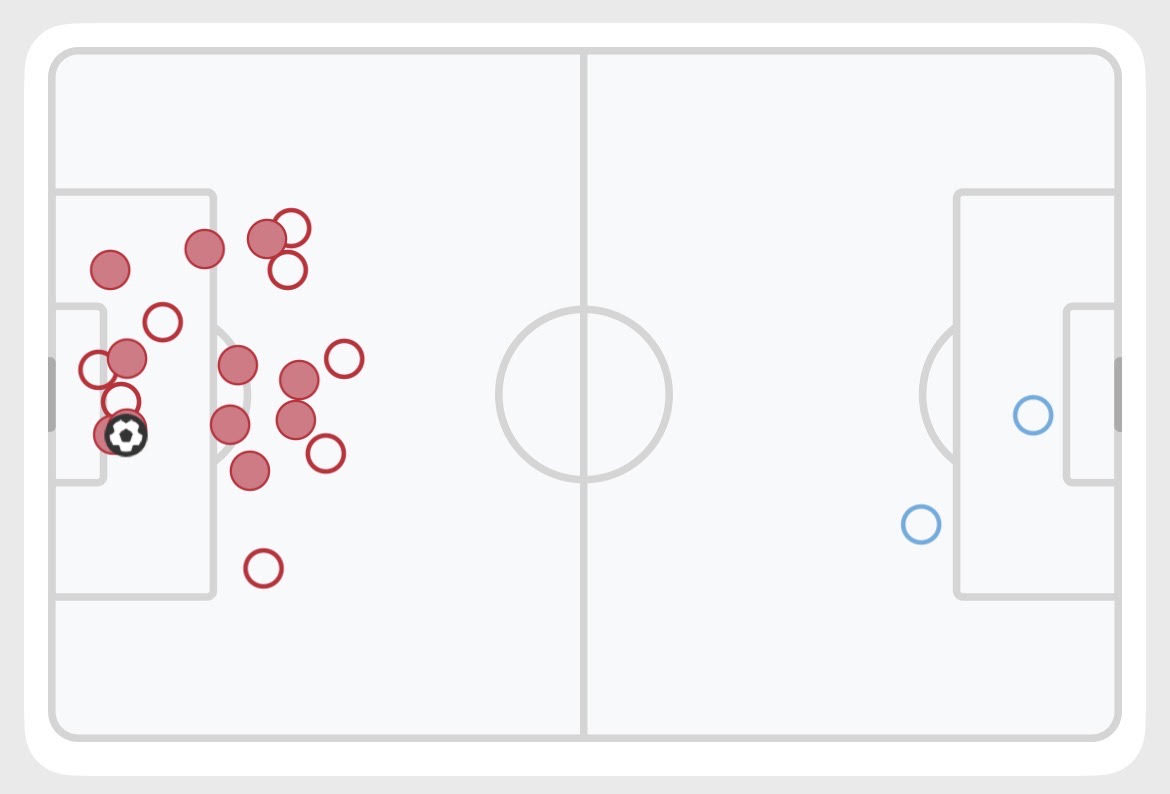
They almost did. Spain thought they’d scored in the 96th when Williams tucked home a rebound, but the goal was ruled out for a Merino foul on Otamendi in the buildup. Merino then flicked a Williams cross inches past the post. But 37 seconds after the restart in the second half of extra time, the dam broke. Spain worked the ball down the right, Porro’s cross found the back post, Williams kept it alive with a clever knockdown, and Torres rifled it into the roof of the net. Fittingly, Torres became the first substitute to score in a World Cup final since Mario Götze’s winner in 2014, also to beat Argentina.
Argentina threw everything forward, Otamendi went up top, and Giuliano Simeone blazed their best chance over the bar off a Messi corner in the final seconds. The full-time numbers told the story: 20 shots and 1.94 expected goals for Spain, two shots and 0.2 xG for Argentina.
The Difference Makers
Emiliano Martínez was the main reason Spain didn’t win this in regulation. His 10 saves through 90 minutes were the most on record by a keeper in a World Cup final, and several were spectacular. He kept a completely overrun team within one moment of penalties.
For Spain, the substitutes were pivotal. Pedri was a game changer off the bench, bringing a level of assertiveness through the middle of the attacking third that Spain had lacked, turning possession into sustained danger. And it was two more subs, Williams and Torres, who combined for the winning goal.
As for Messi, the magic finally ran out. He touched the ball just 22 times through 70 minutes, smothered by Rodri and the Spanish midfield, in what was almost certainly the final World Cup match of his career. He became just the second player ever to appear in three World Cup finals, joining Brazil’s Cafu.
An All-Time Run
This Spain team will go down as one of the great World Cup champions. They conceded exactly one goal in eight games. They never trailed in the knockout rounds. They extended their unbeaten run in regulation to 38 games and added a World Cup to their 2023 Nations League and Euro 2024 crowns.
The run exemplified collective effort. They allowed only 2.3 expected goals across the entire tournament, an average of 0.3 per match, the lowest recorded rate by any team at a men’s World Cup. Their one goal conceded across eight matches set a new record for a World Cup champion. Spain scored 14 goals through seven different players. Three times in the knockout rounds a substitute delivered the decisive goal. Laporte, Cubarsí, Rodri, Cucurella and Porro turned every game into a slow suffocation.
They had the best goalkeeper, the best young player and the official tournament MVP, but their championship never felt dependent on any one of them.
The comparisons to Spain’s golden generation are now unavoidable.
The 2008–12 group remains the standard. It won two European Championships with a World Cup in between and featured Xavi, Iniesta, Sergio Busquets, Iker Casillas, David Villa, Xabi Alonso, Carles Puyol and Sergio Ramos.
This team is not there yet in sustained greatness. But the comparison is no longer ridiculous. And this team is still very young.
World Cup Best XI
Goalkeeper: Unai Simón, Spain
Emiliano Martínez’s performance in the final was the best single-game goalkeeping display of the tournament, and Cape Verde’s Vozinha produced its best underdog story. But Simón was the goalkeeper behind the greatest defensive tournament in World Cup history. He was calm with the ball, dependable when called upon and his anticipation and sweeper instincts were key to keeping Mbappé under wraps in the semifinal. Spain conceded one goal in eight games, and Simón deservedly won the Golden Glove.
Right Back: Pedro Porro, Spain
Porro was a constant source of width and progression down Spain’s right side. He combined especially well with Yamal and defended aggressively. He delivered the back-post cross that began the winning goal in the final and scored against France in the semifinal.
Center Back: Pau Cubarsí, Spain
Cubarsí entered the tournament as a teenager and left as a World Cup champion and the official Best Young Player. His passing allowed Spain to break lines from the back, while his anticipation and recovery speed helped erase the rare moments when opponents escaped the press. He played the position with a composure that made his age almost impossible to believe.
Center Back: Dayot Upamecano, France
France’s tournament ended badly, but Upamecano was excellent through most of it. He handled large spaces, won physical battles and gave France the freedom to push players forward without constantly exposing the defense. Spain finally broke France’s structure in the semifinal, but that did not erase his previous seven games.
Left Back: Marc Cucurella, Spain
Cucurella played every minute of Spain’s tournament and provided the ideal balance on the left. He pressed high, covered enormous amounts of ground, supported the attack and rarely lost his defensive position. Spain’s ability to control both sides of the field depended heavily on the reliability of its fullbacks.
Midfielder: Rodri, Spain
The official Golden Ball winner and the foundation of the champions. Rodri controlled the speed and location of Spain’s games. He protected the defense, recycled possession and consistently made the correct decision under pressure. Spain had plenty of more spectacular players, but none was more essential to how the team functioned.
Midfielder: Jude Bellingham, England
Seven goals and one assist from midfield, including braces in consecutive knockout games. Bellingham became England’s most dangerous player, driving through midfield, arriving in the box and producing goals when the attack stalled. His tournament confirmed that England’s team increasingly belongs to him.
Midfielder: Elliot Anderson, England
The least glamorous selection in the team, but one of the most consistent players in the tournament. Anderson gave England balance beside all of its attacking talent. He won duels, covered ground, moved the ball cleanly and repeatedly helped England control the middle of the field. He did not produce Bellingham’s highlight moments, but he made many of them possible.
Forward: Lionel Messi, Argentina
Eight goals, four assists and another trip to the final at 39 years old. Messi scored or created the crucial goal in every knockout round before Spain finally shut him down. Even without the storybook ending, this was another extraordinary World Cup.
Forward: Erling Haaland, Norway
Haaland scored seven goals in five appearances and led Norway to the quarterfinals. His two late goals against Brazil produced one of the defining upsets of the tournament. Norway could play directly, counterattack or build patiently because every approach eventually had the same destination.
Forward: Kylian Mbappé, France
Mbappé won the Golden Boot with ten goals and added four assists. His two goals in the third-place game inflated the final total a little, but he was still one of the tournament’s most devastating attackers. He also moved past Messi to become the World Cup’s all-time leading scorer, with 22 goals before his 28th birthday.
Tournament MVP: Lionel Messi
FIFA gave the Golden Ball to Rodri, and that is an entirely defensible choice.
Rodri was the most important player on the champion. He embodied everything Spain did well and controlled games without requiring goals or assists to demonstrate his influence. There is no Spain championship without him.
My choice is still Messi.
Messi finished with eight goals and four assists, directly contributing to 12 of Argentina’s 19 goals. He scored the equalizer that saved them from elimination against Egypt. He created the opener against Switzerland. He assisted both late goals against England. At 39, he was still the player every opponent built its defensive plan around. Argentina reached the final because it repeatedly survived long enough for Messi to change the game.
Mbappé deserves consideration as well. Ten goals and four assists is a staggering tournament, and becoming the all-time World Cup scoring leader at 27 is absurd. But two of those goals and one assist came in a 6-4 third-place game that felt closer to an exhibition than a defining World Cup moment. France needed Mbappé most in the semifinal, and Spain held him scoreless.
Messi was quiet in the final, but the final should not erase everything required to get there.
Spain won because it had the best team.
Messi was the tournament’s best player.