After a World Cup filled with upsets, late goals and traditional powers like Brazil and Germany crashing out earlier than expected, the bracket has somehow produced an impossibly loaded final four.
France. Spain. Argentina. England.
This is the World Cup equivalent of Duke, UNC, UConn and Kentucky all advancing to the Final Four as No. 1 seeds.
These were the four pre-tournament favorites. These are four of the eight nations to ever win the World Cup. Every possible final is tantalizing.
Of the four, only France won its quarterfinal comfortably.
France eventually pulled away from Morocco for a 2-0 win behind second-half goals from Kylian Mbappé and Ousmane Dembélé. Morocco felt like it was holding on for dear life, just hoping to score the first goal on a counterattack. Once the dam broke, France seemed inevitable.
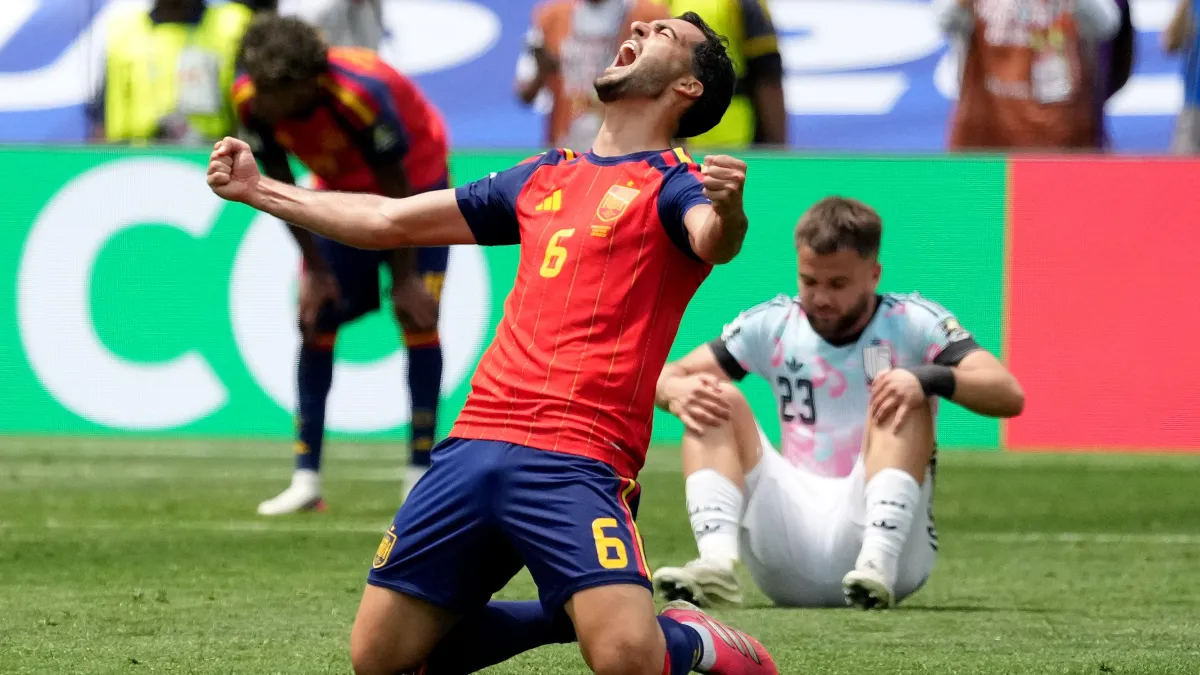
Spain needed another late intervention from Mikel Merino to escape Belgium 2-1, with the winner coming off a rebound from a long-range Pau Cubarsí shot that was spilled in front of goal by Belgian backup keeper Senne Lammens, who had just come on for an injured Thibaut Courtois. Spain once again exerted its stranglehold on the game, with 68% possession, limiting Belgium to just one good chance in 90-plus minutes.
England survived Norway by the same score, winning behind two more goals from Jude Bellingham. The game winner came in extra time on a similar rebound putback as the Spain winner.
Argentina was pushed into extra time despite a 72nd-minute red card to Switzerland’s Breel Embolo for diving. Argentina finally found the winner in the 22nd minute of extra time on a stunning curler from Julián Alvarez, then added the insurance goal nine minutes later to close out the 3-1 win.
That sets up two rivalry games in the semifinals.
Argentina-England carries decades of World Cup history, national tension and some of the most famous moments the sport has ever produced. Spain-France is the more recent rivalry, a matchup that has repeatedly helped determine European supremacy over the last five years.
There are legacies on the line everywhere. Lionel Messi is trying to win another World Cup at 39. England’s golden generation is attempting to end nearly 60 years of waiting. Kylian Mbappé is one victory away from playing in his third World Cup final before turning 28. Spain’s young core has a chance to follow its European championship with a World Cup trophy.
Before we even get to Argentina and England, Spain and France will put more talent on the field Tuesday afternoon than most World Cup finals.
The Spain-France showdown kicks off Tuesday at 3:00 p.m. Eastern from Dallas Stadium in Arlington, Texas. The game will air on FOX and stream through FOX One and FOX Sports.
Recent History
There will not be many surprises between these teams.
The players know each other from international competition, the Champions League and La Liga. Several of the most important individual matchups are between teammates or frequent club opponents. The managers have also seen recent versions of this game play out in several completely different ways.
France defeated Spain 2-1 in the 2021 Nations League final, coming from behind through goals from Karim Benzema and Mbappé. That game provided the French blueprint. Allow Spain to hold the ball, remain dangerous without needing long spells of possession and attack as soon as space appears.
Spain got revenge in the Euro 2024 semifinal. France scored first through Randal Kolo Muani, but a 16-year-old Lamine Yamal produced an outrageous curling goal before Dani Olmo added the winner. Spain controlled the remainder of the game, won 2-1 and went on to claim the European title.
Then came last summer’s Nations League semifinal, which temporarily abandoned all defensive responsibility. Spain raced to a 5-1 lead before France nearly completed a ridiculous comeback, with the game ending 5-4. Yamal scored twice, while Nico Williams, Merino and Pedri also found the net for Spain. It was the highest-scoring game in Nations League history.
Spain has now eliminated France in consecutive semifinals. France, however, has been the defining World Cup team of this era. A victory Tuesday would put it into a third consecutive final and its fifth in the last eight tournaments.
That is what is at stake here. Spain has owned the recent matchup. France is trying to extend one of the greatest runs in World Cup history.
How Spain Got Here
Spain’s tournament started with one of the stranger results of the group stage, a scoreless draw against Cape Verde despite generating plenty of chances. Since then, the results have been nearly flawless.
It beat Saudi Arabia 4-0, Uruguay 1-0, Austria 3-0 and Portugal 1-0 before finally conceding its first goal of the tournament in the quarterfinal against Belgium. Through six games, Spain has scored 11 and allowed just one.
The quarterfinal was a good microcosm of its tournament.
Spain controlled most of the possession, took the lead through Fabián Ruiz and generally limited a talented Belgium attack. Charles De Ketelaere equalized before halftime, but Belgium finished the game with only 0.34 expected goals, meaning the quality of its total chances amounted to roughly one-third of an average goal. Merino then came off the bench and scored the winner in the 88th minute.
Spain has not looked as explosive as it did during Euro 2024. The attack has gone through some frustrating stretches, particularly against Cape Verde and Portugal. Its biggest stars are playing, but several do not appear to be at full capacity.
Yamal entered the tournament dealing with groin and hamstring problems. He has gradually improved, but we have not consistently seen the unstoppable version who dominated France in the Nations League last year. Pedri was dropped from the starting lineup against Belgium after showing signs of fatigue, with Fabián taking his place next to Rodri. De la Fuente has acknowledged that Pedri has not yet found his best form or ideal role in this version of Spain’s midfield.
Nico Williams has endured an even more difficult year of recurring groin and muscular injuries. He finally returned for the final 12 minutes against Belgium and helped create the pressure leading to Merino’s winner, but asking him to start and play 70 or 80 minutes against France would be another matter.
The reason Spain has survived those issues is its defense.
Rodri has been outstanding controlling the space in front of the back line. Aymeric Laporte has provided the experience and distribution expected from him, while 19-year-old Pau Cubarsí has looked remarkably comfortable defending some of the best attackers in the world. Marc Cucurella and Pedro Porro have been solid at fullback, and Unai Simón has rarely been asked to make a difficult save.
Before the quarterfinals, Spain had allowed only 1.49 expected goals across five games. Its possession receives most of the attention, but the ball control serves a defensive purpose too. Opponents cannot create chances if they cannot get the ball.
That formula has carried Spain to its first World Cup semifinal since winning the tournament in 2010. The problem is that France is uniquely equipped to punish the few moments when Spain loses control.
How France Got Here
France has looked like the best team in the tournament. There appears to be no specific type of game it needs in order to win.
It can overwhelm you. It can counterattack. It can defend deep. It can patiently circulate possession. It can win an ugly 1-0 game or turn the match into a track meet.
France won all three group games, beating Senegal 3-1, Iraq 3-0 and Norway 4-1. It followed that with knockout victories over Sweden, Paraguay and Morocco without conceding a single goal. It enters the semifinal with six wins, 16 goals scored and only two allowed.
The quarterfinal against Morocco was its most complete performance. Morocco remained organized and competitive for nearly an hour, but France did not panic or start forcing the game. Mbappé finally broke through in the 60th minute, Dembélé added another six minutes later and France finished with 3.69 expected goals while allowing only 0.14. It was a 2-0 game that could have been considerably worse.
Mbappé has eight goals. Dembélé has five. Between them, they have scored more goals than the entire Spanish team. But this version of France is scarier because the attack does not end there.
Michael Olise has become the connective piece, drifting between midfield and the front line, drawing defenders toward him and slipping passes behind the back line. Désiré Doué and Bradley Barcola give France two different options on the left. One can start, run at tired defenders and then be replaced by another elite winger. France can also bring additional attackers such as Rayan Cherki, Maghnes Akliouche or Jean-Philippe Mateta off the bench without dramatically lowering the talent level.
That embarrassment of attacking riches is the biggest difference between France and everyone else.
It also helps explain why its stars look fresher than Spain’s. France has been able to rotate attacking players without losing its identity, while Spain has spent the tournament carefully managing Yamal, Nico and Pedri. France also played its quarterfinal one day earlier, giving it an additional recovery day.
Aurélien Tchouaméni is expected to return after missing the Morocco game with an adductor injury. He should rejoin Adrien Rabiot at the base of midfield, behind an attacking group likely consisting of Dembélé, Olise, Doué and Mbappé. William Saliba and Dayot Upamecano will anchor the defense, with Jules Koundé and Lucas Digne at fullback.
There are more creative midfields in the tournament. There may be more technically elegant defensive units.
There is no other team with this many ways to hurt you.
What Will the Game Look Like?
Spain will probably have more of the ball.
That does not necessarily mean it will be controlling the game.
Didier Deschamps is unlikely to ask France to out-Spain Spain by chasing possession. France has become more comfortable building attacks through Olise and slowing the tempo when necessary, but the most favorable matchup is obvious. Spain wants to push its back line high, squeeze the field and keep France trapped in its own half. France has Mbappé, Dembélé and Doué waiting to attack the acres of space behind it.
France will likely defend in a compact 4-4-2 or 4-5-1 shape, with Tchouaméni or Koné and Rabiot protecting the middle. It will allow Spain’s center backs to move the ball and become more aggressive once passes enter midfield or go toward the sidelines.
Once possession changes, France will look immediately for Olise between the lines or for an early pass into Mbappé’s path. The combination between Olise and Mbappé has been one of France’s most dangerous weapons. Spain’s high line is excellent at catching opponents offside, but every step forward carries enormous risk against a player with Mbappé’s speed.
For Spain, the most important player is Rodri.
He will be responsible for setting the rhythm in possession, helping Spain escape France’s first wave of pressure and stopping counterattacks before they reach the back line. If Rodri spends the afternoon comfortably receiving the ball and turning forward, Spain can establish itself around the French penalty area.
If Olise can find space behind him, France will be running directly at Spain’s center backs.
That is the game inside the game. Spain needs Rodri high enough to sustain attacks but deep enough to protect against transition. France needs Olise close enough to help its midfield but advanced enough to take advantage when possession changes.
The matchup on Spain’s right side may be the most dangerous area on the field. Pedro Porro likes to get forward, and Yamal naturally drifts inside onto his left foot. That can leave Cubarsí defending a huge amount of space behind them. Asking any center back to deal with Mbappé in that situation is terrifying, even one who has played as well as Cubarsí.
Spain can reduce that threat by keeping the ball and counterpressing immediately after turnovers. When Spain loses possession, the nearest three or four players attack the ball before France can lift its head and find the forward pass. That pressure has smothered most opponents.
France is not most opponents.
Saliba, Tchouaméni, Rabiot and Olise are all capable of escaping that pressure with one pass. If they break the first wave, Spain may suddenly have five players caught ahead of the ball.
At the other end, France must decide how aggressively to defend Yamal. Lucas Digne will need consistent help from the left winger and Rabiot. This may favor the selection of Doué over Barcola, since the former has a bit more defensive bite. Giving Yamal a pure one-on-one matchup is dangerous, even if he has not looked completely healthy. Sending too much help creates openings for Dani Olmo and Oyarzabal in the middle.
Spain will try to pin France’s wide attackers deep, forcing Dembélé and Doué to spend energy tracking the fullbacks. If Spain can turn France’s front four into a second defensive line, it can gradually suffocate the French attack.
France will happily accept some of that pressure if Mbappé remains high enough to provide an escape route.
I do not expect France to park 11 players behind the ball. Deschamps will concede some possession, but he will want enough pressure on Spain’s midfield to generate turnovers. Dropping too deep would allow Rodri and Spain’s attacking midfielders to settle 20 yards from goal, which is how Spain eventually turns possession into a series of quality chances.
France will pick its moments.
Spain will try to eliminate the moments entirely.
It’s not likely to be the end-to-end shootout that last summer’s Nations League semifinal became. I expect more of a tactical chess match in this version.
If you forced me to pick a side, I would have to say France looks more complete right now. Either way, whoever wins this is likely the odds-on favorite to win in the final.