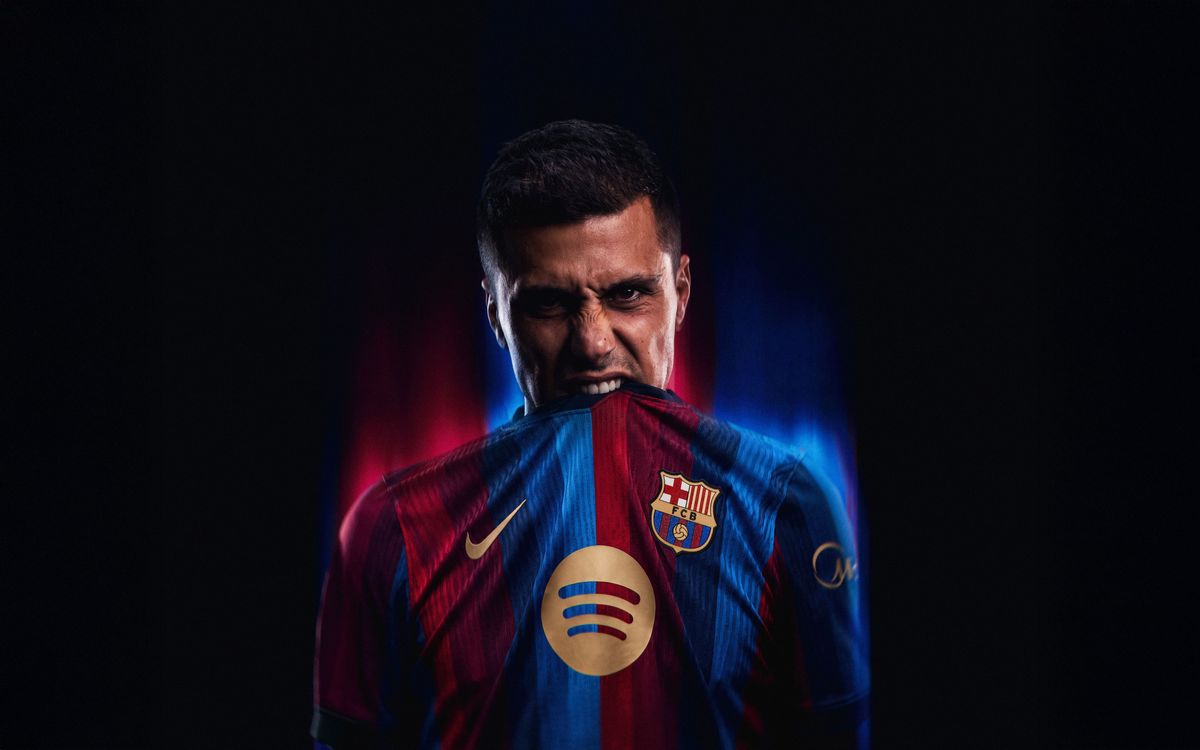
Barcelona already entered this season as the favorite to win a third straight La Liga title. Now they have added the type of player who could make the bigger goal—finally getting Hansi Flick’s team back to the top of Europe—considerably more realistic.
Barcelona officially signed Rodri from Manchester City on Tuesday, adding one of the best holding midfielders of his generation to a midfield that was already overflowing with talent. On the surface, it is easy to call him the long-awaited replacement for Sergio Busquets.
That comparison makes sense, but it undersells what Rodri could change.
Barcelona needed someone who could provide structure behind their existing talented midfield and attack and improve their ability to kill dangerous transition moments for opponents.
Under Flick, Barcelona wants to press high, attack quickly after winning the ball and commit numbers forward. At their best, that aggression can overwhelm opponents. At their worst, the game can become stretched and every turnover turns into an emergency for the center backs.
Rodri should make that style safer without making it less aggressive.
Rodri Fits Flick Better Than You Might Think
There is an obvious stylistic question here. Rodri became the defining holding midfielder of Pep Guardiola’s Manchester City teams, where control, patience and positional possession are foundational principles. Flick’s Barcelona is considerably more vertical.
The important thing Rodri provides is not slow possession. It is knowing when the team should accelerate and when it should hold the ball for another few seconds rather than forcing a pass that is not there.
Barcelona already has plenty of players capable of making something happen quickly. Lamine Yamal, Raphinha, Pedri, Dani Olmo and the other attackers do not need Rodri to teach them how to attack. They need him to help ensure those attacks begin from a stable structure.
When Barcelona loses possession, Rodri is also unusually well suited to protecting the space behind the attack. His defending often begins before the turnover occurs. He positions himself where an opponent will want to play the first counterattacking pass, collects second balls and gives the players ahead of him more freedom to press aggressively.
That is critical in Flick’s system and should reduce the pressure on the Barça back line. The high defensive line only works when Barcelona prevents opponents from cleanly accessing all the space behind it. Rodri cannot save a completely broken press by himself, but he should reduce the number of times Barcelona’s center backs are left sprinting backward against an opponent with the ball and open field.
He also gives Barcelona another elite solution against teams that press them high.
Rodri can receive directly in front of the center backs, slide into different passing angles or even drop between them to create a temporary back three. An opponent trying to man-mark Barcelona’s buildup now has a much more difficult decision.
And that is where the signing gets especially interesting for Pedri.
Rodri Should Make Pedri Better, Not Replace Him
Pedri has been Barcelona’s do-it-all midfielder under Flick.
He frequently drops toward Barcelona’s defense to organize the first phase of possession, escapes pressure, controls the rhythm of the game and then still has to advance forward and create around the penalty area. He has become so important to Barcelona’s midfield that sometimes the problem is how many different jobs they need him to perform.
Rodri can take several of those responsibilities off his plate.
The ideal partnership has Rodri locking down the holding midfield position and allowing Pedri the freedom to drift between lines and into the attack.
Against a high press, Pedri can drop alongside Rodri and give Barcelona two elite players capable of receiving under pressure. Once the first line is broken, Rodri can remain behind the ball while Pedri advances into the space between midfield and defense.
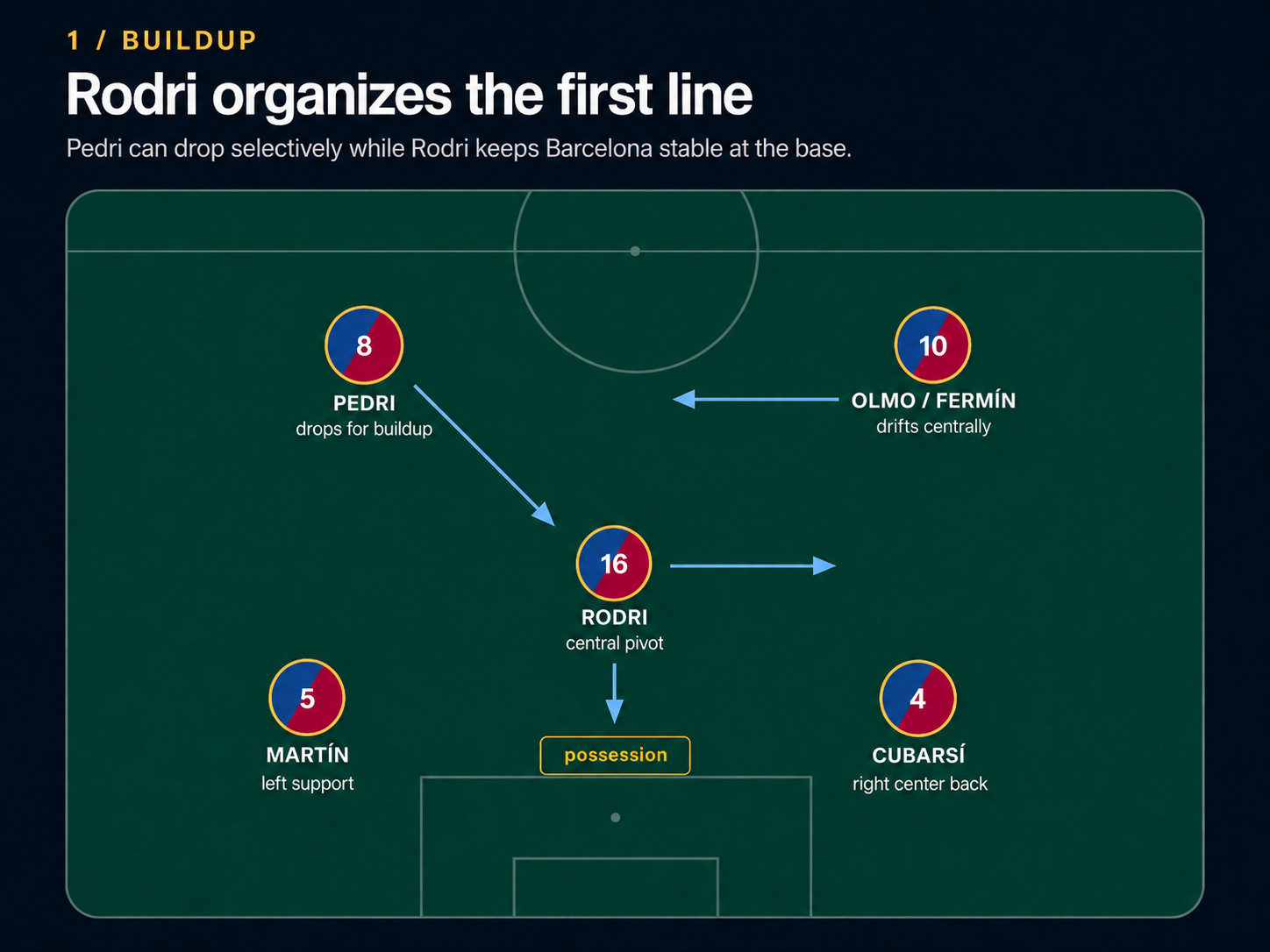
When Lamine receives on the wing, Pedri can move closer to him as the combination player rather than remaining 30 yards deeper because Barcelona needs someone to protect against the next turnover.
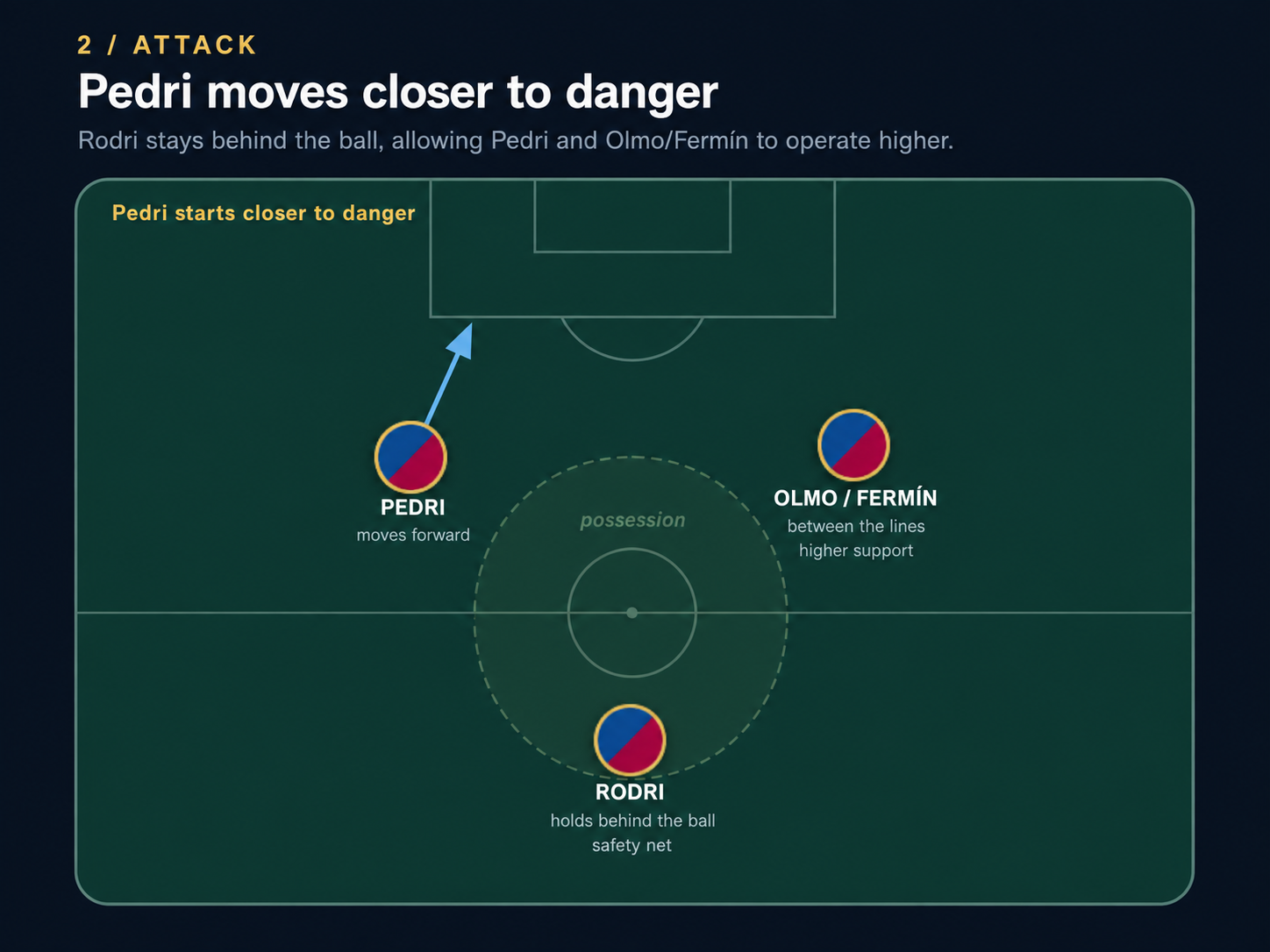
When possession is lost, Pedri can jump toward the ball more aggressively knowing Rodri is behind him protecting the middle. Even as his minutes declined in the knockout rounds for Spain, Pedri was among the tournament leaders at winning the ball back in the opponent’s final third. He has been among Barcelona’s leaders in ball recoveries in each of the past two years, and Rodri will now allow him to apply that pressure higher up the field.
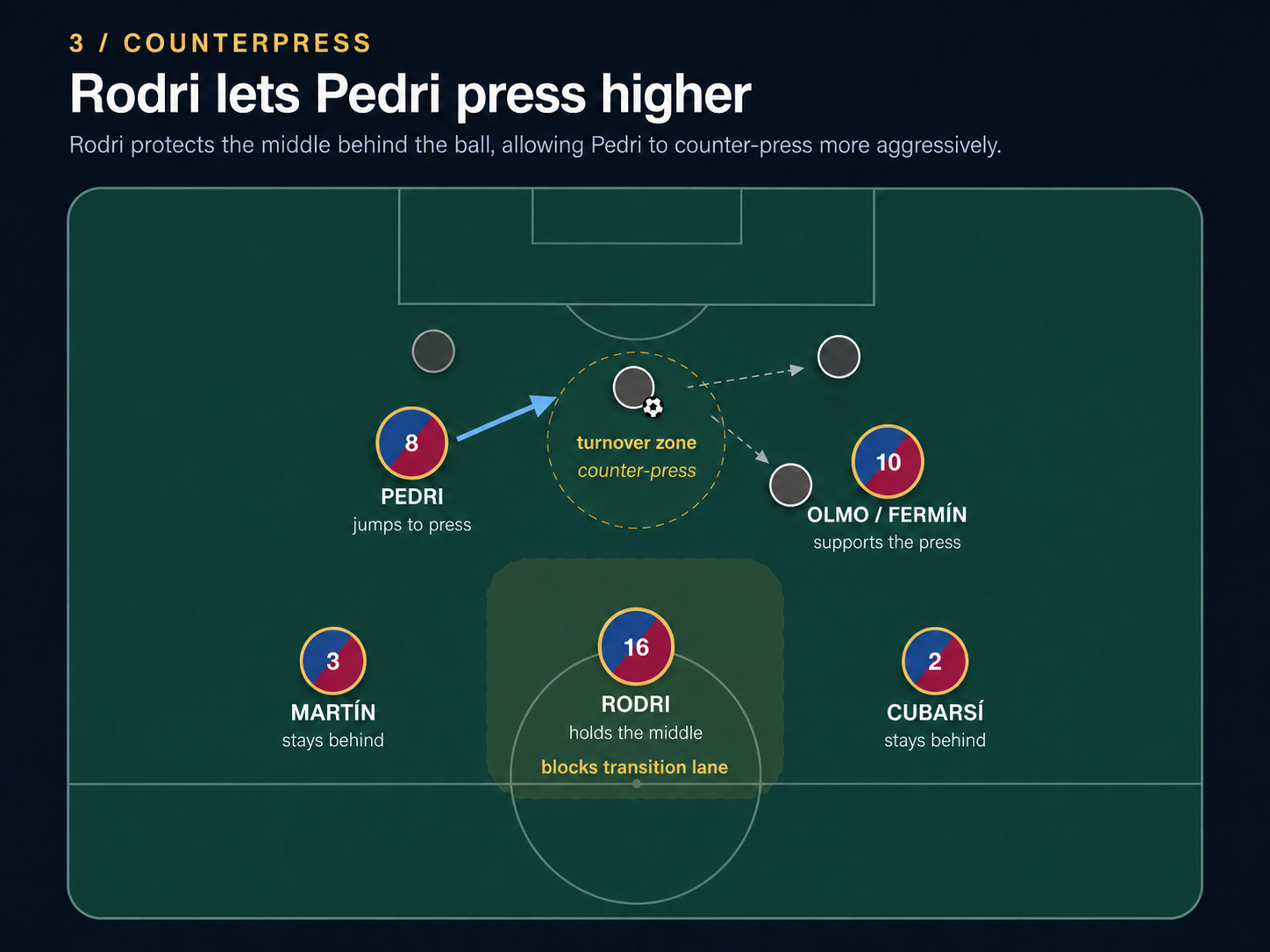
Essentially, Rodri can absorb some of the least glamorous responsibilities Pedri has taken on without reducing his influence on the game.
There is some concern, however, with how Rodri’s centrality to Spain during the World Cup eventually pushed Pedri to an impact-sub role.
In the knockout stages, Luis de la Fuente preferred Fabián Ruiz next to Rodri, with Dani Olmo playing ahead of them, leaving Pedri on the bench during Spain’s biggest knockout games. De la Fuente insisted that was tactical rather than a reflection of Pedri’s form: against Belgium, in particular, he wanted Fabián’s greater physical strength before introducing Pedri later to increase Spain’s control and possession.
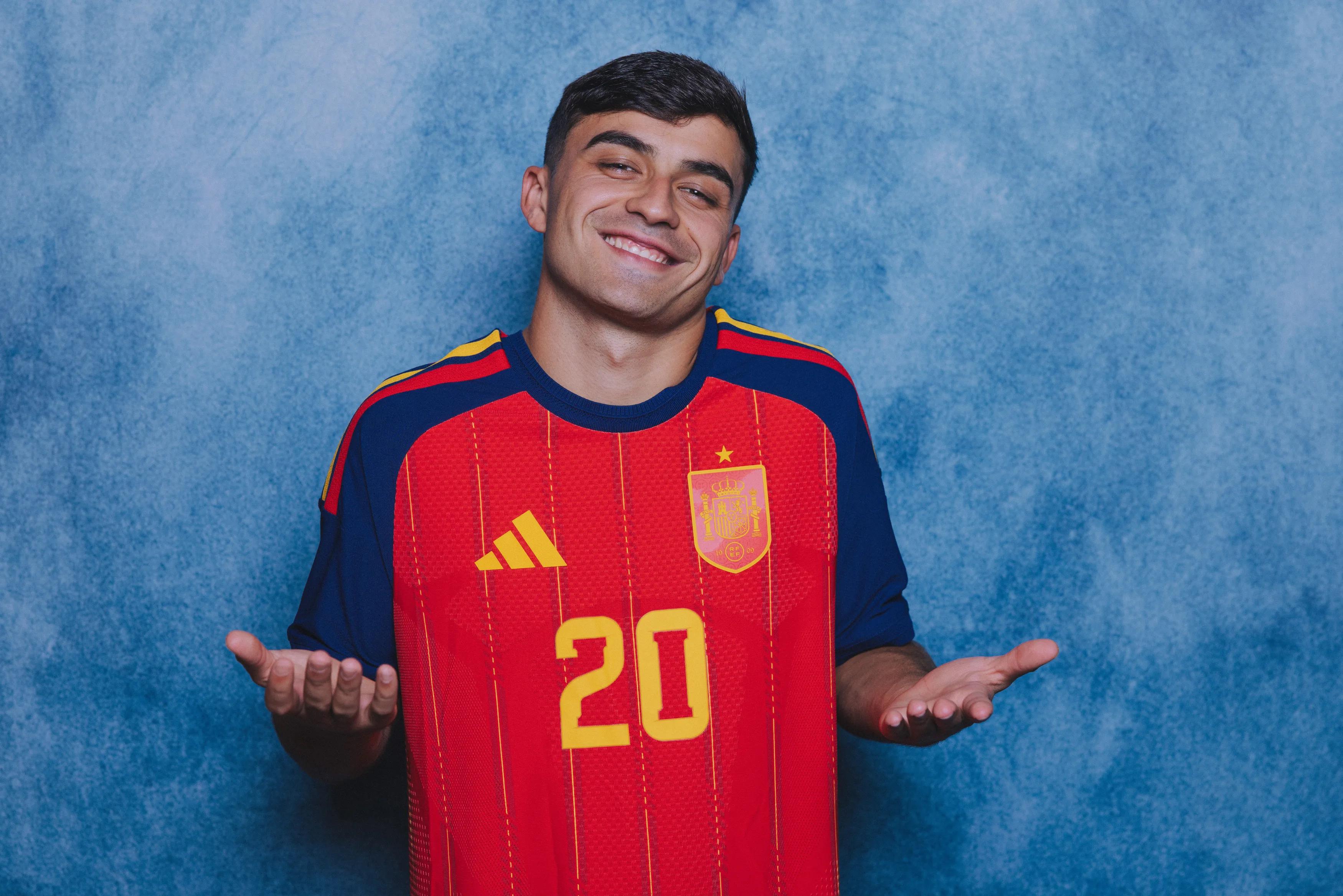
None of this suggests that Rodri and Pedri cannot thrive in tandem. Spain utilized that partnership effectively during the early stages of the competition. However, it underscores how securing a world-class holding midfielder alters a manager’s tactical calculus.
That same possibility exists at Barcelona.
There will be Champions League games where Flick could decide that Rodri needs a more aggressive runner like Gavi next to him with Olmo playing higher. Pedri may no longer be completely automatic in every possible tactical configuration.
But Barcelona does not have to copy Spain.
Pedri is already one of Flick’s foundational players, and his ability to move between a deeper midfield role and more advanced areas is precisely what can make this partnership work.
The mistake would be deciding that because Rodri organizes the buildup, Pedri must now become a permanent No. 10. Barcelona should free Pedri from having to organize every possession, not remove him from buildup entirely.
The Rest of the Midfield Changes Too
Rodri’s arrival should affect almost everyone else in the squad.
Gavi could be one of the biggest beneficiaries. With Rodri controlling the center behind him, Gavi can focus on the things he does best: pressing, running, winning duels and attacking space rather than trying to become Barcelona’s primary deep organizer.
Olmo should receive the ball in better areas more consistently. One of Rodri’s greatest strengths is recognizing when a player becomes available between the opposition’s lines. Olmo lives in those spaces and could also see more time as a false nine if Barça fails to land a traditional striker before the end of the transfer market.
Fermín López becomes easier to use as a specialist runner into the box because Barcelona has more control behind him. Marc Bernal probably loses immediate minutes at No. 6, but that may not be a bad thing for his development. Instead of being asked to stabilize a Champions League contender immediately, he can learn behind Rodri and receive more selective opportunities at both pivot and interior.
Frenkie de Jong may be the player whose role becomes most complicated. His ball carrying and press resistance still have obvious value, but Rodri overlaps directly with some of the deep progression and organization that made De Jong so important. Barcelona no longer needs him to be the veteran midfielder who makes the first phase work.
The larger point is that Flick can now choose his other midfielders based more on what they add rather than what deficiency they need to cover.
That is an enormous luxury.
The Champions League Is Where This Signing Really Matters
Barcelona has already proven it can dominate most opponents in Spain.
Rodri was not necessary to make them favorites against the middle of the La Liga table.
He was signed for the matches where Barcelona’s aggression runs into an opponent capable of resisting it.
The Champions League increasingly becomes a test of whether a team can play through pressure, survive physical midfield battles and control the periods when the opponent begins to build momentum. Those are exactly the situations where Barcelona has sometimes looked vulnerable.
Rodri gives them another player who can survive a man-oriented press. He can create space simply by dragging a marker away from Pedri. He can hold possession for a minute when the match has become frantic and Barcelona needs to regain its structure.
That last quality may be particularly valuable.
Flick’s Barcelona has often responded to chaotic stretches by continuing to attack. Sometimes that works. Sometimes it only creates more chaos.
Rodri gives them the ability to defend through possession without retreating into their own penalty area. Barcelona can take the ball, make the opponent chase for 30 or 60 seconds and then attack again when the opening actually appears.
That kind of game management becomes much more valuable in a Champions League knockout tie than it does when Barcelona is already overwhelming a domestic opponent.
His physical presence also gives Flick something Barcelona has occasionally lacked in elite games. Rodri can compete in midfield without forcing the team to sacrifice technical quality to get stronger or more defensively secure.
Barcelona no longer has to make quite as stark a choice between control and physical resistance.
Experience Matters Too
There is also a simpler benefit.
This remains an extremely talented but relatively young Barcelona team.
Lamine is still developing. Pau Cubarsí is young. Bernal is young. Even Pedri and Gavi, despite how long they have been around the first team, are still entering what should be the prime years of their careers.
Rodri brings an enormous amount of experience from Manchester City and Spain, including playing at the center of teams expected to win every competition they enter.
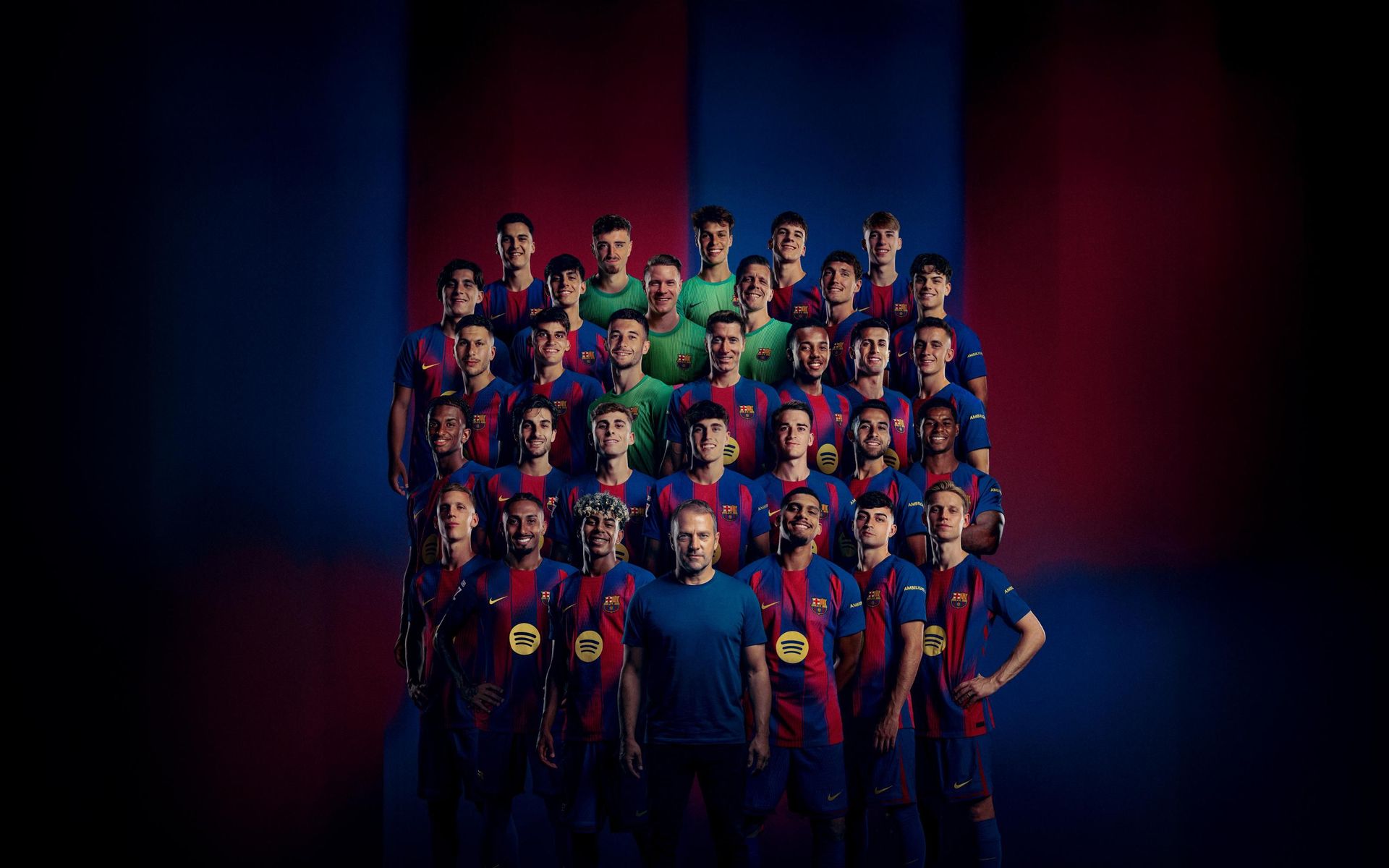
The Champions League is filled with games where a team does not play well for 90 minutes. Sometimes the difference is recognizing that the next ten minutes are about surviving the opponent’s pressure rather than trying to win the game with every possession.
Barcelona has plenty of players who can produce a moment of brilliance, but Rodri gives them another player who can recognize when the moment requires something less spectacular.
The obvious concern is his health. He arrives at 30 with a recent history of significant injuries, and Barcelona would be making a mistake if they treated him as a player who must start 55 games for the system to function. The squad depth should allow them to avoid that.
Bernal can continue developing. Gavi can play deeper in certain matches. Eric García remains an emergency option. De Jong is currently recovering from the knee-ligament injury he suffered at the World Cup and should eventually provide another experienced midfield option. Rodri should make rotation easier, not make Barcelona dependent on him.
Raising Barcelona’s Floor
Barcelona did not need Rodri to become more talented. They needed him to become more stable.
The best version of Flick’s team will still defend high, press aggressively and attack vertically. Lamine should still take on defenders. Olmo and Pedri should still look for spaces between the lines. The fullbacks and midfielders should still commit forward when Barcelona has the advantage.
Rodri simply gives all of that movement a reference point. That may also be why Pedri ultimately benefits the most.
There are legitimate questions about how Flick balances Rodri, Pedri, Gavi and Olmo in the biggest matches. Spain’s World Cup run demonstrated that simply collecting elite midfielders does not make every combination equally effective.
But that is a much better problem than Barcelona had before. Rodri gives Flick more tactical options, more experience, greater defensive security and another elite player capable of controlling the game under pressure.
Barcelona already had one of the highest ceilings in Europe.
This signing should raise the floor underneath it.
And in the Champions League, that may be exactly what they were missing.