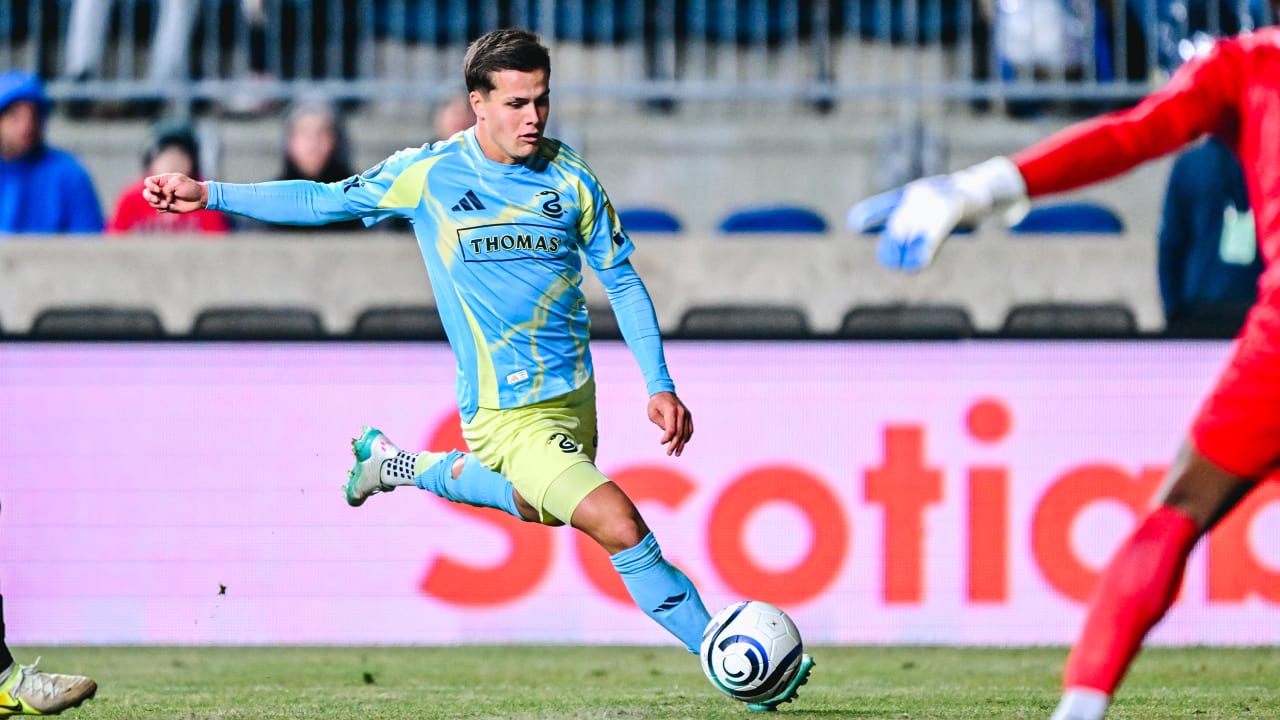
Cavan Sullivan entered Wednesday night’s matchup with Inter Miami sharing the field with Lionel Messi. By the middle of the second half, there were stretches where the 16-year-old looked like the most dangerous player on it.
Sullivan was sharp from the start in Philadelphia’s 2-2 draw, playing an important role in the buildup to the Union’s opening goal. He received the ball on the right and dropped a perfectly weighted pass over the defense for Frankie Westfield, allowing the right back to run onto it without breaking stride. Westfield’s ensuing ball into the box eventually produced the goal.
But Sullivan really took over after halftime.
That does not mean he had a better overall game than Messi, who scored and helped create Miami’s other goal. For a significant stretch of the second half, though, Sullivan was the player most consistently causing problems for the Miami defense.
Most of those problems started with former Real Madrid and Tottenham left back Sergio Reguilón.
Sullivan repeatedly attacked him on the right wing, but the encouraging part of the performance was that he was not simply standing on the touchline waiting for isolation opportunities. As the half progressed, he began drifting into central areas and eventually appeared all the way on the opposite side of the field. Miami had to keep finding him rather than simply assigning Reguilón to deal with him.
These five sequences show why the performance was so encouraging.
1. Recognizing the Pressure
Video clips are available for 14 days after publication. This article's clips have been archived.
Sullivan feels Reguilón's pressure, cuts inside and uses the defender's momentum against him.
This play begins as a fairly ordinary transition opportunity. Sullivan gets the ball on the right with space to attack and immediately starts carrying forward.
The impressive part is his awareness of what is happening behind him.
Sullivan feels Reguilón closing from his blind side and, rather than continuing toward the sideline, abruptly cuts inside. Reguilón has already committed to the chase and runs through him, earning a yellow card.
There is some gamesmanship involved, but it is intelligent gamesmanship. Sullivan recognizes the defender’s momentum and uses it against him. For a 16-year-old facing an experienced international defender, there was very little hesitation.
2. Putting Reguilón Through the Ringer
Sullivan isolates Reguilón, gets to the end line and finds the cutback.
A couple minutes later Sullivan gets Reguilón isolated again.
This time there is no foul to bail the defender out.
Sullivan receives wide on the right and sharply cuts toward the end line, getting Reguilón turning one way and then the other before playing a well-placed cutback to the middle of the box.
The dribbling is obviously the fun part. More encouraging is that he actually turns the dribble into something useful.
Young attackers can beat a defender and still accomplish very little. Sullivan manipulates Reguilón to create the opening and then recognizes when he has done enough, moving the ball rather than attempting another unnecessary trick.
3. Finding the Game in the Middle
After receiving centrally, Sullivan draws Miami inward and shifts the ball back to Westfield on the right.
This may be a more interesting sequence from a USMNT perspective.
Sullivan is nominally playing from the right, but instead of remaining there he drifts well into the middle of the field to get involved in the possession.
After receiving centrally, he attacks the first defender off the dribble and creates just enough separation to force Miami’s shape to collapse toward him. Sullivan then recognizes the space that has opened back on the right and moves the ball to Westfield.
It is a simple concept, but an important one.
The threat is not just Sullivan beating the left back one-on-one. If he can move inside, receive between defensive assignments and then find the player occupying the space he vacated, he becomes considerably more difficult to defend.
4. The Pass That Should Have Been an Assist
Sullivan checks into space and quickly threads a teammate through on goal.
A few minutes later Sullivan again appears centrally, this time dropping toward the ball rather than running away from it.
He checks into the open space, receives facing forward and quickly slices a deft pass through the Miami defense that sends his teammate in alone against the goalkeeper.
The finish lets him down.
This is probably the best example of the creative ability that makes Sullivan such an intriguing prospect. There is nothing spectacular about where he receives the ball. The difference is how quickly he recognizes the opening and the touch required to exploit it.
He does not need three touches to turn, survey the field and eventually attempt the pass. The picture is already forming before the ball arrives.
5. Now He’s on the Left
Sullivan combines on the left, reaches the end line and flashes a cross through the danger area.
By this point Sullivan has wandered all the way across the field.
He shows up on the left touchline, combines quickly with a teammate and continues his run toward the end line. After getting the return ball, Sullivan sends a well-placed cross through the danger area that narrowly misses its intended target.
Again, the larger point is the movement.
Over the course of the half, Sullivan threatened Miami from the right touchline, the center of the field and finally the left. Sometimes he wanted the ball to his feet. Other times he dropped away from the defensive line or accelerated beyond it.
Miami could never get particularly comfortable with where he was going to appear next.
More Than a Few Nice Dribbles
It would be easy to reduce this performance to the clip of Sullivan tying Reguilón in knots. That will probably be the sequence that gets passed around social media, and understandably so.
The rest of the half was more encouraging.
Sullivan was finding space, recognizing pressure, beating players on the dribble and then making useful decisions after he created an advantage. His movement became increasingly adventurous as the game progressed, and Philadelphia repeatedly looked more dangerous when he found the ball.
For a young attacking player, that is the difference between looking talented and actually influencing a senior match.
Against a Miami team featuring Messi and a collection of experienced players who have spent their careers at some of the biggest clubs in the world, Sullivan did plenty of the latter.
He did get sent off at the very end with a red card for trying to help his brother out in a melee, but that should not mar an otherwise strong performance.