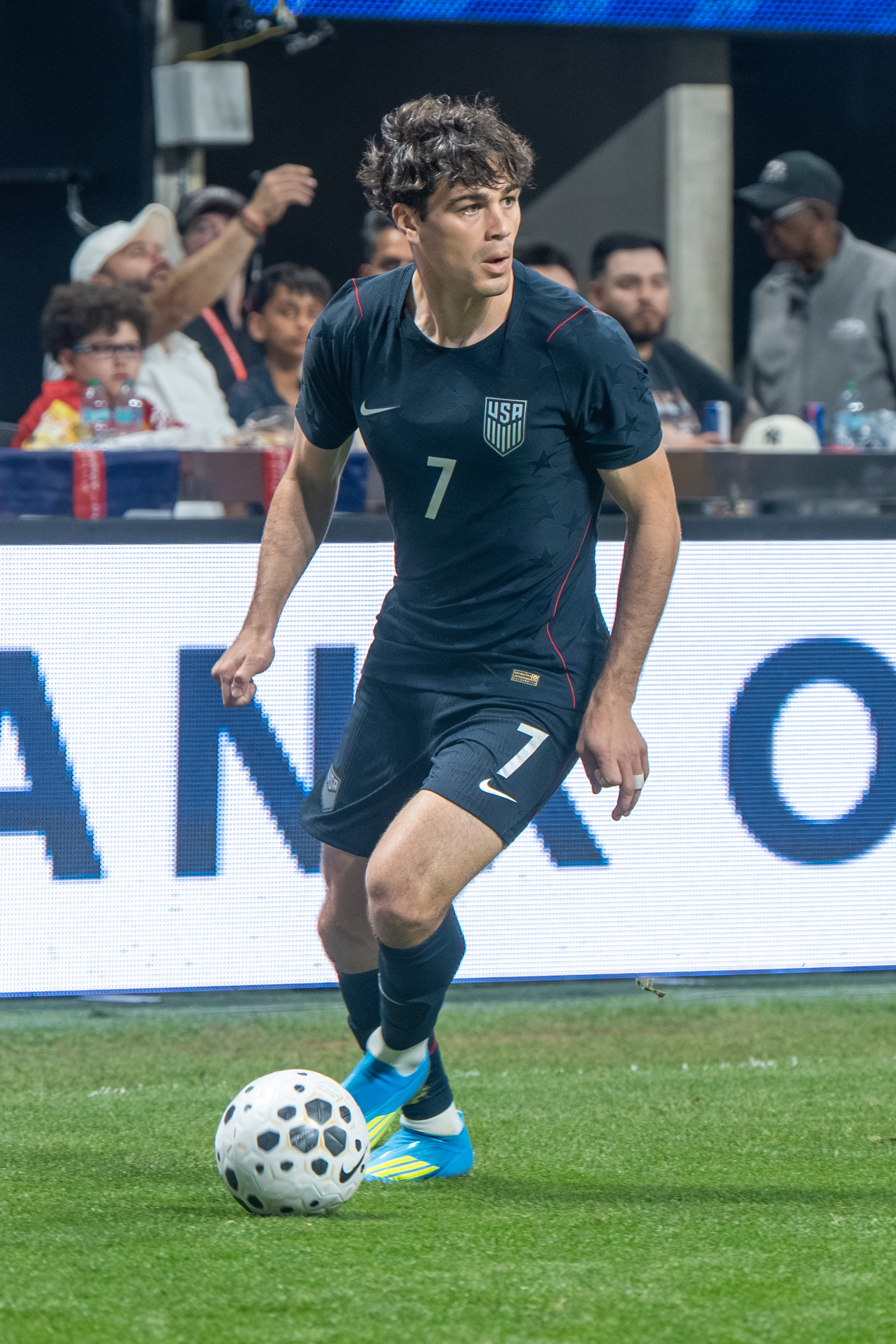
The United States enters its final group stage match in an unfamiliar position, with nothing left to prove in the group. After wins over Paraguay and Australia, the US has already clinched the top spot in Group D. Türkiye, meanwhile, has already been eliminated after opening the tournament with losses to Australia and Paraguay. That leaves Thursday night’s game at SoFi Stadium in Los Angeles a rare World Cup dead rubber.
The standings are done. The knockout round is next. The only real question is how Mauricio Pochettino wants to handle the bridge between the two.
The match kicks off Thursday night at 10:00 p.m. Eastern / 7:00 p.m. local time in Inglewood and will air on FOX and Telemundo. Normally, a final group stage game involving the US would come with calculators, stress, tiebreaker charts, and everyone pretending they understand the fair play points scenario. Not this time. The US is safely through as group winner, and Türkiye is playing only for pride. That does not make the game irrelevant, but it makes it a different kind of test.
How Will the US Approach the Game?
For Pochettino, this is less about chasing three points and more about managing a tournament. The US has put itself in an excellent position. Now the priority has to be making sure that position is not damaged by an unnecessary injury, suspension, or red card in a game that cannot improve their standing.
That should mean heavy rotation.
At a minimum, I’d expect him to sit anyone carrying a yellow card. Four US starters went into this match a single booking away from trouble: Tyler Adams, Chris Richards, Antonee Robinson, and Folarin Balogun. In this World Cup, yellow cards get wiped clean after the group stage, so a lone caution just disappears once the knockouts start. But a second yellow in this game would bring a one-game suspension that would be served in the Round of 32. There’s no upside to risking that in a game that means nothing.
Christian Pulisic should probably stay on the shelf too. He missed the Australia game with a calf issue, and while his return to training is encouraging, there is no reason to push him here. Having him ready for the Round of 32 — that is all that matters. Pulisic does not need a tune-up against an eliminated Türkiye side. He needs to be healthy next Wednesday in Santa Clara.
Think of this game like a Week 18 game for the Ravens with playoff seeding locked up. They’re not risking Lamar Jackson to maintain momentum. I expect the US to take the same approach with key stars.
The good news is that the US has enough depth to make this game useful without making it reckless. Gio Reyna, Haji Wright, Joe Scally, Mark McKenzie, Miles Robinson, Max Arfsten, Alejandro Zendejas, Brenden Aaronson, Ricardo Pepi, Tim Weah, and others could all use real minutes. Some of them may be needed in a much bigger spot over the next few weeks.
That is where this game can still have value. The score is secondary. The information matters.
Reyna is probably the most interesting name. He already gave the US one of the best moments of the tournament with his goal off the bench against Paraguay, and this could be a chance to see what he looks like with a larger role in Pochettino’s current setup. Reyna is not the same kind of player as Pulisic or McKennie or Tillman, but he can see and play passes that most players do not. If the US runs into a packed-in opponent in the knockouts, Reyna could be one of the few players capable of changing the rhythm of the game with one touch.
Haji Wright also has something to gain. Balogun has clearly looked like the first-choice striker, and Pepi has a clean role as the more traditional backup. Wright is the changeup — bigger, more awkward, more direct, and more chaotic. That may not be the version of the attack Pochettino wants from the opening whistle, but it could be useful if the US is chasing a goal late and needs to turn the game into something uglier.
This is also an important chance for the wide players and defenders on the edge of the rotation. Zendejas can show whether he can bring a one-on-one threat off the bench. Arfsten and Scally can give Pochettino a look at alternative wingback options. McKenzie and Miles Robinson can make their case as the next center back up if Richards, Ream, or Freeman cannot go. Tim Weah can continue building his role as a vertical runner who gives the attack a different shape.
The other thing to watch is the shape and tactics. Through the first two games, the US has leaned into a clear identity: three center backs, aggressive wingbacks, a high press, and a willingness to play on the front foot. It has worked. Paraguay and Australia both spent long stretches pinned back, unable to build cleanly, and forced into the kind of uncomfortable defending that eventually wears teams down.
The question is whether Pochettino uses this game to reinforce that system or test a Plan B.
There is a good case for keeping the shape the same. If the bench players are going to be used in knockout games, it is helpful to see them in the actual roles they may be asked to fill. If Arfsten is the backup left wingback, let him play as a left wingback. If McKenzie is the center back most likely to enter a knockout game, let him play in the back three. If Reyna is going to be used as a second-half creator, let him operate in the same attacking framework as the rest of the group.
There is also a case for experimenting. The US has controlled its first two opponents, but the tournament will not stay this forgiving forever. If the Americans make a deep run, there will probably come a point where they cannot press and dictate the game for 90 minutes. Against a true heavyweight, they may need to defend deeper, absorb pressure, and counter. This game gives Pochettino a rare chance to test a different look without risking anything in the standings.
Looking Ahead to the Knockouts
The reason this all matters is because the knockout path is starting to look very real.
As the winner of Group D, the US will play a third-place team from Group B, E, F, I, or J in the Round of 32. The expanded format makes this more confusing than it should be, but the current picture is favorable. Based on current projections, Bosnia is by far the most likely opponent, followed by Qatar, Senegal, Algeria, Austria, and Ecuador.
In simpler terms, the US is most likely getting the winner of Bosnia-Qatar unless that game ends in a draw or the third-place matrix gets weird.
That is about as good as the Americans could have reasonably hoped for. It does not mean the game will be easy. Knockout games rarely are. Bosnia would be dangerous. Qatar would likely be organized and stubborn. Senegal has enough talent to make anyone uncomfortable. Ecuador would be a brutal draw relative to what you normally expect from a third-place team. But the US should be favored against any of those teams, and probably heavily favored against several of them.
The Round of 16 picture may be opening up too. Belgium looked like the most dangerous potential opponent in that portion of the bracket before the tournament, but they now look more likely to finish second in their group. That could leave Egypt as the more likely Round of 16 opponent, possibly coming through a matchup with Czechia, Algeria, or South Korea.
That is the kind of break you need in a tournament. It does not guarantee anything, and the US cannot afford to start thinking about the quarterfinals before it handles the Round of 32. But if the bracket holds this way, the Americans could avoid a true World Cup favorite until the final eight.
At that point, there is probably no hiding. Spain may be waiting. Someone of that caliber almost certainly will be. But you take that every single time. If the US gets to a World Cup quarterfinal, the opponent is supposed to be great. That is the cost of staying alive.
What to Expect From Türkiye
Türkiye, for its part, is hard to know what to expect from. This is a talented team that arrived with real dark horse buzz and has instead produced one of the more disappointing performances of the group stage. Arda Güler, Hakan Çalhanoğlu, Kenan Yıldız, and Ferdi Kadıoğlu give them plenty of quality on paper, but none of it has translated into results. Through two games, Türkiye has zero points and zero goals.
That makes them dangerous in a different way. Sometimes eliminated teams finally loosen up and play their best soccer once the pressure is gone. Sometimes pride kicks in. Sometimes frustration does. A team with Türkiye’s talent could absolutely decide it wants to make a statement by beating the hosts on the way out.
It is just as possible they are already thinking about their party plans next weekend in Ibiza or Mykonos. That is what the US should be hoping for. Not because the result is important, but because the last thing this game needs is an angry, physical opponent turning a meaningless night into a card or injury problem. The best version of Thursday is a professional, controlled game where the US gets useful minutes from the bench, avoids drama, and moves on.
For the players who do start, motivation should not be an issue. They are competing for knockout-round trust. They are trying to prove they can be more than emergency depth. They are trying to show Pochettino that when the tournament gets tight, he can look down the bench and see options rather than question marks.
That is the real story of this game. The US has already won the group. The bracket has become inviting. The tournament has shifted from getting through the first phase to preparing for the part that actually defines legacies.
So no, Thursday night does not matter in the standings.
But it matters in all the ways that determine what comes next.