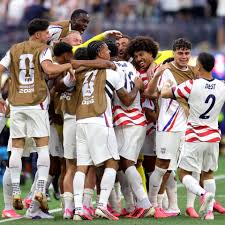
Two games. Two wins. Six points. Group won.
Read that again, because it has never happened before for the US men. For the first time in the modern version of the World Cup, the US men have secured the top of their group with one game to spare. Another dominant first half put the Americans up 2-0 at the break and they rode out the second half to secure the win.
Later in the night, Paraguay held on to beat Türkiye despite going down to ten men in the first half, securing the US at the top of the group. Although there were some shaky moments in the second half, the US once again took care of business and outclassed a weaker team — earning themselves a crucial break before heading into the knockout rounds.
This was not quite the same fireworks show as the Paraguay game. It was not as sharp or complete. But it was another game where the US was clearly better than its opponent for most of the night, built a first-half lead, and did enough after halftime to secure the win.
How They Lined Up
The lineup had one significant change from the opener, with Ricardo Pepi coming in for the injured Christian Pulisic. That forced a slight shift in the shape. Against Paraguay, the US looked more like a 3-4-3 with Balogun up top and two tucked-in attacking midfielders behind him. Against Australia, it looked more like a two-striker setup, with Pepi joining Balogun on the front line and McKennie pushing into advanced areas. The idea was pretty clear. Australia was always likely to sit deep, keep bodies behind the ball, and force the US to break down a compact block. Pochettino wanted an extra target in the box and a little more physical presence around the center backs.
Australia also made the strange decision not to start Nestory Irankunda, who had been one of their most dangerous attacking players in the opener and immediately gave the US trouble with his speed when he came on after halftime. That ended up mattering, because for most of the first half Australia had almost no ability to threaten in transition.
How It Unfolded
The US did give them one early chance. In the opening minute, Alex Freeman played a loose ball across the back line that Mohamed Touré jumped on, driving into the box before shooting straight at Matt Freese from a tight angle. It was a slightly nervy start, but after that the US settled in and took control.
The Americans dominated possession, pressed effectively, and kept Australia pinned deep for long stretches. The touches were not quite as clean as they were against Paraguay. You could feel Pulisic’s absence in tight spaces, especially when the US needed someone to receive the ball under pressure, turn, and immediately put defenders in emergency mode. But even without him, the US still had enough quality and athleticism to overwhelm Australia for most of the first half.
Dest and McKennie were especially active early. They combined down the right side to create the first real US chance, with Dest getting a shot blocked from a dangerous area. McKennie then got free on a corner and powered a header toward goal that was blocked. Tillman was involved. Jedi kept pushing down the left. Balogun looked dangerous every time he drifted into a channel. The US was not carving Australia open every two minutes, but they were clearly asking all the questions.
It didn’t take long. Eleven minutes in, the US went ahead with a goal that rhymed with their opener against Paraguay. With Australia pulled up just a touch, Antonee Robinson slipped a ball around the edge of the defense for Folarin Balogun to run onto in the channel. Balogun blew past his man to the end line and cut it back across the six for an on-rushing Ricardo Pepi, forcing Australian defender Cameron Burgess to scramble and poke it into his own net.
Yes, it goes down as an own goal. But like the own goal against Paraguay, that is not an accident. That is what happens when you attack with pace and purpose. You make defenders sprint toward their own goal. You make them solve problems at full speed. You put them in positions where one wrong step, one bad angle, or one desperate touch ends up in the back of the net.
Balogun has become a game-changer for this team. There were long stretches of my life watching the US men where the striker position was basically a combination of hard work, hope, and vibes. Balogun is different. He has real acceleration. He can threaten in behind. He can hold up against physical center backs. He forces defenders to backpedal. He makes opposing teams defend the entire depth of the field. Maybe peak Jozy Altidore is the closest comparison, but even that feels different stylistically. The US has just not had many forwards who can change the geometry of a game like this.
He probably should have had a goal of his own early in the second half, when Tyler Adams slipped him in behind and he looked to be through on goal. But Balogun slowed down, took a heavy final touch, and allowed Alessandro Circati to recover and block the shot. That was a missed chance to put the game completely to bed. Still, in the first half especially, Australia’s big center backs just could not handle him.
The second goal came just before halftime, and it was another massive moment for Alex Freeman. Dest and Tillman combined nicely on the right to win a free kick in a dangerous area. Antonee Robinson played a disguised pass on the free kick to Dest at the top of the box, and his deflected shot looped high into the air. Freeman reacted first, sprinted in behind the defense, and nodded it past the keeper. The flag went up initially, but VAR showed he had been kept onside by Jacob Italiano, and the goal was given.
That made it 2-0, and it felt fully deserved. At halftime, the US had nine shots and 1.2 expected goals. Australia had two shots for just 0.12 xG. This was not quite the avalanche we saw against Paraguay, but it was another first half where the Americans looked bigger, faster, more aggressive, and more confident than the team across from them.
Freeman deserves a lot of credit again. He had a few shaky passes early, including the mistake in the first minute, but he recovered quickly and put together another strong performance. His physical tools are obvious. He is big, strong, fast, and comfortable defending in space, which is exactly what this system requires from the outside center backs. He also made one of the most important defensive plays of the first half, cutting out a dangerous low cross at the near post when Australia looked like they might have a tap-in chance. Then he followed that up by scoring the goal that effectively decided the game.
For a player who was not exactly a household name a month ago, the Baltimore-born Freeman is quickly becoming one of the stories of the tournament for the US.
Chris Richards was excellent too. This is why his return matters so much. He gives the back line a different level of confidence. He won headers. He cleared danger. He organized. And when Irankunda finally came on and gave Australia some real pace in the second half, Richards made a huge play to cover for Tim Ream and prevent a potentially dangerous break from turning into something worse.
Second Half Concerns?
That second half, though, is where the concern comes in.
The US did not collapse, and it felt worse in the tension of the moment than the stats or a brief re-watch would suggest. Australia finished with only three shots and 0.35 xG, so this was not a game where the Americans were hanging on for dear life. But the second-half dropoff is starting to become a trend. It happened in the friendlies against Portugal, Belgium, and Germany. It happened against Paraguay. It happened again here.
In the friendlies, there was an easy explanation. Mass substitutions. Experimental lineups. Disjointed second halves. That is what friendlies are for. But now we have seen it in both group games. The US comes out flying, presses like crazy, overwhelms the opponent, and then the energy drops after halftime. Maybe that is inevitable when you play with this much intensity in the first half. Maybe it is just game management with a lead. Maybe it is a substitution pattern issue. But against better teams, it could become a real problem.
Australia made three changes at halftime, including bringing on Irankunda and Connor Metcalfe, and they started pressing higher. The US handled it well for the first 10 or 15 minutes of the half, but then the game got sloppier. Passes started missing. Touches got loose. Australia began to win more second balls. The field tilted back toward the US goal for a stretch, even if the Socceroos still did not create a ton of clear chances.
The best chance came when Irankunda got in behind Ream down the right and cut the ball back to Cristian Volpato, who blasted his first-time shot over the bar. Later, Australia got a dangerous sequence in the box with a looping cross, a cutback, and a blocked shot in traffic. It was not constant danger, but it was enough to make you think about what this might look like against a team with more quality.
The referee did not help matters. Felix Zwayer was too hesitant to give Australia cards for persistent fouling, and the game got chippier as the half went on. There were several challenges that could have brought yellows for Australia earlier. Instead, the temperature kept rising until Balogun and Harry Souttar got tangled up late, leading to a brief scuffle and yellow cards for both. Balogun’s yellow is frustrating because it was avoidable, but it also felt like a product of a game the referee allowed to get too physical for too long.
What’s Next?
That matters because the US now have to think about cards in the final group game. Cards reset after the group stage, but any player that picks up a second yellow in the final group game would be suspended for the first knockout game. So Tyler Adams, Antonee Robinson, Chris Richards, and Balogun are all players you would rather not risk if there is any chance they could miss the Round of 32. With the group won, Pochettino can rotate heavily. Christian Pulisic will get some extra time to rest. Maybe he gets a late cameo if the staff wants him to test the calf. But after two wins in two games, there is no reason to force it. Perhaps Pochettino can even experiment with a different tactical look that the team may need to break out against a stronger opponent in the latter stages of the knockouts.
As for the individual standouts, Balogun and Freeman will get the headlines, and deservedly so. But Weston McKennie was quietly excellent in the first half. He created danger in the box, combined well on the right, pressed aggressively, and helped give the US some of the chaos that Pulisic usually provides in those attacking pockets. Dest also caused all kinds of problems. He set up the free kick that led to the second goal and took the deflected shot that Freeman eventually finished. When the US needed creativity without Pulisic, Dest was one of the main sources.
Malik Tillman had a little less of the spotlight than he did against Paraguay, but he still had several nice moments connecting play and worked his butt off to win back balls on defense. Adams was his usual metronome in the middle until things got stretched. Jedi created the first goal with that ball in behind. Freese was not asked to do much, but he handled what came his way.
That is probably the biggest takeaway from these first two games. The US are not just getting one or two great individual performances. They are getting contributions everywhere. Different players are stepping forward. Different patterns are producing chances. Different game states are being managed. That is what good tournament teams do.
Now, to be clear, there are levels to this. Paraguay and Australia are not the teams the US will eventually have to beat if this run is going to become something truly special. The second-half lulls need to be cleaned up. The sloppiness under pressure needs to be addressed. The game management and substitution timing may need to be tweaked. A better opponent may punish the US for the kinds of mistakes Australia could not turn into goals.
But that is a conversation for another day.
For now, the US have done exactly what they needed to do. They beat Paraguay. They beat Australia. They have six points from six. They have booked their place in the knockout rounds. They have likely set themselves up for a favorable Round of 32 matchup, possibly against a third-place team depending on how the rest of the group stage and the bracket shake out.
This was not a perfect performance. It was not as thrilling as the opener. It probably will not be remembered the same way.
But in some ways, that makes it more encouraging. The US did not need their best player. They did not need everything to be perfect. They did not need a wild, emotional, once-in-a-generation performance. They just needed to be better than Australia, and they were.
Comfortably.
Two games. Two wins. Six points. Won the group. On to the knockouts.
For once, the US did not make us suffer to get there.
That alone is worth celebrating.