The United States men’s national team will not have much time to recover from the 2026 World Cup before the next cycle begins.
There will be a coaching decision, a new sporting structure to establish, a four-match international window, and a Nations League knockout round before the end of 2026. World Cup qualifying begins less than a year later. By summer 2028, the US could be balancing qualifiers, a possible Copa América appearance, and a home Olympic tournament within the same crowded stretch of the calendar.
The next four years will not resemble the buildup to 2026.
As co-hosts, the Americans were guaranteed a place in the 2026 World Cup. That gave U.S. Soccer the freedom to arrange friendlies, experiment with the roster, and treat the Copa América as the primary competitive checkpoint before the tournament.
There is no such luxury this time. The US must qualify for 2030.
That changes the incentives from the beginning. Roster experimentation still matters, especially with several positions likely to open during the cycle, but competitive results will arrive quickly. The coach will have to develop younger players without allowing the senior team to drift.
The most important evaluation will come in summer 2028.
For either a newly hired coach or a re-signed Mauricio Pochettino, that summer could provide the most revealing combination of competition, pressure, player development, and roster management available before the World Cup.
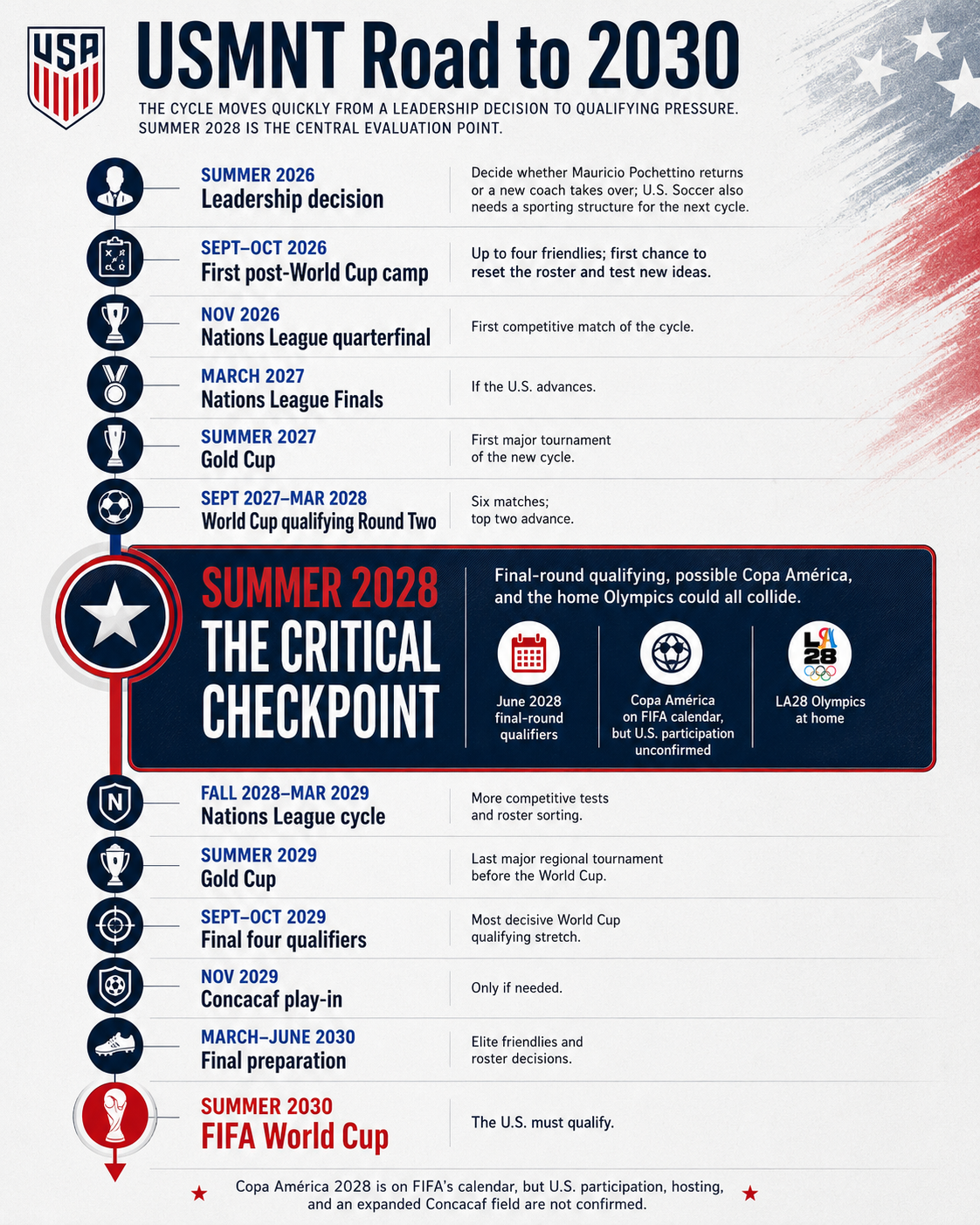
The first decision comes immediately
The first major checkpoint is not a game. It is deciding who controls the next cycle.
Pochettino’s original agreement ran through the 2026 World Cup, meaning U.S. Soccer must decide whether to extend him or begin again with a new coach. That decision will also take place while the federation is replacing sporting director Matt Crocker.
Ideally, the next sporting director would help choose the coach and establish how the senior team, Olympic program, U-20s, and broader development pathway fit together. Hiring a coach first could limit the sporting director’s authority before that person even begins.
There will also be a question of how much roster turnover is necessary. Some members of the 2026 team should remain central through 2030. Others may still have value but should no longer be automatic selections. The next coach must decide which veterans remain part of the core, which younger players are ready for responsibility, and which positions require a genuine search rather than another round of familiar names.
Those decisions will begin almost immediately.
The September and October 2026 FIFA window allows as many as four senior matches. Because the US bypasses the Nations League group stage, those games can be used as the first post-World Cup laboratory.
That window should not be wasted on four comfortable home friendlies.
The Americans need opportunities to evaluate new players, but they also need games that expose weaknesses. At least one trip outside the United States would be useful. The national team has often looked more comfortable in controlled home conditions than in road environments where the field, officiating, crowd, and opponent all create different problems.
A new cycle should begin by testing whether the team can solve those problems, not by hiding from them.
Competitive games arrive in November
The United States is already seeded into the quarterfinals of the 2026–27 Concacaf Nations League, with a two-leg series scheduled for the November 9–17 window. The opponent will be the highest-ranked runner-up from the group phase.
That may not sound like a major test compared with the World Cup, but a home-and-away regional tie only four months after the tournament will reveal whether the team has properly reset.
Nations League success would not prove the US has closed the gap with the best teams in Europe or South America. Regional dominance and global progress are not the same thing. We have learned that lesson enough times by now.
Still, failure would matter. The United States should expect to beat nearly every Concacaf opponent over two legs. Doing so with a coherent tactical approach, while beginning to refresh the roster, would be a useful first step. Struggling through the tie would raise immediate questions about the direction of the team.
If the US advances, the Nations League Finals will be held at SoFi Stadium in March 2027. That would provide the first opportunity to win a trophy in the new cycle and another chance to evaluate the team in knockout conditions.
The 2027 Gold Cup is the first full tournament
The 2027 Gold Cup, scheduled from June 19 through July 11, should be the first complete tournament under the next-cycle coaching structure.
It will be tempting to treat the competition as an extended audition. That would have some value. The roster will need new options at several positions, and European club workloads may affect availability.
But the Gold Cup also comes only a few months before World Cup qualifying.
By that point, the coach should have more than a collection of experiments. Hopefully he will have settled on his core group of players and implemented any tactical or stylistic changes required in the wake of the 2026 World Cup.
The 2027 Gold Cup will not answer every question because Concacaf opposition can only tell us so much. It should, however, show whether the coach has developed an identity that can survive different opponents and game states.
What it will do is provide a platform to evaluate new players being integrated to the team or players who missed the 2026 roster but are finding a place back in the squad either due to a new coach or a step up in their performance.
That tournament is followed almost immediately by the beginning of 2030 World Cup qualifying.
Qualifying returns
The United States has not played a World Cup qualifier since March 2022.
The US is expected to bypass Concacaf’s opening round and enter the second phase, which features 24 teams divided into six groups of four. Each team plays six matches, with the top two advancing.
The expected schedule has them playing two qualifiers in late September or early October 2027, two more in November, and the final two in March 2028.
The expanded World Cup gives Concacaf six direct places, so the qualification path is much more forgiving than the old Hexagonal. The United States should advance comfortably from the second round.
However, even against weaker competition qualifying creates pressures that friendlies cannot reproduce. Opponents will slow the game down, protect narrow leads, target individual matchups, and force the Americans to play through uncomfortable conditions. A talented roster can still lose control of a game through one defensive mistake, one poor reaction, or a long stretch without creating a clear chance.
The coach will have to balance development with results. A young player may deserve an opportunity, but there will be less room to give away entire windows for experimentation. Every roster decision will take place inside a competition with consequences.
Failure to advance from the second round would eliminate the US more than two years before the World Cup. That would be one of the largest disasters in federation history.
Assuming the Americans avoid that outcome, the cycle reaches its defining point.
Summer 2028 is the critical checkpoint
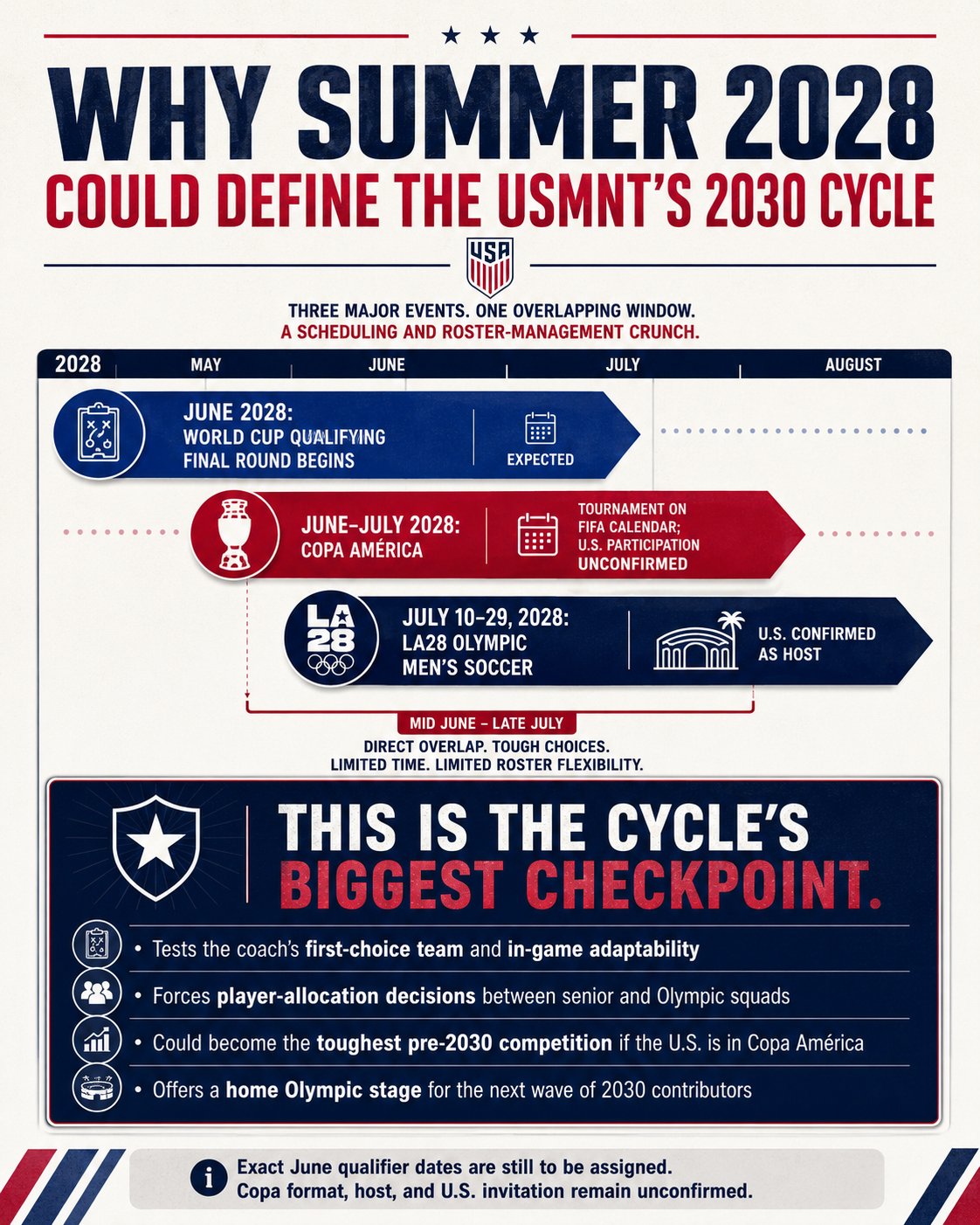
Concacaf has assigned the opening portion of the final qualifying round to June 2028. The exact match dates have not been publicly assigned, but FIFA’s relevant senior window runs from May 29 through June 6.
The final round will feature 12 teams divided into three groups of four. Each team plays six games. The top two in each group qualify directly for the World Cup, while the strongest third-place teams remain alive through a regional play-in.
In addition, a 2028 Copa América appears on FIFA’s international calendar for June and July. The United States has been discussed as a possible host, and another expanded competition involving Concacaf teams has been reported as a possibility.
CONMEBOL has not officially announced the host, exact dates, format, number of teams, or participation of the United States. Until it does, the Copa must be treated as a major possibility rather than part of the official USMNT schedule.
Though it is not guaranteed yet, the Copa America would provide the most significant test and learning experience in the entire cycle. It is the closest any event will come to replicating the competition level and stakes of the World Cup.
The Nations League and Gold Cup are useful for measuring the US against its region. A Copa América would measure the team against the type of countries it must eventually prove it can beat if the goal is to make a meaningful World Cup run.
For a new coach, summer 2028 would provide roughly two years of work before the tournament. That is enough time to establish a system, evaluate the player pool, and build a first-choice team.
For a re-signed Pochettino, it would be an even clearer referendum. By then, familiarity would no longer be an excuse. The team would have gone through a World Cup, a Gold Cup, and at least one round of qualifying under his direction.
The standard should not simply be results. Tournament draws and individual mistakes can distort a small sample. The evaluation should include how the team performs relative to its talent, whether the approach creates good chances, how the coach responds to adversity, and whether recurring weaknesses are actually improving.
Summer 2028 would provide the best available evidence.
The Olympics create a second national-team project
The possible Copa is only part of the equation.
Olympic men’s soccer begins July 10 and runs through July 29, with the United States automatically qualified as host. The men’s gold-medal game is scheduled for July 28 at the Rose Bowl.
This tournament could have greater influence on the 2030 roster than either Gold Cup.
The Olympic team should include several players who will be entering or approaching their prime by the World Cup. A strong run could help identify candidates for open spots on the full senior team.
It will also force difficult allocation decisions as some Olympic-eligible players may already be ready for the senior roster. If the United States participates in Copa América, U.S. Soccer must determine which tournament best serves each player. The Olympic team may also use overage positions on senior players who need leadership experience, competitive minutes, or a chance to prove themselves in a larger role.
Club release could complicate everything. Olympic soccer does not carry the same release protections as a senior FIFA window, and clubs may resist sending important players after a long season.
This is why summer 2028 is not merely another checkpoint for the coach. It is a test of the entire federation.
The senior coach, U-23 coach Steve Cherundolo, sporting director, and club-relations staff must work from a coordinated plan. The best roster for one tournament may weaken the other. A player may benefit more from leading the Olympic team than sitting on the Copa bench. Another may be too important to the senior side to release.
There will not be a perfect solution. The quality of the decision-making will reveal whether U.S. Soccer has built an actual development pathway or merely several national teams operating at the same time.
2029 - Last Tests Before the World Cup
The second Nations League cycle is expected to occupy the fall of 2028 and spring of 2029. That will be followed by the 2029 Gold Cup, the final major regional tournament before the World Cup.
Then comes the most demanding qualifying stretch of the cycle.
Concacaf has placed the final four qualifiers in a combined window from September 24 through October 9, 2029. That means four competitive games in roughly two and a half weeks, potentially with multiple trips across the region.
Finishing first or second secures a direct World Cup place. A third-place finish may lead to a Concacaf play-in in November, with the winner advancing only to FIFA’s intercontinental playoff.
For the United States, reaching that point would mean the cycle had gone badly. It would also provide one final route out of the mess.
The goal should be to make that contingency irrelevant.
The final preparation
A qualified US team will have a two-match FIFA window in March 2030 and a final preparation window from June 3 through June 11.
Those matches should be chosen with the World Cup in mind rather than for convenience or ticket sales. The Americans should seek strong opponents, including at least one game outside the United States if logistics permit.
The World Cup will be staged primarily in Spain, Portugal, and Morocco, with centenary matches in South America. The United States must qualify before it can worry about the draw, venues, or travel.
That may sound obvious, but it represents the central difference between this cycle and the last one.
The road to 2026 was mostly about preparing for a guaranteed opportunity. The road to 2030 requires the US to earn it.