
A home World Cup only comes around once in a generation, and the US has a real chance to do something special with it. But the path matters enormously. Where the Americans finish in their group will shape the entire bracket in front of them — and the difference between first and second place could be the difference between a manageable climb and an immediate collision with one of the tournament favorites. Here is how a magical run could actually unfold.
The Preferred Path: Win the Group
The most straightforward path for the US is to win the group. That is certainly easier said than done, especially after Türkiye won the European playoff and added a strong counterweight to the US in the foursome. They are the slight favorites to finish top, and doing so will make their path much easier as the knockout rounds play out.
If the US is going to have the kind of tournament fans are hoping for, winning the group has to be the target. Not just as a nice symbolic step, but because of what it likely does to the bracket.
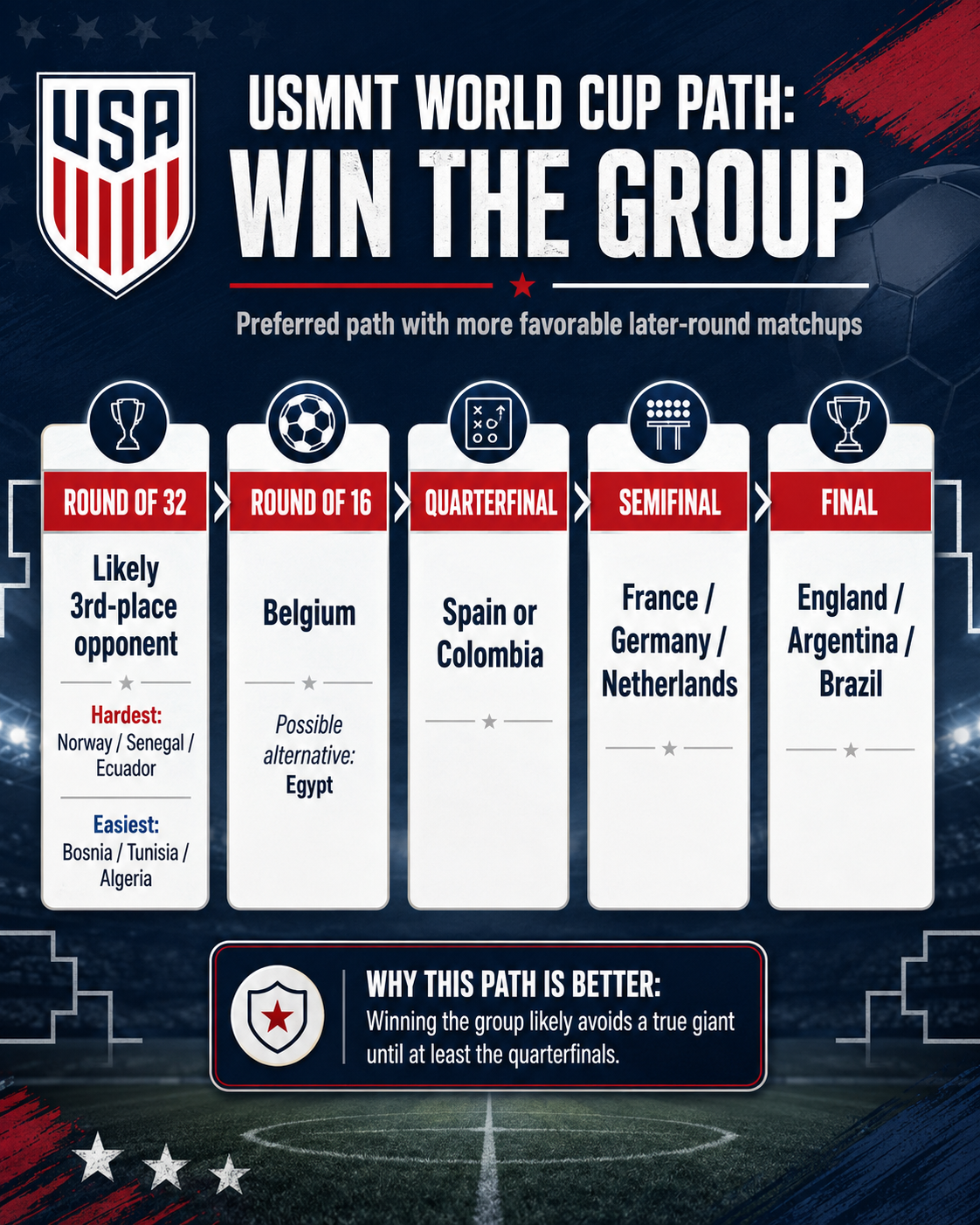
Winning the group would send the US into a Round of 32 matchup against a third-place team from Group B, E, F, I or J. That sounds complicated because it is. The new World Cup format makes the third-place paths a little messy, and the exact opponent will depend on which third-place teams advance and how FIFA’s predetermined combinations shake out.
There is a pretty wide range of possible opponents. On the more difficult end, the US could draw Norway, Senegal or Ecuador, none of which would be much of a reward. If the US were to land one of those three they would surely have their work cut out for them, and may not even be favored to advance. They did look like the better team against Senegal in the warm-up friendly but it’s probably best not to read too much into that game.
The better options for possible third-place finishers are Bosnia, Tunisia or Algeria. None are automatic wins, but those would be the kinds of opponents where the US would be favored and where advancing would be expected.
That is the first major benefit of winning the group. The Round of 32 opponent could still be dangerous, but the range of outcomes is generally more favorable than what the US might see if it finishes second.
The Round of 16: The First Real Test
If the US wins the group and survives the Round of 32, the likely Round of 16 opponent would be Belgium, with Egypt as a possible alternative.
That is where the tournament would really begin to feel serious.
Belgium is no longer quite the terrifying golden generation version of Belgium from the last decade, but they still have considerable talent, as the US saw in their friendly in March. That game demonstrated the gap between the teams, but also saw the US outplay Belgium for the entire first half. A full game performance like that with a boisterous home crowd could push the US to the quarterfinals.
This would be a legitimate test, no doubt. But it is also the kind of test the US should want if the goal is to make a run. A home World Cup Round of 16 game against Belgium would be difficult, but not impossible. It would not require the US to play a perfect game or pull off one of the great upsets in program history. It would require them to play well, get a big performance from their best players, and avoid the kind of self-inflicted mistake that has so often defined the program’s most painful exits.
Egypt would be a different type of opponent. Less talented than Belgium, but still dangerous enough to make the game tense. Either way, this is a much more appealing Round of 16 scenario than immediately running into one of the absolute favorites.
That is really the whole point. Winning the group does not give the US an easy path. There is no easy path to the quarterfinals of a World Cup. But it gives them a plausible one.
The Quarterfinal: Spain or Colombia
At this point, there would be no hiding from the reality of the tournament. A quarterfinal at a home World Cup would be a massive game, the biggest for the US men since the 2002 quarterfinal against Germany, if not ever. Just getting there would represent a successful tournament. Winning it would be the kind of breakthrough moment American soccer has been waiting for.
This is where the Americans would have to enter fairytale land with a major upset. Defeating either of these teams in a knockout would be the biggest win in US World Cup history, especially Spain, the favorites to win the whole tournament.
That being said, it is not an impossible result to achieve or imagine. In a one-off game anything can happen. The US beat an immensely talented Colombia in the group stage at home in 1994. In 2002 they beat Portugal in the group and pushed Germany to the limit in the quarterfinals. In a disappointing 2006 run they managed to tie eventual champions Italy 1-1 in the group. They have tied England twice in the group stages as well and went to extra time against Belgium in the round of 16 in 2014. All this is to say, it would be a major upset to win a quarterfinal, but it is not beyond the wildest dreams if they can get there.
Spain would be the more difficult stylistic matchup. The US wants games where its athleticism, pressing and transition play can matter. Spain can take those things away. They can keep the ball, slow the game down, pull the midfield out of position and force opponents to defend with patience for long stretches. That is not the most comfortable game state for the US.
Colombia might be slightly more favorable, though still extremely difficult. They have high-end talent, athleticism and confidence, but that game might become a little more open, physical and chaotic. That does not mean the US should prefer Colombia by a mile, but it does feel like the kind of matchup where the Americans would have a clearer path to making the game uncomfortable.
Either way, this is probably the dividing line between a good tournament and a historic one. A quarterfinal appearance would meet a very ambitious but fair expectation for a host nation with this level of talent. A quarterfinal win would change the conversation around the program entirely.
The Dream Scenario: A Semifinal
If the US somehow gets beyond that, the likely semifinal opponent would come from a group of teams like France, Germany or the Netherlands.
At that point the bracket math stops being very useful. You are simply playing one of the best teams in the world with a spot in the final on the line.
France would probably be the scariest possible opponent, with the combination of elite attacking talent, athleticism and tournament experience that has made them such a force over the last decade. Germany would bring all the historical weight and technical quality you would expect. The Netherlands may not have quite the same aura as France, but they are almost always organized, physical and difficult to beat.
Could the US beat one of those teams in a one-game setting at home? Sure. Strange things happen in World Cups. A set piece goal, a goalkeeper standing on his head, a red card, a penalty shootout, who knows.
But that is the dream scenario, not the expectation. The realistic goal is to give yourself a chance to get there. Winning the group is the best way to do that.
The Alternate Path: Second in the Group
The second-place path is not a disaster, but it likely presents a much stronger opponent earlier in the knockout phase.
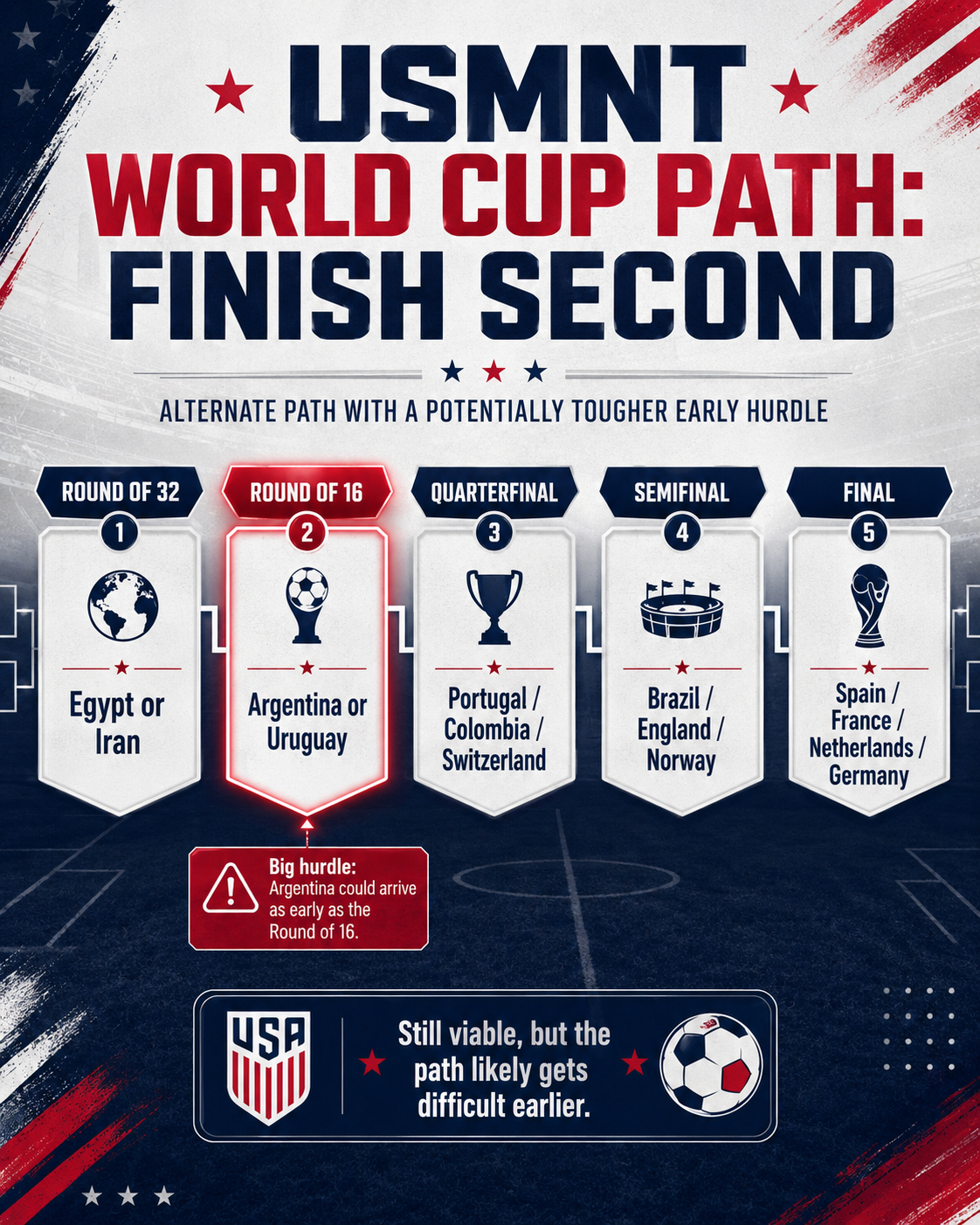
Due to the new 48-team setup, the US will still avoid a group winner in the Round of 32 with a second place finish of their own. If the US finishes second in the group, the likely Round of 32 opponent would be Egypt or Iran (2nd place in Group G). That is not a terrible first knockout matchup. Both teams would be difficult in different ways, and either could absolutely knock the US out if the Americans play poorly. But it is still a game where the US would be favored to advance.
The problem is what comes next.
The likely Round of 16 opponent would be reigning champions Argentina, or if they slip up, Uruguay. That is a much different proposition than Belgium or Egypt.
Argentina is the obvious nightmare scenario. Even if this is not quite the same version that won the World Cup in Qatar, they are still among the top favorites this time around. It is a team that knows how to manage knockout games, suffer through difficult moments and find one piece of quality when it matters. And, of course, there is the Messi factor, which would turn that game into a massive global event and give the US one of the most difficult possible Round of 16 matchups.
Uruguay would be difficult as well, but more manageable. The US dominated them in a friendly last year but struggled against them in a must-win game at the Copa America in 2024. Uruguay are tough, physical, talented and more than comfortable dragging opponents into the kind of match that feels less like a soccer game and more like a 90-minute argument.
That does not mean the second-place path is impossible. It just means the US would likely need its signature win earlier than it would prefer. Instead of building into the tournament and getting a heavyweight in the quarterfinals, they might have to beat Argentina or Uruguay just to get there.
If they did pull that off, the quarterfinal would likely bring Portugal, Colombia or Switzerland. The hope in this scenario is that someone has knocked off Portugal. The US would not be favored against Colombia or Switzerland but they would have a much better chance than against the stacked Portugal squad.
From there, the semifinal could be Brazil, England or Norway, and the final could be Spain, France, the Netherlands or Germany. So the second-place route is not closed off, but it forces the US to clear a much bigger obstacle earlier in the tournament and potentially requires them to knock off one more top level opponent than if they win the group.
What About Third Place?
The expanded format also means a third-place finish could still be enough to advance. That is worth mentioning, but it is not really where the optimistic version of this tournament lives.
If the US finishes third in this group, something has probably gone wrong. Maybe they lose a tight game, draw another, and sneak through on four points. Maybe the group gets weird. That can happen in tournament soccer.
But a third-place finish would almost certainly mean a difficult Round of 32 matchup and a much lower chance of making any kind of extended run. At that point, the conversation would shift from “Can the US make the quarterfinals?” to “Can they survive one more game?”
That is not impossible, but it is not the path to bet on. A third-place finish would keep the tournament alive, but it would likely set up an early exit unless the US suddenly found its best form against a much stronger opponent.
What Would Count as Success?
For this team, on home soil, the Round of 16 should be the minimum expectation. That would mean winning one knockout game, which they have done at other World Cups. A truly successful World Cup would require reaching the quarterfinals. At that point, if they go out valiantly to a tournament favorite like Spain, they could hold their heads high, though it wouldn’t necessarily move the bar for the program or soccer in the US.
A transformational run would require them to either catch some breaks with opponents later in the bracket or conjure up a magical upset to reach the semifinal. That could elevate the view of American soccer around the world in the same way Morocco’s run did in 2022.
The opportunity is there. The US is playing at home, with a talented roster, in a group it should be capable of winning. The expanded format creates one extra knockout game, which adds danger, but it also potentially gives the group winner a more manageable first step into the knockout rounds.
The best version of this tournament is pretty clear.
Win the group. Get a manageable third-place team in the Round of 32. Beat Belgium or Egypt in the Round of 16. Then take your swing against Spain or Colombia in the quarterfinal.
That is not easy. It is not a cupcake path. But it is a real path.
The second-place route is still alive, but it likely requires dealing with Argentina or Uruguay before the tournament has even reached the quarterfinals. The third-place route might keep the US in the bracket, but it probably means the dream of a long run is already on life support.
So the assignment is simple enough, even if the execution will not be: win the group, improve the bracket, and give yourself the best possible chance to turn a home World Cup into the kind of tournament American soccer has been waiting for.