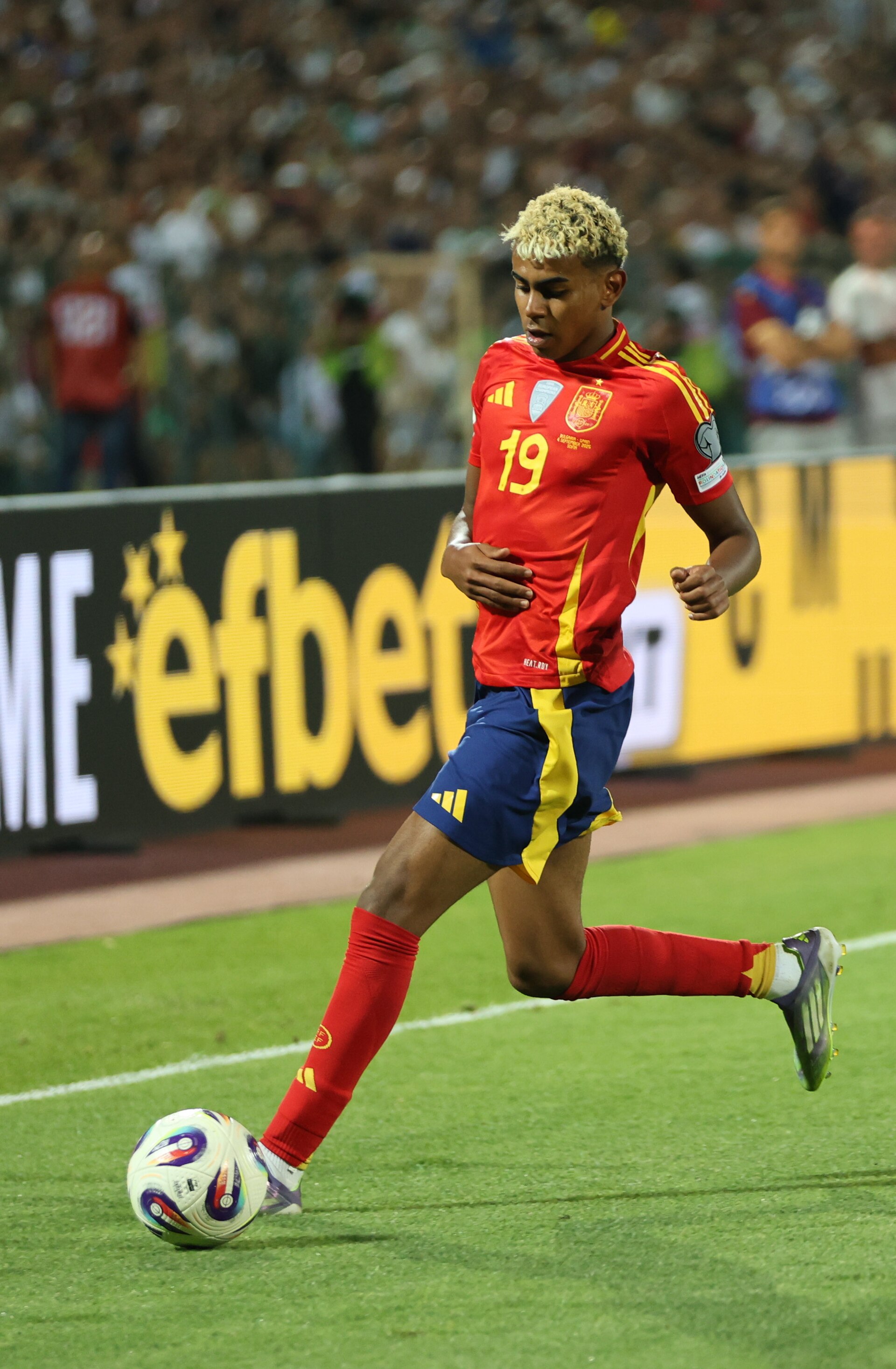
There was really only one way this list could end.
Mbappé at No. 2 is the safer superstar, the player with the World Cup trophy, the Golden Boot, the 12 career World Cup goals and the most obvious path to being the best player in the tournament. But Lamine Yamal is the player who makes this World Cup feel like it might be introducing the next era of the sport. That is why he lands at No. 1. Mbappé may be the surest bet to decide the biggest matches, but Yamal is the dazzling new force, who may just have the highest ceiling of any player we’ve seen since a certain other dribbly, left-footed Barcelona right-winger.
Yamal is 18 years old, already valued by Transfermarkt at $235.2m, already has 25 caps and six goals for Spain, and already feels like the most important attacking player on the best team in the tournament. That last part is the wildest thing. It would be one thing if he were a teenage sensation on an overmatched team, the kind of player you watch because the future is obviously coming even if the present still belongs to someone else. But Spain are not a future project. They are European champions, my No. 1 team in the field, and maybe the cleanest tournament team in the world. And Yamal is not some exciting side story. He is the player who changes the whole shape of their attack.
At Euro 2024, he was already doing things that felt made up. UEFA named him Young Player of the Tournament after he played 507 minutes, scored once, had a tournament-high four assists, and also led the tournament with 32 dribbles. He became the youngest player ever to appear at a European Championship, the youngest scorer in tournament history, and then assisted Nico Williams in the final against England the day after turning 17. That is not normal teenage promise. That is walking into one of the highest-pressure environments in world soccer and immediately becoming one of the defining players of the tournament.
It’s an impossible burden to be measured against perhaps the greatest player of all time, but given his profile and his similar upbringing in the Barcelona system, the Messi comparisons are inevitable. And the crazy thing is, at this point in his career, Yamal is possibly even ahead of where Messi was.
By the end of his age-18 season, Messi was already clearly special, but still mostly a rising Barcelona phenomenon. He had 25 appearances and eight goals in 2005-06, after nine appearances and one goal the year before, while Barcelona won La Liga and the Champions League. Yamal, by contrast, has already been a full-on centerpiece with 149 official matches and 49 goals for the club before turning 19, in addition to 25 Spain caps and six goals. He is coming off a season where he led Barcelona to a second consecutive La Liga title, scoring 16 goals and delivering 11 assists, earning the Player of the Year award from most publications.
But it’s not just about the stats. Yamal is arguably a more complete player than Messi was at the same age. Whereas Messi was an incredible dribbler and finisher, Yamal brings those qualities but adds an other-worldly passing touch for such a young player. He already has a near-patented outside of the boot with his left foot pass, that constantly catches defenses off guard and lands perfectly weighted for an on-rushing attacker.
Messi had the aura, the dribbling, the low-center-of-gravity magic, and the obvious sense that something historic was coming; Yamal has all of that same “this should not be possible at this age” feeling, but with a far bigger role earlier for both club and country. Messi had shown the superstar potential by age 18, Yamal is being asked to realize that on the game’s biggest stage and lead his team to the Cup.
The reason he is so terrifying is that he gives Spain the one thing their more sterile post-2012 versions sometimes lacked. Spain have always had midfield control. They have Pedri, Rodri, Zubimendi, Fabián Ruiz, Gavi, Dani Olmo and enough technical midfielders to make most countries feel like they are playing a different sport. But Yamal gives that control a cutting edge. He receives wide on the right, pauses just long enough to freeze the fullback, and then the whole field opens. He can go outside, come inside, slide the reverse pass, whip a ball to the back post, or curl one into the far corner. He is not just a winger who beats defenders. He is a winger who makes defenders start solving problems before he has even touched the ball.
That is what makes him different from almost every other young player in the tournament. His game already has manipulation in it. He does not just run fast or dribble well, though he does both. He changes tempo. He makes defenders commit their weight the wrong way. He plays with the confidence of a player who knows the whole stadium is waiting for him to do something and somehow seems more comfortable because of it. Most teenage stars play like they are trying to prove they belong. Yamal already plays like the game belongs to him.
The injury is the only thing that really complicates this. Spain’s excitement around him comes with some anxiety because his season was affected by groin trouble and a serious hamstring injury sustained in April. That is the one reason this tournament is not simply a coronation watch. Wingers like Yamal depend on explosion, balance, confidence and that tiny half-step that lets them turn a fullback from comfortable to desperate. If he is 90 percent instead of 100 percent, it matters. Spain can survive that because the team around him is so good, but the truly frightening version of Spain needs Yamal fully sharp.
That is also part of what makes him such a compelling No. 1. There is a little uncertainty here. Mbappé’s World Cup story is already written in permanent ink. Messi’s is too. Haaland’s is about whether Norway can give him a real platform. Pedri’s is about whether Spain’s midfield can own the tournament. But Yamal’s story still feels like it is being written in real time. He could be the most exciting player in the tournament. He could be the player who turns Spain from favorite into champion. He could also be the player everyone is watching with a little nervousness every time he accelerates down the right side.
Spain’s group gives him a perfect runway if he is healthy. Cape Verde should be a match where Spain dominate the ball and Yamal gets plenty of chances to isolate defenders. Saudi Arabia may sit deeper and force him to create in crowded spaces. Uruguay bring intensity, athleticism, nastiness and enough transition threat to make Spain prove they can handle a game that is not played entirely on their terms. The group is not just about Spain advancing. It is about whether Yamal looks ready to become the face of the tournament.
There are players in this tournament with greater legacies. There are players with more goals, more trophies, more scar tissue, more proof across multiple World Cups. But there is nobody with a more interesting combination of talent, team context, age, pressure, uncertainty and possibility. Yamal is not No. 1 just because he is young. He is No. 1 because he is young and already central to a team that can win the World Cup. He is No. 1 because every Spain match might include the moment everyone will remember for years to come. He is No. 1 because the story is not just whether he can someday become the best player in the world. It is whether that someday is actually now.
If Spain win the World Cup, it will probably be because their midfield controls the tournament, their structure holds up, and their depth solves problems over seven matches. But the image everyone remembers may still be Yamal on the right wing, ball stuck to his left foot, defender backing up, stadium rising, and that sudden feeling that something impossible is about to happen.