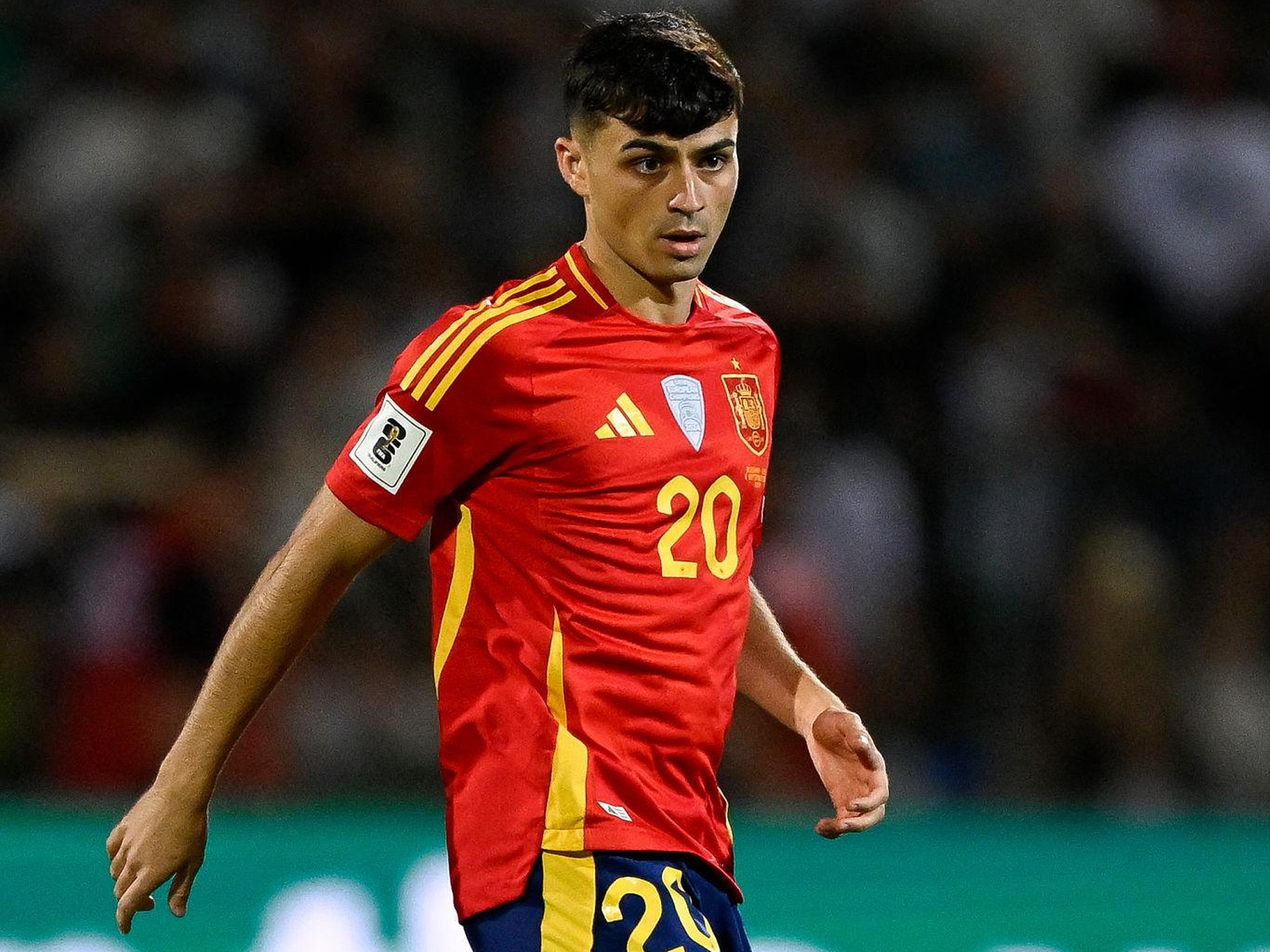
Pedri might be the cleanest answer to the question of why Spain feel like the team to beat. Lamine Yamal is the headline, Rodri is the former Ballon d’Or winner, Nico Williams gives them width and explosiveness when healthy, and Mikel Merino and Fabián Ruiz give Luis de la Fuente different midfield profiles. But Pedri is the player who makes Spain look like Spain. He is the one who controls the game and makes it all come together like clockwork.
He is still only 23, which feels almost impossible given how long he has been central to both Barcelona and Spain. Transfermarkt values him at $176.4m, with 40 caps and five goals for the national team. Pedri is a nearly unfathomable combination of Barcelona legends Xavi and Iniesta with a little Luka Modrić thrown in.
He has Xavi’s sense of rhythm, that rare ability to make the simple pass feel like the most important one on the field. He has Iniesta’s balance and softness in tight spaces, the way he can receive with bodies around him and still make the game feel suddenly calm. And Modrić’s ability to turn a defensive moment into an attacking one without ever seeming hurried. Pedri does not copy any of them exactly, but he borrows enough from all three that watching him can feel like watching a modern remix of the best midfielders of the last 20 years.
He is easily the best tempo setting midfielder in the world, controlling games from the middle of the field with a full range of skills. The ball sticks to his feet like glue. You will almost never see him dispossessed and he rarely misses a pass. That was already clear when he was still a teenager at Euro 2020, where he completed 92.3% of his passes for the tournament and an almost absurd 65 of 66 in the semifinal against Italy.
Pedri can just as easily beat a defense with a line splitting pass or a snaking dribble. He is the player pulling the strings in the final third for a Spain team arriving at the World Cup as the odds-on favorites. Pedri does not just keep the ball, he constantly changes the speed and angle of the attack.
On top of all that, he is a relentless worker on the defensive side of the ball, finishing third among midfielders in La Liga in ball recoveries this season and sixth in possessions won in the final third.
The club form is important because the old concern with Pedri was never talent. It was durability. He has had too many seasons interrupted by muscle injuries, and Spain have already lived through the frustration of not getting the fully healthy version at the wrong time. This season has been a much better reminder of what he looks like when he is available and in rhythm. He finished with 2 goals, 12 assists across all competitions and 2,107 La Liga minutes for Barcelona in 2025-26, with a 90.45% passing accuracy in the Champions League. That is not gaudy attacking production, but it is exactly the profile of a midfielder who controls games without needing every move to end with his final touch.
What makes Pedri so valuable for Spain is that he lets everyone else play faster without making the team feel rushed. He can receive under pressure, turn away from the first defender, play the obvious pass when that is the right answer, or pause just long enough to let Yamal or Williams isolate a fullback. Spain can still press, counterpress, and attack quickly, but Pedri gives them the ability to decide when the game should speed up and when it should calm down.
This version of Spain is more direct, more athletic, and more dangerous wide than the Spain teams that sometimes passed opponents to sleep without creating enough. They are built around tactical discipline, adaptability and a deep system rather than dependence on one superstar. Pedri fits that perfectly. He is not the whole attack, but he is the player who connects all the most dangerous parts of it.
Spain’s Group H path — Cape Verde, Saudi Arabia and Uruguay — gives Pedri three very different midfield tests. Cape Verde may sit in and force Spain to break down a compact debutant. Saudi Arabia have recent World Cup giant-killing history and will try to pounce on any Spanish mistakes. Uruguay are the real measuring stick, because Federico Valverde and Manuel Ugarte can turn midfield into a running fight.
Pedri probably will not lead the tournament in goals, and he may not even be Spain’s most viral player by the end of the group stage. But if Spain win the World Cup, it will be because the whole thing moved through him: the tempo, the control, the little half-turns, the passes before the assist, the game-turning tackles, and the quiet stretches where Spain make elite opponents feel like they are chasing shadows. He doesn’t pop off the screen like Haaland, Mbappé or Yamal, but Pedri is quietly the most decisive player in this tournament.