There is something uniquely frustrating about a bad baseball team that turns out to be just good enough for its biggest offseason mistake to matter.
If the Orioles were 45-71, we could look back and say no amount of help in the offseason was fixing the team. No pitcher would make up twenty wins by himself.
Instead, the Orioles entered August 8 at 56-60, just two games out of an American League Wild Card spot despite already reaching the trade deadline as sellers.
This is a mediocre baseball team, plain and simple. But being mediocre instead of terrible actually makes the offseason failure harder to swallow, because the Orioles did not need ten extra wins to alter the trajectory of their season. They may have needed three to five.
That got me wondering what the top free-agent pitchers the Orioles could have added last winter have done this season, and how that could have changed their outlook.
The O’s spent last winter pursuing a group of established starters that included Cease, Ranger Suarez, Michael King and Framber Valdez before ultimately failing and turning to Chris Bassitt as a fallback.
All four misses do not look equally damaging in hindsight. King and Valdez have not pitched like frontline starters, but even their more ordinary performances would have represented meaningful upgrades over what the O’s actually received from the back of its rotation.
Cease and Suarez certainly could have changed the season.
And when a few marginal wins might have been the difference between selling at the deadline and entering August in playoff position, those misses become much more than another offseason complaint.
What Would a Better Starter Actually Have Changed?
Let’s try to break down exactly how much each of these targets may have added to the 2026 Orioles win total thus far.
For this exercise, I used the aggregate production the Orioles actually received from every start not made by its top four starters: Shane Baz, Kyle Bradish, Trevor Rogers and Brandon Young.
Those four accounted for 85 of the Orioles’ first 116 starts. The other 31 came from Bassitt, Dean Kremer, Trey Gibson, Cade Povich, Keegan Akin (as an opener) and Zach Eflin. That revolving-door fifth-starter group combined for 138 1/3 innings with an innings-weighted 5.72 FIP and approximately a 5.99 ERA.
That group represents the production any other free-agent acquisition would have replaced, while keeping Baz, Bradish, Rogers and Young constant.
I then compared that fifth-starter/depth slot with each free agent using FIP, which attempts to isolate outcomes a pitcher controls more directly, and converted the resulting runs saved into wins using Baltimore’s actual run environment.
Estimated impact through August 8, 2026
| Scenario | Runs saved | Wins added | Estimated Orioles record |
|---|---|---|---|
| Actual Orioles | — | — | 56-60 |
| Dylan Cease | 49.4 | +5.0 | ~61-55 |
| Ranger Suarez | 34.5 | +3.4 | ~59-57 |
| Michael King | 22.2 | +2.2 | ~58-58 |
| Framber Valdez | 23.8 | +2.3 | ~58-58 |
The model compares each target with the Orioles' fifth-starter/depth workload, using FIP and Baltimore's actual run environment. It is an estimate, not a replay of the season.
This is obviously not a replay of the season. We cannot know whether Cease would have won the exact same games in Baltimore, whether Craig Albernaz would have handled the bullpen differently behind him or whether a particular 3-2 loss becomes a 2-1 win.
But that is not really the point.
The point is the size of the difference.
Cease has been worth roughly five wins compared with the kind of rotation production Baltimore actually received from its weakest spot. For a team buried in the standings, five wins are trivial. For a team two games out of a playoff spot, five wins can change everything.
Cease Is the Painful One
Of the four, Cease is the counterfactual that should bother Orioles fans the most.
Through 126 1/3 innings, Cease has a 2.28 ERA. More importantly, essentially every underlying number says he has pitched like an ace rather than merely gotten ace-like results.
His 2.20 FIP is actually better than his ERA. His xFIP is 2.63 and his expected ERA is 2.69. He has struck out 36.4% of the hitters he has faced, producing an absurd 26.1% strikeout-minus-walk rate.
He is also suppressing damaging contact, with an 86.1 mph average exit velocity and just a 4.5% barrel rate.
There is always some noise in a pitcher’s ERA. There isn’t much noise in that collection of numbers. Cease is missing bats, limiting home runs and preventing hitters from squaring him up. This is what a legitimate ace season looks like.
Against the Orioles’ actual fifth-starter baseline, the FIP model estimates Cease would have prevented about 49 runs. That translates to approximately five additional wins.
Give the Orioles five additional wins and they aren’t 56-60.
They’re roughly 61-55.
That does not suddenly make them the 1998 Yankees. It does, however, almost certainly change the way we have discussed this team for the past month.
And possibly the way the front office handled the trade deadline.
The Marginal Value of Those Wins Matters
This is where simply saying “five wins” undersells the issue.
Wins do not have equal practical value in every situation.
If a 65-win team becomes a 70-win team, congratulations, it is still going home in September. If a 100-win team becomes a 105-win team, it might improve its postseason seeding, but both versions are comfortably playing in October.
Moving a team from the mid-50s in wins to the low-60s in early August is different.
Baltimore reached this point close enough to the Wild Card race that three to five additional wins could have taken them from the outside of the playoff field to the inside. Those are exceptionally valuable marginal wins.
The timing matters too.
The Orioles did not begin selling because they were mathematically eliminated. They sold because the front office looked at a mediocre team, its remaining schedule and the likelihood of reaching October and decided the expected value of converting present major leaguers into future assets was greater than continuing to chase the 2026 postseason.
Change the record before the deadline, and perhaps that calculation changes.
We obviously cannot prove that signing Cease means the Orioles keep every player they eventually traded. Maybe Mike Elias still decides that some of those deals make sense. Maybe injuries or other weaknesses lead them to the same conclusion anyway.
But a team sitting six games above .500 and occupying, or very close to occupying, a playoff position has a very different deadline than one sitting below .500.
Instead of asking what they could get for veterans, perhaps the conversation becomes what they can add around Cease, Kyle Bradish and Trevor Rogers.
Instead of conceding another season from this competitive window, perhaps they are trying to extend it into October.
One offseason signing potentially changes not only five games, but the organizational decisions that follow from those five games.
Suarez Would Have Mattered Too
Ranger Suarez is not quite as dramatic, mostly because he has thrown fewer innings, but his performance has also validated the idea that Baltimore should have been more aggressive at the top of the market.
Suarez has a 3.32 ERA in 103 innings, with a 2.71 FIP, 3.27 xFIP, 3.55 expected ERA and 18.4% strikeout-minus-walk rate.
In his case, the advanced numbers make the season look better, not worse. His FIP is more than half a run below his ERA, and his underlying performance suggests a legitimately excellent starter.
Using his actual workload, the model gives Baltimore about 3.4 additional wins, putting the Orioles around 59-57.
That may not sound dramatically different from 56-60, but again, look at the standings. Three games above .500 might have been enough to keep the Orioles on the other side of the deadline decision.
Not to mention the Orioles would have these pitchers for years into the future as well.
Not Every Expensive Pitcher Would Have Saved Them
The counterargument deserves a hearing because hindsight can make free-agent criticism far too easy.
Signing an expensive pitcher does not automatically mean getting an ace.
Michael King has a 3.45 ERA and has certainly been valuable, but his underlying numbers are far less impressive. His FIP is 4.19, his strikeout rate has fallen to 21.2% and his strikeout-minus-walk rate sits at only 11.2 percent. His low .254 BABIP helps explain why his run prevention has been substantially better than his component statistics.
Even so, the revised model gives Baltimore about 2.2 additional wins from King, putting them around 58-58. That isn’t a season-altering output by itself, but it also is not insignificant for a team sitting two games out of a playoff spot.
Framber Valdez has been similarly ordinary by his standards. His 4.17 ERA comes with a 4.04 FIP, 4.16 xFIP and 4.30 expected ERA, with a strikeout-minus-walk rate of just 10.4 percent.
Again, the model still estimates roughly two additional wins, about 2.3 to be exact, because the O’s actual fifth-starter production was so poor.
The lesson is that the Orioles had identified the correct need, had legitimate frontline options available and still came away without one. There is risk in every long-term pitching contract. Pitchers get hurt. Performance declines. A deal that looks smart in February can look ridiculous by August.
King and Valdez demonstrate why the front office might have been cautious. Neither has pitched like the ace the Birds needed. But the revised model also shows just how low the Orioles set the bar at the back of their own rotation. Even those disappointing outcomes would have represented meaningful upgrades.
Cease and Suarez demonstrate the much larger cost of being wrong.
Spending More Isn’t the Same as Spending Enough
The new owner likes to point out that the team has spent more and increased payroll since he took over.
That is objectively true.
Spotrac currently estimates Baltimore’s adjusted 2026 payroll around $162 million, compared with roughly $111 million in 2024. The organization also signed Pete Alonso to a five-year, $155 million contract and signed Shane Baz and Kyle Bradish to sizable extensions.
This is not the Angelos-era payroll anymore, but the increase only looks significant because it’s coming from such a low baseline. Going from one of baseball’s cheapest payrolls to approximately the middle of the league is progress. It is not evidence that the job is finished or that ownership is really serious about being truly competitive rather than just hopeful.
For a franchise that spent years deliberately losing and accumulating premium young talent, the promise was always that the cheap years would eventually create room to spend when contention arrived.
Well, we thought contention had arrived. You know “lift off” and all.
Rubenstein said in February 2025 that there was no financial limit imposed on Elias and described money as not being “the big issue,” saying the ownership group was financially in very good shape.
If that remains true, then the inability to finish the job on a frontline starter becomes increasingly difficult to excuse. Whether Cease did not sign because the Orioles would not meet the price, because Elias did not value the contract highly enough or because the player simply preferred somewhere else is difficult to know from outside the organization.
The result is easier to evaluate.
The Orioles needed top-end starting pitching for a second straight offseason and for a second straight offseason they did not acquire enough of it. One of the pitchers they pursued is now having an ace season, another has been an excellent starter, and even the two less impressive outcomes would have been substantial improvements to the Orioles rotation.
Which Brings Us Back to Elias
The more difficult part to reconcile is Rubenstein’s continuing faith in Mike Elias.
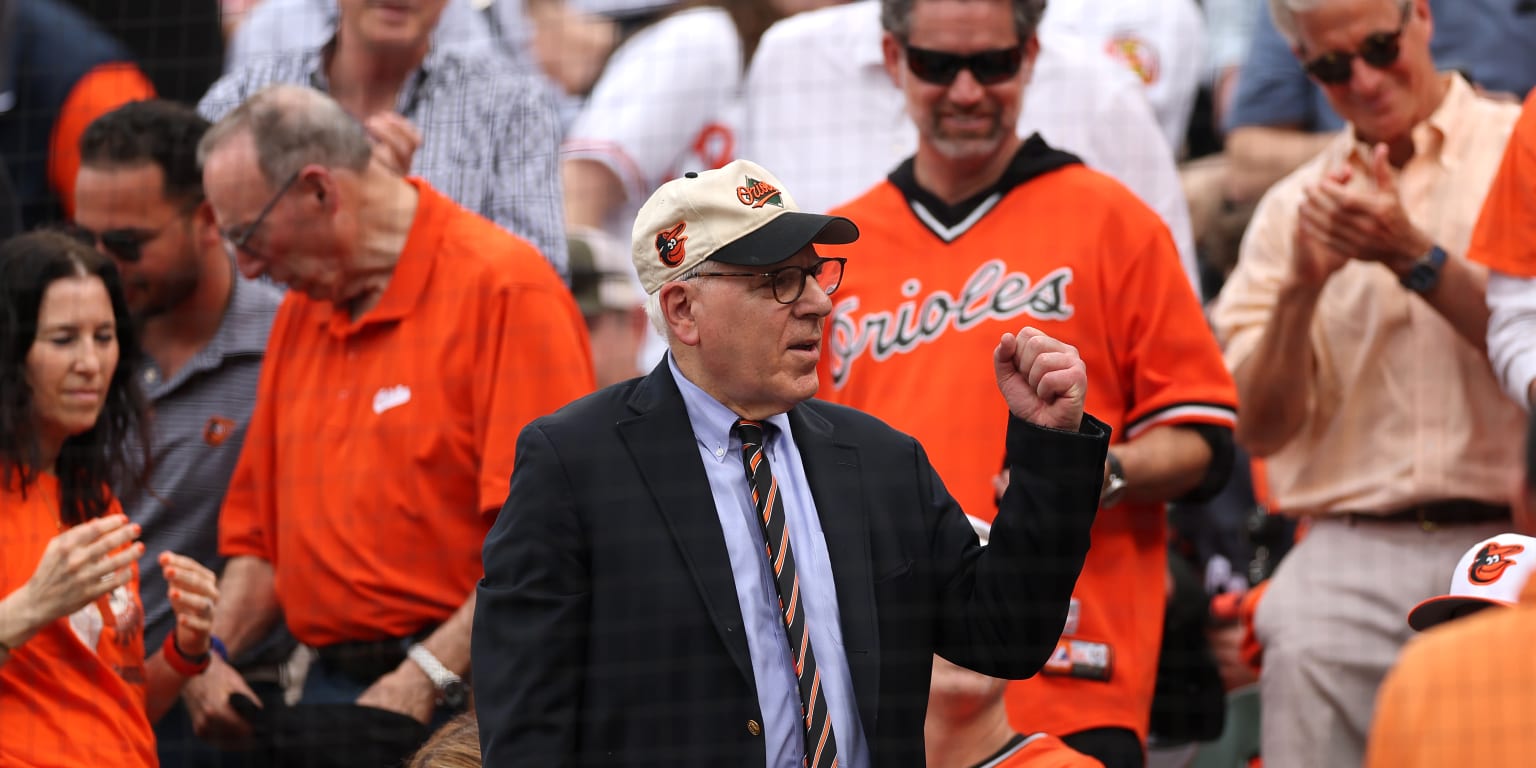
On July 24, with the Orioles again enduring a disappointing season, Rubenstein offered unequivocal support for his president of baseball operations. Asked whether Elias would continue leading the organization, Rubenstein said, “Absolutely. Of course,” praised his reputation around baseball and added that ownership “couldn’t be more pleased.”
That is increasingly difficult to square with the stated expectations for the franchise.
If money is not the obstacle, then baseball operations has to explain why the Orioles repeatedly reached seasons with an obvious need for frontline pitching without solving it.
If Elias is doing a terrific job, then ownership has to explain why a team that emerged from one of the deepest rebuilds in baseball history has now likely burned through two consecutive seasons of its competitive window without a playoff run.
Both things cannot simply be waved away.
To be fair, Elias cannot control injuries and he cannot force a free agent to sign in Baltimore. And it would be ridiculous to argue that Dylan Cease alone explains every failure of the 2026 Orioles.
The lineup has underperformed in important stretches. Players who were supposed to become foundational pieces have failed to develop as expected. The bullpen has had problems. Injuries have again tested the organization’s depth.
But much of those issues are specifically created by Elias’s roster construction and organizational philosophy. Perhaps if they had spent more draft capital on pitching instead of underperforming hitting prospects, they would have developed a true homegrown ace by now. Perhaps if Elias had as good a scouting eye as we once thought, they could have used the money spent on Pete Alonso to fill the hole at the top of the rotation.
We can only hope that the ownership group finally learns the lessons this season and makes the necessary changes or shows the necessary ambition next year to prevent this team from completely squandering their once-promising competitive window.