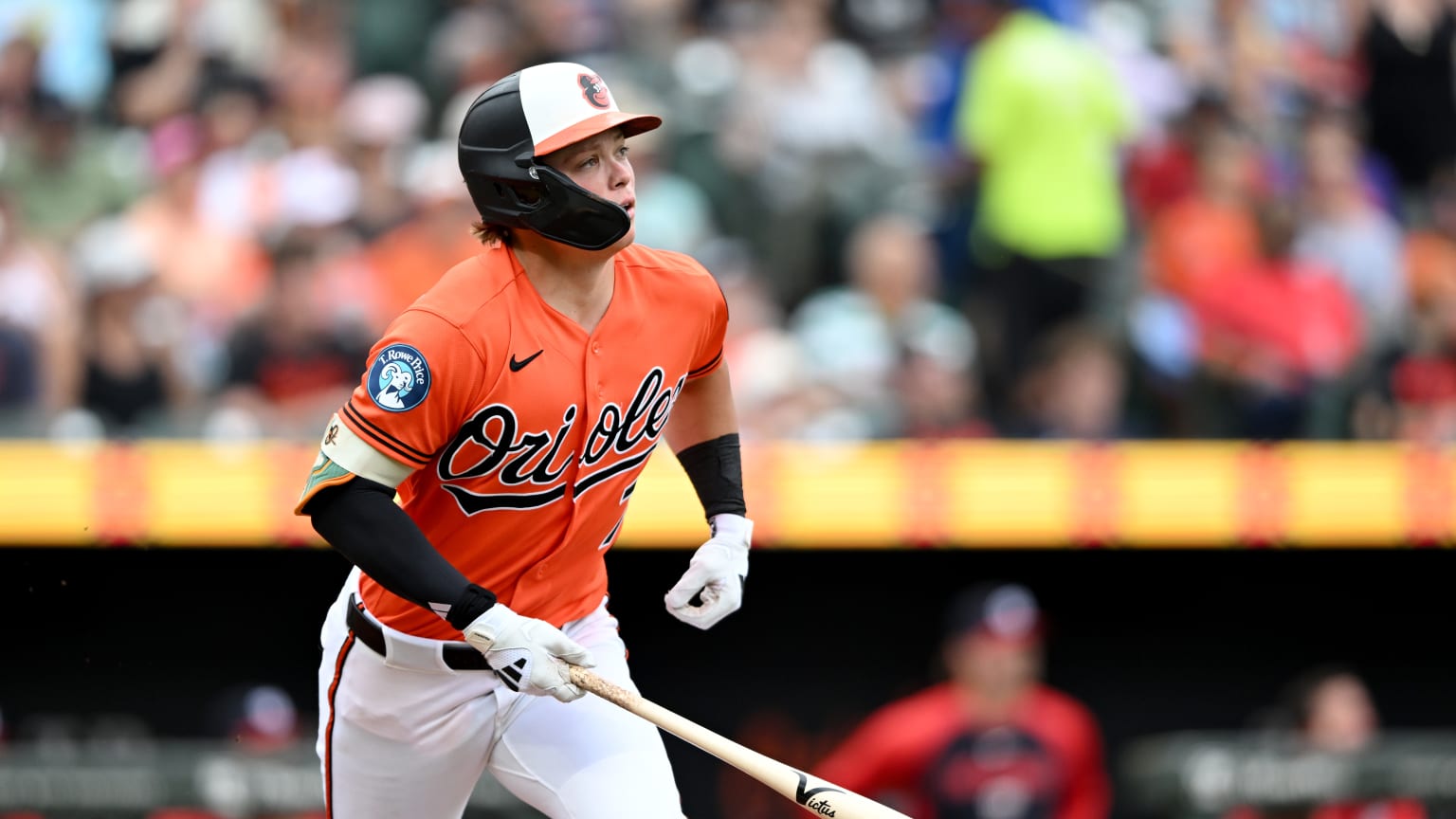
Jackson Holliday had two more hits against left-handed pitching on Sunday, driving in three runs with a single off Garrett Cleavinger and a two-run double off Steven Matz in the Orioles’ 10-2 win over Tampa Bay. Those hits pushed his season line against lefties to .265/.379/.388, good for a .767 OPS.
That number becomes considerably more interesting when placed next to his first two seasons.
It is a remarkable progression for a weakness that appeared capable of turning Holliday into at least a partial platoon player. As recently as May, Craig Albernaz was selectively sitting him against left-handed starters while saying the Orioles needed to balance development with putting players in favorable situations. At that point, Holliday owned a career .541 OPS against southpaws.
Now he is producing at roughly an average or better major-league level against them.
So what changed?
Holliday is clearly having more success against lefties, but the underlying numbers reveal a much more specific development. He is not suddenly crushing lefties. His exit velocity has barely changed, his barrel rate has actually declined, and he is still striking out far too often.
The biggest difference is that Holliday has reduced his chasing outside the strike zone against lefties.
The Biggest Change Is the Walks
Start with perhaps the strangest number in the entire split.
Holliday has already drawn nine walks in 58 plate appearances against lefties this season. He drew only 11 in 179 plate appearances against them all of last year and four in 46 as a rookie. Before Sunday’s game, his walk rate against lefties sat at 16.1%, up from just 6.1% last season and 8.7% as a rookie.
That accounts for a huge portion of the improvement.
It is certainly not coming from a dramatic reduction in strikeouts. Holliday has struck out 18 times in those 58 plate appearances. His pre-Sunday strikeout rate against lefties was 32.1%, compared with 24.0% last season. As a rookie it was an ugly 34.8%.
So he is not suddenly seeing the ball better and putting everything in play.
In fact, his overall contact rate against lefties was considerably better last year. He made contact on 75.7% of his swings in 2025, compared with roughly 68% this season before Sunday. His swinging-strike rate has also risen from 10.9% last season.
Normally that would be bad news. Yet his production has improved dramatically because the swings he is not taking have become increasingly important.
Lefties Are Giving Him Fewer Good Pitches
The way pitchers are attacking Holliday has changed considerably.
In 2025, 30.5% of the pitches he saw from lefties were in Statcast’s “heart” of the strike zone. This season that number has fallen all the way to 21.1%. At the same time, the percentage of pitches in the chase region has risen from 17.0% to 21.6%, while pitches in the waste area have increased from 7.8% to 11.5%.
In other words, left-handed pitchers have become considerably less willing to simply challenge Holliday.
That makes sense with his first overall pick pedigree. Even through his struggles he has always had enough bat speed to punish mistakes. The traditional plan for a lefty against a young left-handed hitter is to make him prove he can lay off breaking balls moving away and sinkers running toward difficult parts of the zone.
The important development is that Holliday has largely stopped helping opposing pitchers.
Lefties are increasingly trying to get Holliday to expand the zone, but he has not taken the bait. His swing rate on pitches in Statcast’s chase region is 14.9%, virtually unchanged from 14.8% last season, even as those pitches have become a much larger part of how lefties attack him. That has not made his plate discipline better than it was last year, but it has allowed him to benefit from pitchers becoming less willing to challenge him in the strike zone.
That is how you get nine walks in 58 plate appearances.
It also lines up almost perfectly with what Holliday and Albernaz have said publicly about his broader offensive improvement. Holliday described his recent approach as being ready for fastballs in the zone while trying not to get himself out. Albernaz similarly praised his ability to stop chasing, force pitchers into the strike zone and use the entire field.
Sometimes the advanced numbers uncover something nobody can see.
This time they mostly confirm what the hitter says he is trying to do.
He Is Also Doing More With the Strikes He Gets
There is another encouraging piece buried inside the zone data.
When lefties have thrown pitches in the heart of the zone, Holliday has made contact on 89.3% of his swings, up from 83.5% last season and 81.5% as a rookie.
That distinction matters.
Holliday is still vulnerable around the edges. His contact rate in the shadow portion of the zone has actually fallen from 72.5% last year to 64.6% this season. Same-side breaking balls that start as strikes and move toward the edges remain a legitimate problem.
But the overall approach is beginning to make more sense.
Do not expand for the pitcher’s pitch. Accept the walk if he refuses to come into the zone. When he finally does make a mistake over the plate, do not miss it.
That sounds exceptionally simple. Major-league pitchers spend their careers making it difficult.
The Contact Is Better Shaped, Not Harder
The next question is whether Holliday is actually hitting lefties harder once he puts the ball in play.
Not really.
Before Sunday’s game, his average exit velocity against left-handed pitching was 86.8 mph, barely different from 86.0 mph last season. His Statcast hard-hit rate had actually fallen from 31.1% to 24.1%, while his barrel rate declined slightly from 4.1% to 3.4%.
Those are not the numbers of someone suddenly pounding same-side pitching. Holliday has one home run against a lefty this year, Sunday’s double was only his fourth extra-base hit against them and his isolated power remains modest. The improvement is more about what kind of contact he is producing.
Last season, 54.1% of Holliday’s balls in play against lefties were ground balls and only 17.2% were line drives. This year, those numbers had essentially flipped into a much healthier distribution: 32.1% ground balls and 32.1% line drives. His opposite-field rate had also climbed from 20.5% to 31.0%, while his pull rate fell from 43.4% to 34.5%.
There are only around 30 batted balls in this year’s sample, so nobody should start chiseling those percentages into stone. Line-drive rate in particular can bounce around wildly in such a small sample.
However, the direction fits Holliday’s broader development.
Across all pitchers, Statcast has his line-drive rate climbing from 13.9% as a rookie to 21.9% last year and 25.5% this season. His ground-ball rate has moved the other way, from 56.6% to 49.0% to 45.6%. His sweet-spot rate—balls hit at productive launch angles—has risen from 27.0% to 32.4% to 37.6%.
That makes the lefty batted-ball improvement a little easier to believe. The exact 32% line-drive rate will not last, but hitting fewer balls directly into the ground appears to be part of a larger change rather than a platoon-split accident.
Colton Cowser recently pointed specifically to Holliday’s ability to let the ball travel and use the opposite field, saying that approach gives him a larger timing window. Albernaz has made the same observation about Holliday becoming more comfortable using the whole field.
Against same-side pitching, that could be particularly important. Trying to yank every slider or sinker into the right-field seats gives a left-handed pitcher exactly the swing he wants. Staying through the baseball longer creates more room for Holliday to handle pitches moving away from him.
The Slider Is No Longer Killing Him
Which brings us to perhaps the most encouraging pitch-specific development.
Lefties have tried to beat Holliday with sliders and sinkers, but he is not getting fooled by them as easily as in past seasons.
Sliders account for 34.4% of all pitches he has seen from left-handed pitchers this season, up from 29.7% last year. Sinkers account for another 25.2%. Put those together and almost 60% of his pitches from lefties have been the two shapes most naturally designed to exploit a left-on-left matchup.
Those pitches destroyed Holliday as a rookie.
FanGraphs’ pitch values had him at 2.61 runs below average per 100 sliders against lefties in 2024. That improved to 0.55 runs below average last year and is almost exactly neutral this season at 0.11 runs below average per 100.
The progress against sinkers is similar: from 1.50 runs below average per 100 in 2024, to 0.45 below last year, to 0.85 runs above average this season.
Again, the sample is small, but the progression is notable because the league has continued testing him in exactly the area where he previously struggled. Pitchers have not forgotten the scouting report. Holliday is simply surviving the attack better.
And “surviving” may be the key word.
He does not need to slug .500 against left-handed sliders. He needs to stop turning every left-handed reliever into an automatic matchup advantage. Taking the slider that starts outside and stays outside counts. Fouling off the borderline one counts. Hitting a sinker the other way for a single counts.
The improvement appears to be coming from the entire plate appearance rather than one newly dominant swing.
How Much of This Is Real?
With just 58 plate appearances to base this on, we cannot jump to too many solid conclusions, but the trends continue to move in the right direction.
Holliday’s .379 OBP against lefties will almost certainly come down if the walks regress. His strikeout rate remains around 31%, which is far too high. He is not hitting the ball particularly hard, and his current .388 slugging percentage hardly qualifies as dominance.
There is also some ball-in-play help in the results. Before Sunday’s two hits, Holliday carried a .357 BABIP against lefties, compared with .246 last year.
However, the expected statistics provide an important defense of the improvement.
Before Sunday, Holliday had a .321 wOBA against lefties and a .313 expected wOBA. Last season those numbers were .255 and .260. In other words, Statcast did not view his improved production as some giant collection of bloops and fortunate outcomes. The expected results were almost as good as the actual ones.
FanGraphs likewise had him at a 107 wRC+ against lefties, meaning his offensive production was seven percent above league average after adjusting for league and park. That compares with a 62 wRC+ last season and 27 as a rookie.
That is the more meaningful progression.
The Lefty Problem Is Evolving
Combining the top-line stats with the underlying analytics paints a picture of year-over-year improvement against lefties for the young former number one overall pick.
The .767 OPS probably overstates where Holliday’s true talent against left-handed pitching sits today, and the strikeouts and lack of authoritative contact are too significant to ignore. Still, the progression is a positive sign, and he has room to improve further.
If Holliday can simply remain somewhere around league average against lefties, the Orioles no longer need to protect him from the matchup. He can play every day, continue accumulating repetitions against the pitches that have given him trouble and force opposing managers to think twice before automatically reaching for a left-handed reliever when his spot comes up.
At 22 years old, that is a major developmental win.
Progress is not always linear; Orioles fans need to look no farther than Holliday’s middle-infield partner for a reminder of that. Nonetheless, Holliday has the chance to continue this progression as he matures and could eventually turn a weakness into a strength by improving his strikeout and power numbers against southpaws in the future.